WASHINGTON: President Donald Trump announced that he had suspended plans to impose tariffs on Mexico, tweeting that the country “has agreed to take strong measures” to stem the flow of Central American migrants into the United States. But the deal the two neighbors agreed to falls short of some of the dramatic overhauls the US had pushed for.
A “US-Mexico Joint Declaration” released by the State Department late Friday said the US “will immediately expand the implementation” of a program that returns asylum-seekers who cross the southern border to Mexico while their claims are adjudicated. Mexico will “offer jobs, health care and education” to those people, the agreement stated.
Mexico has also agreed, it said, to take “unprecedented steps to increase enforcement to curb irregular migration,” including the deployment of the Mexican National Guard throughout the country, especially on its southern border with Guatemala. And Mexico is taking “decisive action to dismantle human smuggling and trafficking organizations as well as their illicit financial and transportation networks,” the State Department said.
The move puts to an end — for now — a threat that had sparked dire warnings from members of Trump’s own party, who warned the tariffs would damage the economy, drive up prices for consumers and imperil an updated North American trade pact. Trump’s Friday night tweet marked a sharp reversal from earlier in the day, when his spokeswoman Sarah Sanders told reporters: “Our position has not changed. The tariffs are going forward as of Monday.”
Mexican President Andrés Manuel López Obrador tweeted, “Thanks to the support of all Mexicans, the imposition of tariffs on Mexican products exported to the USA has been avoided.” He called for a gathering to celebrate in Tijuana Saturday.
The changes, in part, continue steps the Trump administration was already taking. The US announced in December that it would make some asylum seekers wait in Mexico while their cases were being proceeded — a begrudging agreement with Mexico that has taken months to scale and that has been plagued with glitches, including wrong court dates, travel problems and issues with lawyers reaching their clients.
Homeland Security officials have been ramping up slowly, and were already working to spread the program along the border before the latest blowup. About 10,000 people have been returned to Mexico to wait out the processing of their immigration cases since the program began Jan. 29. More than 100,000 migrants are currently crossing the US border each month, but not everyone claims asylum and migrants can wait an entire year before making a claim.
Any sizable increase may also be difficult to achieve. At the San Ysidro crossing alone, Mexico had been prepared to accept up to 120 asylum seekers per week, but for the first six weeks only 40 people per week were returned.
Trump had announced the tariff plan last week, declaring in a tweet that, on June 10, the US would “impose a 5% Tariff on all goods coming into our Country from Mexico, until such time as illegal migrants coming through Mexico, and into our Country, STOP.” US officials had laid out steps Mexico could take to prevent the tariffs, but many had doubts that even those steps would be enough to satisfy Trump on illegal immigration, a signature issue of his presidency and one that he sees as crucial to his 2020 re-election campaign.
After returning from Europe Friday, though, Trump tweeted, “I am pleased to inform you that The United States of America has reached a signed agreement with Mexico.” He wrote that the “Tariffs scheduled to be implemented by the US on Monday, against Mexico, are hereby indefinitely suspended.”
He said Mexico has agreed to work to “stem the tide of Migration through Mexico, and to our Southern Border” and said those steps would “greatly reduce, or eliminate, Illegal Immigration coming from Mexico and into the United States.”
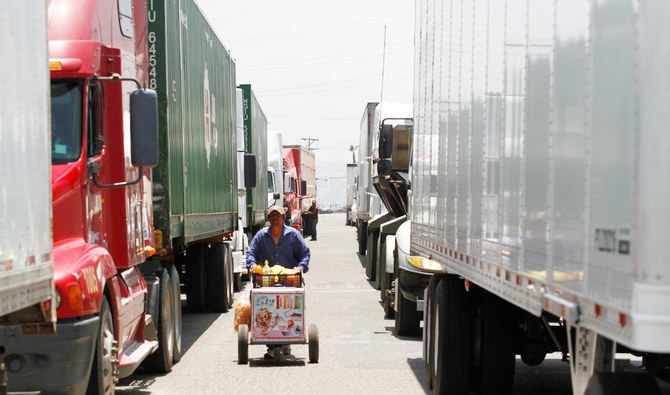
The 5% tax on all Mexican goods , which would increase every month up to 25% under Trump’s plan, would have had enormous economic implications for both countries. Americans bought $378 billion worth of Mexican imports last year, led by cars and auto parts. Many members of Trump’s Republican Party and business allies had urged him to reconsider — or at least postpone actually implementing the tariffs as talks continue — citing the potential harm to American consumers and manufactures.
From the moment Trump announced the tariff threat, observers wondered whether he would pull the trigger, noting his habit of creating problems and then claiming credit when he rushes in to solve them.
In late March, Trump threatened to shut the entire US-Mexico border if Mexico didn’t immediately halt illegal immigration. Just a few days later, he backed off that threat, saying he was pleased with steps Mexico had taken. It was unclear, however, what — if anything — Mexico had changed.
US and Mexican officials met for more than 10 hours Friday during a third day of talks at the US State Department trying to hash out a deal that would satisfy Trump’s demand that Mexico dramatically increase its efforts to crack down on migrants.
The talks had been focused, in part, on attempting to reach a compromise on changes that would make it harder for migrants who pass through Mexico from other countries to claim asylum in the US, those monitoring the situation said. Mexico has long opposed such a change but appeared open to considering a potential compromise that could include exceptions or waivers for different types of cases. The joint declaration, however makes no mention of the issue.
Leaving the State Department Friday night, Mexican Foreign Secretary Marcelo Ebrard said he thought the deal struck “a fair balance” because the US “had more drastic proposals and measures at the start.”
But Leticia Calderón Cheluis, a migration expert at the Mora Institute in Mexico City, said the agreement is essentially a series of compromises solely by Mexico, which she said committed to “a double clamp at both borders.”
Trump in recent months has embraced tariffs as a political tool he can use to force countries to comply with his demands — in this case on his signature issue of immigration. Beyond Trump and several White House advisers, though, few in his administration had believed the tariffs were a good idea, according to officials familiar with internal deliberations. Those people had worried about the negative economic consequences for Americans and argued that tariffs — which would likely spark retaliatory taxes on US exports — would also hurt the administration politically.
Republicans in Congress had also warned the White House that they were ready to stand up to the president to try to block his tariffs, which they worried would spike costs to US consumers, harm the economy and imperil a major pending US-Mexico-Canada trade deal .
Senate Minority Leader Chuck Schumer, D-N.Y., greeted Friday night’s news with sarcasm. “This is a historic night!” he tweeted. “Now that that problem is solved, I’m sure we won’t be hearing any more about it in the future.”


![]()
![]()

Trump says US, Mexico reach agreement to prevent tariffs

Trump says US, Mexico reach agreement to prevent tariffs
- Trump has nonetheless embraced tariffs as a political tool he can use to force countries to comply with his demands — in this case on his signature issue of immigration


Latest updates


© 2026 SAUDI RESEARCH & PUBLISHING COMPANY, All Rights Reserved And subject to Terms of Use Agreement.