LONDON: England may change a winning World Cup side by recalling fast bowler Mark Wood when they face Pakistan at Trent Bridge on Monday.
The ground is renowned as a batsman’s paradise, with England having twice set the world record for the highest score in a one-day international --- 444 for three against Pakistan in 2016 and last year’s 481 for six — on the very pitch that will be used for Monday’s match at Trent Bridge.
But Pakistan’s batsmen had anything but an easy ride in Nottingham as they succumbed to a bouncer barrage from the West Indies that saw them slump to 105 all out and a comprehensive defeat in their opening match of the World Cup on Friday.
England, who launched their quest to win the World Cup for the first time with a 104-run rout of South Africa at the Oval in which fast bowler Jofra Archer starred may now, in the light of Pakistan’s problems against short-pitched bowling, unleash Wood in partnership with the Sussex speedster.
“We’re aware of what went on yesterday,” England assistant coach Graham Thorpe said Saturday. “It was interesting viewing.
“The West Indies bowled very well, they looked like they roughed Pakistan up,” the former England batsman added.
“I think it (drafting Wood) will be discussed, to be honest.
Wood has bowled a mere 13.1 overs since the start of the season amid fears his longstanding left ankle injury could flare up again.
But his ability, in common with Archer, to top speeds of 90 mph meant England thought he was worth the risk at the World Cup.
England have risen to the top of the ODI rankings since their woeful first-round exit at the 2015 edition mainly as a result of piling on the runs.
But they showed they were more than ‘flat-track bullies’ with a score of 311 for eight on an awkward surface at the Oval before an attack led by Archer overwhelmed the Proteas.
Scoring 500 in an ODI was once viewed as impossible but, given their recent record-breaking exploits, England could go close if they bat first at Trent Bridge on Monday.
“It has generally always been a good pitch so we are looking forward to it,” said Thorpe.
“We didn’t quite unlock the door in terms of our batting at the Oval, being able to let go because we kept losing wickets at crucial times so we had to keep trying to put on those mini-partnerships again and that was really good.
“It’s the same thing coming here against Pakistan: if we get into a good position, we’ll try to score as many as we can. But at the same time if it doesn’t happen, you’ve got to put a competitive score on the board to put the opposition under pressure.”
Pakistan, who’ve lost their last 11 ODIs — including a recent 4-0 series defeat by England — are braced for short-pitched stuff with Wahab Riaz defiantly insisting: “If people want to bowl us bouncers, then we will have no problems with that.”
Monday’s match will also be an important test for what World Cup organizers insist will be improved procedures after thousands of frustrated fans were left queueing for hours on Friday, in some cases missing the entire Pakistan innings, as they waited to collect their match tickets.


England play down 500 talk as their quicks eye Pakistan
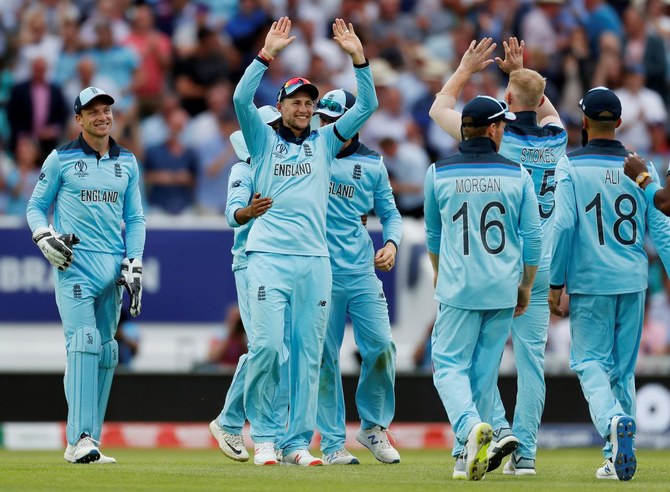
England play down 500 talk as their quicks eye Pakistan
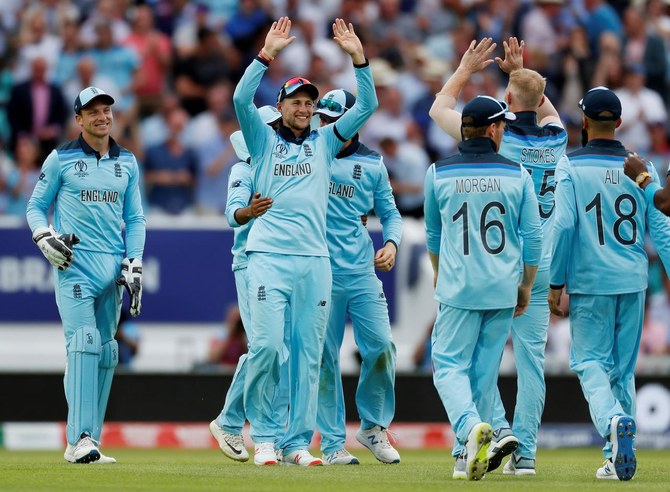
- Fast bowler Mark Wood recalled for Monday face-off with Pakistan at Trent Bridge
- England likely to score close to a ‘once impossible’ 500 if they bat first

Pakistan’s president defends ongoing strikes in Afghanistan, urges Kabul to dismantle militants
- Afghanistan on Thursday launched attacks in retaliation for Pakistani airstrikes the previous Sunday
- Pakistan’s military says it is only targeting Afghan military installations to avoid civilian casualties
ISLAMABAD: Pakistan’s president on Monday defended his country’s ongoing military strikes in neighboring Afghanistan, saying Islamabad tried all forms of diplomacy before targeting militants operating from Afghan territory, and called on the Taliban government in Kabul to disarm groups responsible for attacks in Pakistan.
Pakistan earlier said it is in “open war” with Afghanistan, alarming the international community. The border area remains a stronghold for militant organizations including Al-Qaeda and the Daesh (Islamic State) group.
“(The Afghan Taliban) must choose to dismantle the terror groups that survive on conflict and its war economy,” Asif Ali Zardari said during a speech to lawmakers, adding that “no state accepts serial attacks on its soil.”
Afghanistan on Thursday launched attacks in retaliation for Pakistani airstrikes the previous Sunday. Since then, Pakistan has carried out operations along the border, with Information Minister Attaullah Tarar claiming the killing of 435 Afghan forces and the capture of 31 Afghan positions.
Kabul has denied such claims.
In Afghanistan, the deputy government spokesman Hamdullah Fitrat said Pakistan’s military fired mortar shells at a refugee camp in eastern Kunar province, killing three children and injuring three others.
Afghanistan’s defense ministry said Afghan forces carried out strikes targeting a Pakistani military facility near Paktia province, causing “substantial losses and heavy casualties.”
Pakistan’s military did not respond to questions. It has said Pakistan is only targeting Afghan military installations to avoid civilian casualties.
Pakistan has witnessed a surge of violence in recent months and blames it on the outlawed Pakistani Taliban, known as Tehreek-e-Taliban Pakistan or TTP. It operates both inside Pakistan and from Afghan territory.
Islamabad accuses Afghanistan’s Taliban government of providing safe havens for the TTP, which Kabul denies.
The latest cross-border fighting ended a ceasefire brokered by Qatar and Turkiye in October. The two sides failed to reach a permanent agreement during talks in Istanbul.
Zardari reiterated Pakistan’s call for talks, saying, “We have never walked away from dialogue.”
The Pakistani leader again accused Afghanistan of acting as a proxy for India by sheltering militant groups.
“Stop being used by another country as a battlefield for their ambitions,” he said.
Zardari cited a recent report from the United Nations Security Council’s monitoring team that described the presence of militant groups in Afghanistan as an extra-regional threat.


