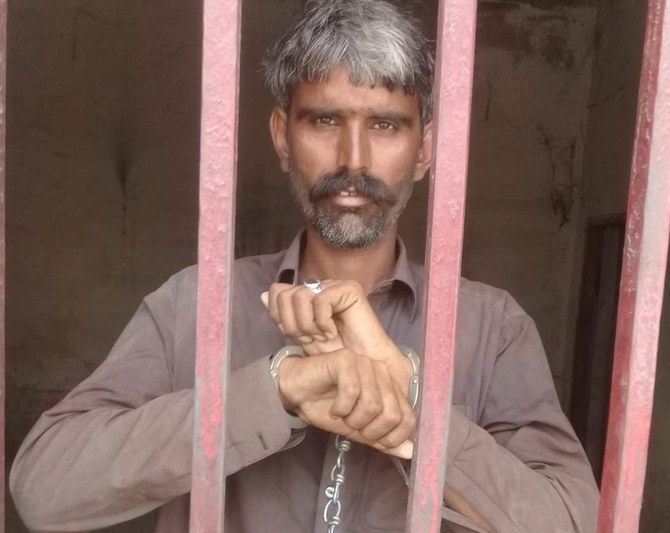
KARACHI: A man strangled his wife to death after she tested positive for Human Immunodeficiency Virus (HIV) in Pakistan’s southern Sindh province where an outbreak of the disease has unleashed panic and fear in recent weeks, officials said on Thursday.
“Bahadur Rind, a resident of Tharo Rind village, killed his wife Zarina Bibi after she tested positive [for HIV],” police official Farooq Amjad told Arab News, adding that her husband later hung her body from a tree.
“Her husband, who has not undergone an HIV screening, claimed his wife had an affair with a man, meaning that she had contracted the virus from someone else,” Amjad said, adding that authorities would now test the husband for the virus as well.
In rural Sindh, access to information about HIV and other diseases has kept large swathes of the population in the dark about how the virus is transmitted. There is widespread stigma attached to the disease across Pakistan and its spread has unleashed widespread rumors and superstitions in areas like Sindh, long plagued by poverty and illiteracy.
A team of experts from the World Health Organization (WHO) arrived in Pakistan on Tuesday to determine the causes of the massive HIV outbreak in the country’s southern province.
Authorities first discovered the burgeoning crisis after 18 children – most of them from a town on the outskirts of Larkana city – tested positive for the virus in the last week of April.
Officials have traced the spread of the virus to a paediatrician named Muzaffar Ghangharo who allegedly used contaminated syringes while vaccinating patients.
“He has been arrested and a Joint Investigation Team (JIT) currently interrogating him is expected to submit its report soon,” Kamran Nawaz, a senior police officer, told Arab News.
According to the Sindh AIDS Control Program (SACP), more than 24,568 people were screened for the virus between April 25 and May 29 using the Rapid Diagnostic Test. The results showed that 712 people, including 583 children, had tested positive for the virus.
Dr. Ghulam Shabir Imran Arbani, who discovered the first case of the virus on February 22, 2019, told Arab News that the SACP did not count around 100 cases that surfaced at Aga Khan and PPHI, a non-profit company.
“This is just the tip of the iceberg. If the screening is conducted across the province [of Sindh], the number will be in the thousands,” the doctor said, adding that Dr. Ghangharo could be just one of many sources through whom the disease had spread.
Arbani said Zarina’s murder was not the only case where a victim of the disease had been punished. He recalled the case where a father was unwilling to test his 16-month baby for the disease, saying the test was only meant “for adults with bad moral character.”
He added that during an awareness campaign at the Waris Dino Mashi village, he found a woman tied to a tree like an animal. “The family told us she was HIV positive and would spread the deadly virus if she was not tied properly,” he said.
“A 3-year-old baby who was HIV positive was brought to my clinic on Wednesday,” Arbani continued. “Her mother told me that her son was mistreated by all the children in the neighborhood who did not play with him since they thought he was going to bring harm to them.”
Dr. Masood Solangi, the head of the SACP, said his department had launched an awareness campaign.


![]()

Man kills wife after she tests HIV positive in Pakistan’s Sindh province
Man kills wife after she tests HIV positive in Pakistan’s Sindh province
- 712 people, including 583 children, have tested positive for the virus since last month
- Medical practitioners say lack of awareness about how virus is transmitted is a major issue
Latest updates




Recommended


© 2026 SAUDI RESEARCH & PUBLISHING COMPANY, All Rights Reserved And subject to Terms of Use Agreement.