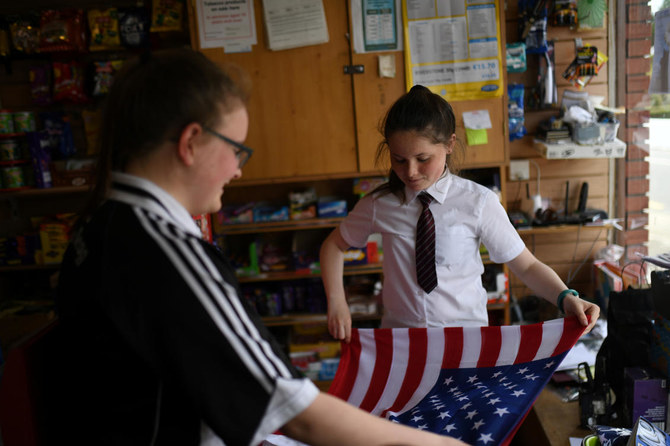
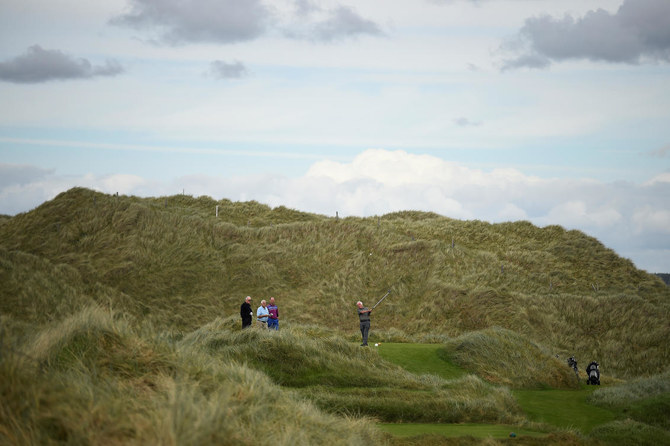
DOONBEG, Ireland: In a small corner of Ireland’s west coast Donald Trump means jobs. And the locals are getting ready to line the street with the Stars and Stripes to express their gratitude when he visits next week.
Like in Britain, where Trump has been promised demonstrations on his first European stop, a number of Irish groups have called on people to protest against the president’s policies on issues such as immigration and climate change.
But in Doonbeg, where residents credit Trump with securing their livelihoods when he bought the nearby golf resort five years ago, the tiny village is being decked out in American flags and bunting in advance of his visit.
“There are over 300 employed here because of him, what else is around here?” Joe Pender said, as he and fellow locals Tommy Haugh and Danny Buckley were hanging flags from every lamppost in the one-street village.
“If we didn’t have the hotel, we’d have nothing here. It’d be a ghost town.”
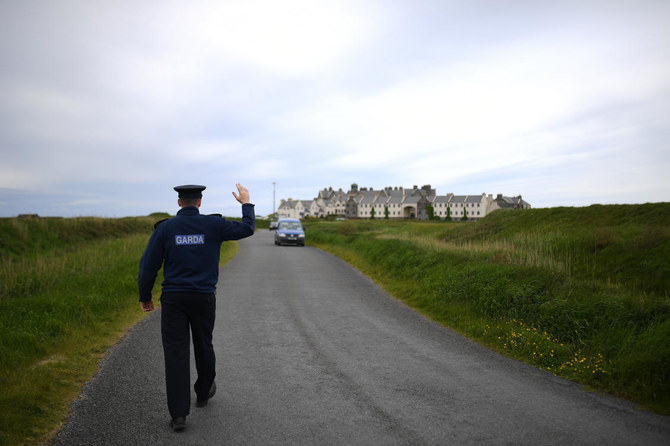
Trump is expected to stay in his hotel for at least one night on June 5 in between visits to Britain and France, with security already stepped up in the area.
Pender, 60, remembers feeding cattle in the green fields where the Greg Norman-designed golf course was built in 2002 during Ireland’s “Celtic Tiger” boom years, promising to transform the local area.
He worked for the previous owners who placed the resort into receivership when Ireland’s boom turned to a spectacular bust a decade ago and unemployment in the region rocketed above 16 percent.
Trump, like many foreign investors, saw a potential bargain in Ireland and reaped the benefits as the economy grew faster than any other in Europe for five straight years, unemployment fell back below 5 percent and record numbers of tourists flocked to spots like Doonbeg, which overlooks the Atlantic Ocean.
“Nobody is perfect but if any place had what we had, they’d be on top of the world. He’s put bread and butter on the table,” said local priest Father Joe Haugh who, at the age of 87, still enjoys a round of golf — free of charge.
It is a top class course, according to Haugh, who is also flying an American flag outside his church for the visit.
But while Barack Obama was met by cheering crowds and struck public relations gold by sharing a Guinness with a distant cousin during the last presidential visit to Ireland in 2011, Trump should not expect a similar reception outside Doonbeg.
Irish Prime Minister Leo Varadkar opposed extending an invitation to Trump as a cabinet minister before changing his mind. He will meet the president at Shannon Airport, where a previous ministerial colleague was criticized by opposition politicians for greeting Trump on a red carpet on his last visit, as an investor, in 2014, before he was elected president.
Trump’s fans in Doonbeg are aware that he is a divisive figure, but it is still very difficult to find any among its population of 200 who will say a bad word against him.
“He has his own past but we didn’t elect the man. If our president went abroad and wasn’t welcomed, we’d be very upset. It’s courtesy,” said Ita Comerford, whose family have lived in the village for four generations.
Michael and Theresa McDermott, whose idyllic house overlooks the golf course, are in the security “red zone” and while they have identity passes to come and go next week, the one thing they cannot find is a US flag. The local shop is sold out.
With a night of Irish dancing and entertainment planned in the village while Trump is in town, local restaurant owner and publican Tommy Tubridy has been perfecting his Guinness pours, using careful tap skills to create the letters “T-R-U-M-P” in the creamy foam of the pint, just in case they get a visit.
“He’s a man that pulls a lot of surprises so you’d never know, he could pop down,” said Tubridy, who credits the hotel with keeping Doonbeg’s five pubs in business and even bringing home some of its emigrants hopeful of getting work again.
“He’s a non drinker though so he’d probably have a glass of the local spring water and that’d be grand.”

Tiny Irish village to welcome Trump with pride, not protest
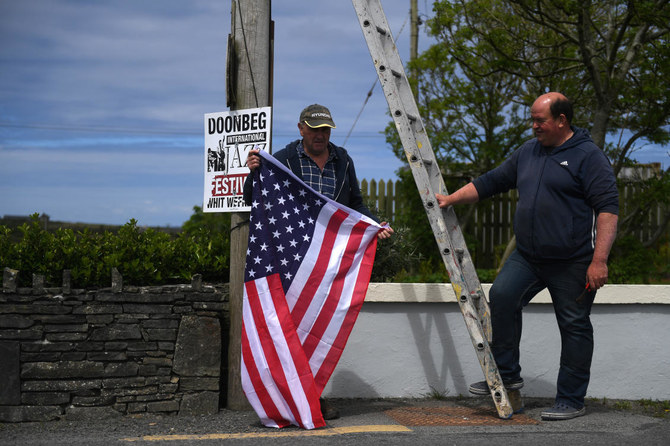
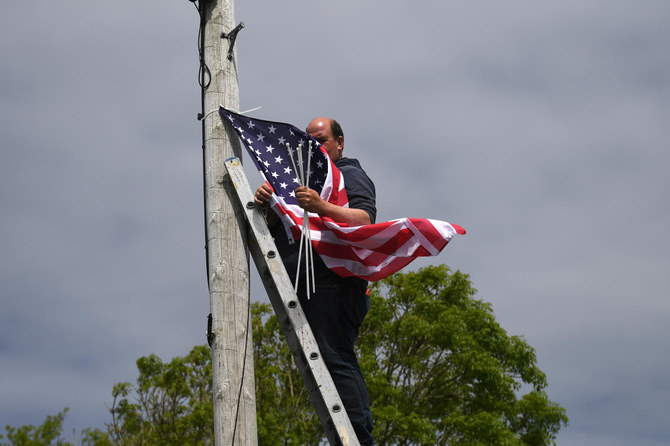
- In Doonbeg, where residents credit Trump with securing their livelihoods when he bought the nearby golf resort five years ago, the tiny village is being decked out in American flags
- Trump is expected to stay in his hotel for at least one night on June 5 in between visits to Britain and France, with security already stepped up in the area
Coast Guard is pursuing another tanker helping Venezuela skirt sanctions, US official says
- US oil companies dominated Venezuela’s petroleum industry until the country’s leaders moved to nationalize the sector, first in the 1970s and again in the 21st century under Maduro and his predecessor, Hugo Chávez
WEST PALM BEACH, Florida: The US Coast Guard on Sunday was pursuing another sanctioned oil tanker in the Caribbean Sea as the Trump administration appeared to be intensifying its targeting of such vessels connected to the Venezuelan government.
The pursuit of the tanker, which was confirmed by a US official briefed on the operation, comes after the US administration announced Saturday it had seized a tanker for the second time in less than two weeks.
The official, who was not authorized to comment publicly about the ongoing operation and spoke on the condition of anonymity, said Sunday’s pursuit involved “a sanctioned dark fleet vessel that is part of Venezuela’s illegal sanctions evasion.”
The official said the vessel was flying a false flag and under a judicial seizure order.
The Pentagon and Department of Homeland Security, which oversees the US Coast Guard, deferred questions about the operation to the White House, which did not offer comment on the operation.
Saturday’s predawn seizure of a Panama-flagged vessel called Centuries targeted what the White House described as a “falsely flagged vessel operating as part of the Venezuelan shadow fleet to traffic stolen oil.”
The Coast Guard, with assistance from the Navy, seized a sanctioned tanker called Skipper on Dec. 10, another part of the shadow fleet of tankers that the US says operates on the fringes of the law to move sanctioned cargo. It was not even flying a nation’s flag when it was seized by the Coast Guard.
President Donald Trump, after that first seizure, said that the US would carry out a “blockade” of Venezuela. It all comes as Trump has ratcheted up his rhetoric toward Venezuelan President Nicolás Maduro.
This past week Trump demanded that Venezuela return assets that it seized from US oil companies years ago, justifying anew his announcement of a “blockade” against oil tankers traveling to or from the South American country that face American sanctions.
Trump cited the lost US investments in Venezuela when asked about his newest tactic in a pressure campaign against Maduro, suggesting the Republican administration’s moves are at least somewhat motivated by disputes over oil investments, along with accusations of drug trafficking. Some sanctioned tankers already are diverting away from Venezuela.
US oil companies dominated Venezuela’s petroleum industry until the country’s leaders moved to nationalize the sector, first in the 1970s and again in the 21st century under Maduro and his predecessor, Hugo Chávez. Compensation offered by Venezuela was deemed insufficient, and in 2014, an international arbitration panel ordered the country’s socialist government to pay $1.6 billion to ExxonMobil.
Maduro said in a message Sunday on Telegram that Venezuela has spent months “denouncing, challenging and defeating a campaign of aggression that goes from psychological terrorism to corsairs attacking oil tankers.”
He added: “We are ready to accelerate the pace of our deep revolution!”
Sen. Rand Paul, R-Kentucky, who has been critical of Trump’s Venezuela policy, called the tanker seizures a “provocation and a prelude to war.”
“Look, at any point in time, there are 20, 30 governments around the world that we don’t like that are either socialist or communist or have human rights violations,” Paul said on ABC’s’ “This Week.” ”But it isn’t the job of the American soldier to be the policeman of the world.”
The targeting of tankers comes as Trump has ordered the Defense Department to carry out a series of attacks on vessels in the Caribbean and eastern Pacific Ocean that his administration alleges are smuggling fentanyl and other illegal drugs into the United States and beyond.
At least 104 people have been killed in 28 known strikes since early September. The strikes have faced scrutiny from US lawmakers and human rights activists, who say the administration has offered scant evidence that its targets are indeed drug smugglers and that the fatal strikes amount to extrajudicial killings.
Trump has repeatedly said Maduro’s days in power are numbered. White House chief of staff Susie Wiles said in an interview with Vanity Fair published last week that Trump “wants to keep on blowing boats up until Maduro cries uncle.”
Sen. Tim Kaine, D-Virginia, told NBC’s “Meet the Press” on Sunday that Trump’s use of military to mount pressure on Maduro runs contrary to Trump’s pledge to keep the United States out of unnecessary wars.
Democrats have been pressing Trump to seek congressional authorization for the military action in the Caribbean.
“We should be using sanctions and other tools at our disposal to punish this dictator who is violating the human rights of his civilians and has run the Venezuelan economy into the ground,” Kaine said. “But I’ll tell you, we should not be waging war against Venezuela. We definitely should not be waging war without a vote of Congress.