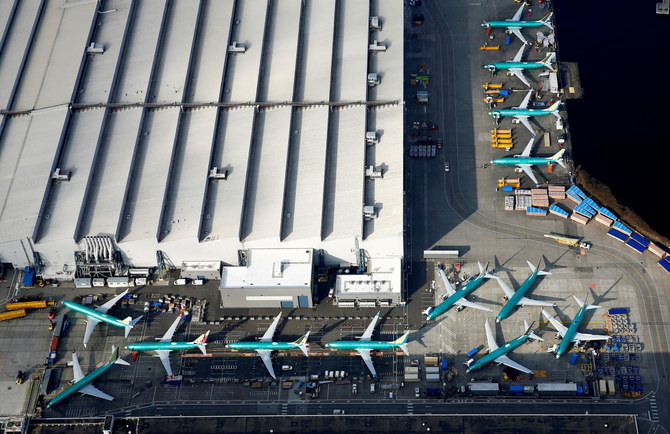
Boeing 737 MAX may not return to service until August: IATA head

IATA plans to organize a summit with airline industry stakeholders to discuss what is needed for the Boeing 737 MAX to return to service. (Reuters)
Updated 29 May 2019
Follow

Boeing 737 MAX may not return to service until August: IATA head

  • The 737 MAX was grounded globally in March after a crash in Ethiopia, the model’s second deadly crash in five months
  • Airline members want regulators to cooperate closely on the decision for the plane’s re-entry to service

SEOUL: The International Air Transport Association (IATA) expects it could take until August before the Boeing 737 MAX returns to service, the airline group’s head said on Wednesday, adding that the final say on the timing rested with regulators.
The 737 MAX was grounded globally in March after a crash in Ethiopia killed all 157 people on board, the model’s second deadly crash in five months.
“We do not expect something before 10 to 12 weeks in re-entry into service,” IATA Director General Alexandre de Juniac told reporters in Seoul. “But it is not our hands. That is in the hands of regulators.”
IATA plans to organize a summit with airlines, regulators and the manufacturer in 5 to 7 weeks to discuss what is needed for the 737 MAX to return to service, he said.
At an IATA meeting in Montreal last week, airline members said they wanted regulators to cooperate closely on the decision for the plane’s re-entry to service, de Juniac said.
“We hope that they will align their timeframe,” he said of regulators.
The Federal Aviation Administration (FAA) expects to approve the jet’s return to service as soon as late June, representatives of the US air regulator informed members of the United Nations’ aviation agency in a private briefing last week, sources told Reuters.
US operators United Airlines, Southwest Airlines, and American Airlines have removed the planes from their flight schedules until early to mid-August.


King Abdulaziz Airport among world’s busiest after record-breaking 2025

Updated 02 January 2026
Follow

King Abdulaziz Airport among world’s busiest after record-breaking 2025

RIYADH: King Abdulaziz International Airport has achieved a new historical milestone, reaching 53.4 million passengers in a single year.

This is the highest number ever recorded at a Saudi airport since the beginning of air travel in the Kingdom, placing it among the world’s mega airports in terms of passenger traffic, according to the Saudi Press Agency.

The airport handled a total of 310,000 flights and 60.4 million bags, representing a 12 percent increase compared to 2024. It also handled 9.57 million Zamzam water containers and 2,968 cargo flights. 

This achievement reflects the airport’s qualitative transformation and its position as a regional hub and national gateway connecting the Kingdom to the world. It also highlights its role in facilitating the movement of visitors and pilgrims, promoting tourism in line with the goals of Vision 2030, diversifying the economy, and providing a distinguished travel experience. 

For his part, CEO of Jeddah Airports Co. Mazen Johar, affirmed that reaching 53.4 million passengers confirms the airport’s high operational readiness and represents a pivotal milestone for moving to the next phase, in preparation for doubling this number, God willing, in the coming years. 

He pointed out that this national achievement would not have been possible without the grace of God Almighty, followed by the directives of the wise leadership and the continuous follow-up from the minister of transport and logistics, the president of the General Authority of Civil Aviation, and the CEO of Airports Holding Co. 

He explained that King Abdulaziz International Airport is strengthening its position as a major aviation hub in the region through expansions, increased capacity, and improved services, supporting the objectives of the aviation program and aligning with the goals of the Kingdom’s Vision 2030. 

The CEO of Jeddah Airports Co. expressed his gratitude to the partners in success from various government and private sectors for their fruitful cooperation through a collaborative work system that contributed to providing the best services.