

Why Jerusalem’s Al-Aqsa Mosque matters for Muslims

Updated 03 June 2019
Follow

Why Jerusalem’s Al-Aqsa Mosque matters for Muslims

  • The shrine is Islam's third holiest after Makkah and Madinah in Saudi Arabia
  • The first mosque built within the Al-Aqsa compound dates back to 638 AD

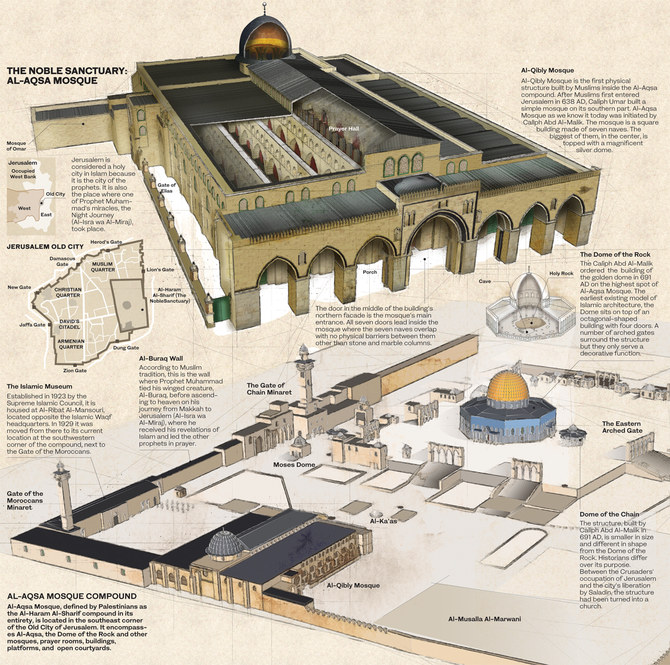
AMMAN: “There is a spot just in the center of Al-Qibli Mosque where you feel so light when you stand in it.”

This is the way Wasfi Kailani, of the Hashemite Fund for the Restoration of Al-Aqsa Mosque, describes his favorite spot within Jerusalem’s Al-Aqsa Mosque, the UNESCO World Heritage site also known to Muslims and Palestinians as Al-Haram Al-Sharif.

The spot that Kailani refers to is not far from Saladin’s pulpit, rebuilt by King Abdullah II of Jordan after it was destroyed in a 1969 arson attack.

“I feel that the holiest spot in the entire compound is in the center of the mosque,” he told Arab News. “It is the place from where Prophet Muhammad ascended to the heavens to meet God Almighty with all the prophets with him.”

For Ziad Khalil Abu Zayyad, a spokesman for Fatah, the Palestinian political party, the most special spot is a small room under the Dome of the Rock mosque.

“It is called the Souls Cave,” Abu Zayyad told Arab News. “I like it for the high level of energy and spirituality that can be felt while praying inside it.”

His views are echoed by Ahmad Budeiri, a former BBC staffer, who was born in Jerusalem and has spent all his life there. “I enter the mosque to experience the beauty of its architecture,” he said. “Then I go down to the cave and I get the feeling that all the spiritual meaning in the mosque is condensed in that small space.”

Abla Rweis, a mother of three from Nablus, told Arab News that her favorite spot is the mosque itself. “It has a special holiness to it as it is where the holy prophet Muhammad spent the night on his ascent to heaven.”

Rweis is talking about Al-Isra wa Al-Miraj, the two parts of a Night Journey that Prophet Muhammad took. In Islam, Al-Isra wa Al-Miraj signifies both a physical and spiritual journey.

A little more than a decade on, Caliph Omar was in Jerusalem and he began building the first Al-Aqsa Mosque. Al-Aqsa means “the farthest,” a reference to the distance of Islam’s third holiest shrine from Makkah and Madinah in Saudi Arabia.

For Khalil Attiyeh, a Jordanian parliamentarian, the feeling while going down the stairs from the Dome of the Rock to Al-Aqsa Mosque is special. But for many worshipers and visitors, the entire 144 dunum (144,000sq meters) of the Al-Aqsa compound is sacred.

Political activist Hazem H. Kawasmi said that his favorite spot is across from the water fountain, where worshipers come for the ritual washing. “I have been coming to Al-Aqsa since I was a child. I love to sit on the stairs across from the mosque and gaze at the water fountain,” he said.

For Arafat Amro, the Islamic Museum located within the compound is special because of its priceless contents. “It is a window to civilizations and history,” said Amro, who is also the musuem’s director.

“Everything here, from parchments, wooden works and metal items to stone carvings, reflects different times. Visitors who came to this mosque down the ages from different locations went back with the history of their Arab and Muslim forefathers etched in their memories.”

The Islamic Museum is located close to both Al-Buraq Wall and a gate through which groups of Jewish extremists often make uninvited incursions with an armed Israeli security escort.

The area was cleared of Palestinians soon after the capture in 1967 of East Jerusalem by Israel, marking the beginning of the occupation.

For Hazem Shunnar, a respected Palestinian economist, Al-Buraq wall is what he often thinks about “because the Israelis took it by force.”


Hundreds flee to government-held areas in north Syria ahead of possible offensive

Updated 16 January 2026
Follow

Hundreds flee to government-held areas in north Syria ahead of possible offensive

  • Many of the civilians who fled used side roads to reach government-held areas
  • Men, women and children arrived in cars and pickup trucks that were packed with bags of clothes

DEIR HAFER, Syria: Scores of people carrying their belongings arrived in government-held areas in northern Syria on Friday ahead a possible attack by Syrian troops on territory held by Kurdish-led fighters east of the city of Aleppo.
Many of the civilians who fled used side roads to reach government-held areas because the main highway was blocked with barriers at a checkpoint that previously was controlled by the Kurdish-led and US-backed Syrian Democratic Forces, Associated Press journalists observed.
The Syrian army said late Wednesday that civilians would be able to evacuate through the “humanitarian corridor” from 9 a.m. to 5 p.m. Thursday. The announcement appeared to signal plans for an offensive against the SDF in the area east of Aleppo.
There were limited exchanges of fire between the two sides.
Men, women and children arrived in cars and pickup trucks that were packed with bags of clothes, mattresses and other belongings. They were met by local officials who directed them to shelters.
In other areas, people crossed canals on small boats and crossed a heavily damaged pedestrian bridge to reach the side held by government forces.
The SDF closed the main highway but about 4,000 people were still able to reach government-held areas on other roads, Syrian state TV reported.
A US military convoy arrived in Deir Hafer in the early afternoon but it was not immediately clear whether those personnel will remain. The US has good relations with both sides and has urged calm.
Inside Deir Hafer, many shops were closed and people stayed home.
“When I saw people leaving I came here,” said Umm Talal, who arrived in the government-held area with her husband and children. She added that the road appeared safe and her husband plans to return to their home.
Abu Mohammed said he came from the town of Maskana after hearing the government had opened a safe corridor, “only to be surprised when we arrived at Deir Hafer and found it closed.”
SDF fighters were preventing people from crossing through Syria’s main east-west highway and forcing them to take a side road, he said.
The tensions in the Deir Hafer area come after several days of intense clashes last week in Aleppo, previously Syria’s largest city and commercial center, that ended with the evacuation of Kurdish fighters from three neighborhoods north of the city that were then taken over by government forces.
The fighting broke out as negotiations stalled between Damascus and the SDF over an agreement reached in March to integrate their forces and for the central government to take control of institutions including border crossings and oil fields in the northeast.
The US special envoy to Syria, Tom Barrack, posted on X Friday that Washington remains in close contact with all parties in Syria, “working around the clock to lower the temperature, prevent escalation, and return to integration talks between the Syrian government and the SDF.”
The SDF for years has been the main US partner in Syria in fighting against the Daesh group, but Turkiye considers the SDF a terrorist organization because of its association with Kurdish separatist insurgents in Turkiye.