

Lebanon receives Israeli response to border demarcation

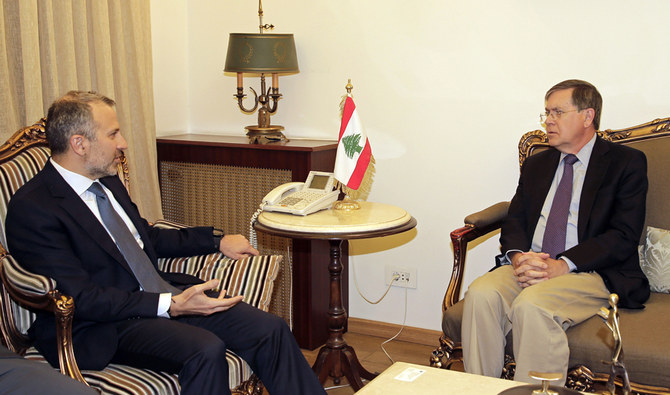
US Deputy Assistant Secretary of State David Satterfield, right, who is attempting to mediate a border dispute between Lebanon and Israel, meets with Lebanese Foreign Minister Gibran Bassil at the Lebanese foreign ministry in Beirut, Lebanon, Tuesday, May 28, 2019. (AP)
Updated 28 May 2019
Follow

Lebanon receives Israeli response to border demarcation

  • Lebanese Foreign Ministry sources said after Satterfield’s meeting with Foreign Minister Gebran Bassil that the atmosphere was “positive”

BEIRUT: David Satterfield, deputy US assistant secretary of state for Near Eastern affairs, conveyed Israel’s response to Lebanon regarding negotiations on border demarcation.

Sources at the Lebanese prime minister’s office said negotiations will focus on demarcating the maritime border, and will also tackle disputed points on the Blue Line, a border demarcation published by the UN in June 2000 to determine whether Israel had fully withdrawn from Lebanon. There are 13 disputed points on the Blue Line.

Lebanese Foreign Ministry sources said after Satterfield’s meeting with Foreign Minister Gebran Bassil that the atmosphere was “positive.”

They added that the final touches were being put on the form of negotiations and the role of concerned parties, including the UN, Lebanon, Israel and the US. Satterfield also met with Lebanese Parliament Speaker Nabih Berri.

Lebanon’s presidential media office said President Michel Aoun on Monday discussed with Jan Kubis, the UN special coordinator in Lebanon, the UN’s role “in helping to demarcate the southern Lebanese border.”

Lebanon delivered a proposal to Satterfield stressing its “determination to demarcate the maritime border through the tripartite commission originally formed in April 1996, as was done for the Blue Line after liberation in 2000, which is to be completed by a White Line in the sea.”

Beirut said it rejected “any direct Israeli-Lebanese negotiations,” and “demanded negotiations involving officers from Lebanon, Israel and the United Nations, with the participation of topographic and oil experts. The function of the tripartite committee is to demarcate the maritime line. There is no objection to the participation of American diplomats in the tripartite demarcation, provided that they are neutral.”

The head of the union of workers in the gas and exploration sector in Lebanon, Maroun Al-Khouli, said: “Solving this problem with Israel will establish a significant renaissance in Lebanon’s investment in its oil resources in the maritime economic zone, especially as Lebanon is preparing to begin drilling for oil and gas in blocks 4 and 9 in its territorial waters.”

He added: “This will also help large companies, including American companies, to enter the field of exploration in the second licensing cycle, which will be launched later.”


Hamas to hold leadership elections in coming months: sources

Updated 4 sec ago
Follow

Hamas to hold leadership elections in coming months: sources

  • A Hamas member in Gaza said Hayya is a strong contender due to his relations with other Palestinian factions, including rival Fatah, which dominates the Palestinian Authority, as well as his regional standing

GAZA CITY, Palestinian Territories: Hamas is preparing to hold internal elections to rebuild its leadership following Israel’s killing of several of the group’s top figures during the war in Gaza, sources in the movement said on Monday.
“Internal preparations are still ongoing in order to hold the elections at the appropriate time in areas where conditions on the ground allow it,” a Hamas leader told AFP.
The vote is expected to take place “in the first months of 2026.”
Much of the group’s top leadership has been decimated during the war, which was sparked by Hamas’s unprecedented attack on Israel in October 2023.
The war has also devastated the Gaza Strip, leaving its more than two million residents in dire humanitarian conditions.
The leadership renewal process includes the formation of a new 50-member Shoura Council, a consultative body dominated by religious figures.
Its members are selected every four years by Hamas’ three branches: the Gaza Strip, the occupied West Bank and the movement’s external leadership.
Hamas prisoners in Israeli prisons are also eligible to vote.
During previous elections, held before the war, members across Gaza and the West Bank used to gather at different locations including mosques to choose the Shoura Council.
That council is responsible, every four years, for electing the 18-member political bureau and its chief, who serves as Hamas’s overall leader.
Another Hamas source close to the process said the timing of the political bureau elections remains uncertain “given the circumstances our people are going through.”
After Israel killed former Hamas chief Ismail Haniyeh in Tehran in July 2024, the group chose its then-Gaza chief Yahya Sinwar as his successor.
Israel accused Sinwar of masterminding the October 7 attack.
He too was killed by Israeli forces in the southern Gaza city of Rafah, three months after Haniyeh’s assassination.
Hamas then opted for an interim five-member leadership committee based in Qatar, postponing the appointment of a single leader until elections are held and given the risk of being targeted by Israel.
According to sources, two figures have now emerged as frontrunners to be the head of the political bureau: Khalil Al-Hayya and Khaled Meshaal.
Hayya, 65, a Gaza native and Hamas’s chief negotiator in ceasefire talks, has held senior roles since at least 2006, according to the US-based NGO the Counter-Extremism Project (CEP).
Meshaal, who led the Political Bureau from 2004 to 2017, has never lived in Gaza. He was born in the West Bank in 1956.
He joined Hamas in Kuwait and later lived in Jordan, Syria and Qatar. The CEP says he oversaw Hamas’s evolution into a political-military hybrid.
He currently heads the movement’s diaspora office.
A Hamas member in Gaza said Hayya is a strong contender due to his relations with other Palestinian factions, including rival Fatah, which dominates the Palestinian Authority, as well as his regional standing.
Hayya also enjoys backing from both the Shoura Council and Hamas’s military wing, the Ezzedine Al-Qassam Brigades.
Another source said other potential candidates include West Bank Hamas leader Zaher Jabarin and Shoura Council head Nizar Awadallah.