

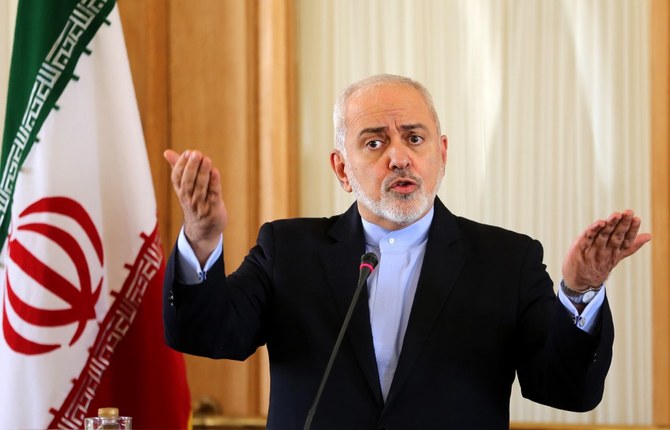
Iran will defend itself against any aggression: foreign minister

Zarif said they hope to have balanced relations with their gulf neighbors. (File/AFP)
Updated 27 May 2019
Follow

Iran will defend itself against any aggression: foreign minister

  • Iraq said they will act as an intermediary between US and Iran
  • Iran said they proposed to sign a non-aggression pact with Gulf countries

BAGHDAD: Iranian will defend itself against any military or economic aggression, Foreign Minister Mohammad Javad Zarif said on Sunday, calling on European states to do more to preserve a nuclear agreement his country signed.

Speaking in a news conference in Baghdad with his Iraqi counterpart Mohammed Al-Hakim, Zarif said his country wanted to build balanced relations with its Gulf Arab neighbors and that it had proposed signing a non-aggression pact with them.

“We will defend against any war efforts against Iran, whether it be an economic war or a military one, and we will face these efforts with strength,” he said.

Meanwhile,  Iranian Deputy Foreign Minister Abbas Araqchi arrived on Sunday in Oman and discussed "regional developments" with Yousuf bin Alawi bin Abdullah, the sultanate’s minister responsible for foreign affairs, the state-run Oman News Agency reported.
Bin Alawi said earlier this week that his country is trying "with other parties" to calm tensions between the United States and Iran.

Strains have increased between Iran and the United States, which is a firm backer of Tehran’s regional rival Saudi Arabia, after this month’s attack on oil tankers in the Gulf region that Washington has blamed on Iran.

Tehran has distanced itself from the bombings, but the United States has sent an aircraft carrier and an extra 1,500 troops to the Gulf, sparking concerns about the risks of conflict in a volatile region.

Iraq stands with Iran and is willing to act as an intermediary between its neighbor and the United States, Hakim said, adding that Baghdad does not believe an “economic blockade” is fruitful, a reference to US sanctions.

“We are saying very clearly and honestly that we oppose the unilateral actions taken by the United States. We stand with the Islamic Republic of Iran in its position,” said Hakim. The United States and Iran are Iraq’s two main allies.

Washington has been seeking to tighten sanctions against Iran, as relations worsen under President Donald Trump, who last year pulled out of a nuclear agreement his predecessor Barack Obama had signed with Iran alongside other world powers in 2015.

In Tehran, President Hassan Rouhani floated the idea of holding a referendum over Iran’s nuclear program, Iranian media reported.

A referendum over the controversial nuclear program could give Iran’s leaders space to maneuver and a chance to resolve the standoff with the United States.

Top Iranian leaders have said they are not seeking war with the United States and officials speaking to Reuters from Tehran said last week that despite the sharpened rhetoric with Washington, authorities are trying to avoid an open conflict.

“Article 59 of the Constitution (referendum) is a deadlock breaker ... and could be a problem-solver at any junction,” the semi-official news agency ILNA quoted Rouhani as saying late on Saturday.

Rouhani said that, when he was a top nuclear negotiator in 2004, he had proposed holding a referendum on the nuclear issue to Supreme Leader Ayatollah Ali Khamenei.

Iran has only held three referendums since its 1979 Islamic revolution — to approve the setting up of an Islamic Republic and then to approve and amend the constitution.

Washington says it has built up the US military presence in the region, accusing Tehran of threats to US troops and interests. Tehran has described US moves as “psychological warfare” and a “political game”.

Separately, a deputy commander of Iran’s elite Revolutionary Guards said the US military presence in the Middle East was at its “weakest in history” despite the talk of a build-up.


Aoun reassures Lebanon that risk of war is ‘fading’ in year-end message

Lebanese President Joseph Aoun. (File/AFP)
Updated 31 December 2025
Follow

Aoun reassures Lebanon that risk of war is ‘fading’ in year-end message

  • Israeli military spokesperson said it targeted 380 armed operatives, 950 military sites in Lebanon in past year
  • Beirut’s southern suburb residents pledge to avoid celebratory gunfire on New Year’s Eve

BEIRUT: Lebanese President Joseph Aoun on Wednesday sought to reassure citizens in his year-end address, saying “the overall atmosphere remains positive and the risk of war is fading,” amid widespread concern over a possible Israeli escalation against Hezbollah.

Fear of renewed attacks followed Israeli criticism of a Lebanese Army weapons-confiscation operation that is set to enter its second phase at the start of the 2026. The plan include the expansion from areas north of the Litani River to the Awali River, after the first phase was completed south of the Litani.

President Aoun cautioned that this does not mean “completely eliminating the risk of war,” stressing that “work is underway with various friendly and brotherly countries to completely neutralize the threat of war.”

Addressing Internal Security officials, Aoun said that the “situation is among the best,” noting that this assessment has been echoed by foreign visitors to Lebanon, despite the strain caused by large numbers of Syrian and Palestinian refugees.

He added that security forces were fully carrying out their duties and solving crimes with notable speed, pointing to the successful visit of Pope Leo XIV earlier this year as further evidence of progress.

On Monday, Egyptian Ambassador to Lebanon Alaa Moussa stressed during a Beirut press conference that implementing “international agreements and resolutions, foremost among them the Nov. 27, 2014 agreement and Resolution 1701, constitutes the fundamental approach to sparing Lebanon further security tensions,” speaking of “dire consequences that could result from continued escalation.”

The Egyptian diplomat indicated that “there are no hidden warnings or threats directed at Lebanon, but rather a clear commitment to the agreements signed by the concerned parties, which must be fully implemented by everyone.”

The ambassador stated that his country, under the directives of President Abdel Fattah El-Sisi, is “exerting intensive efforts to reduce tensions in southern Lebanon and the region in general, through active diplomatic contacts led by the Minister of Foreign Affairs Badr Abdelatty with relevant regional and international parties.”

Israeli military spokesman Avichai Adraee published on Wednesday a summary of Israeli attacks on Hezbollah in Lebanon in 2025.

“The Army targeted approximately 380 armed operatives, including Ali Tabatabai (chief of staff), Hassan Kamal (responsible for anti-tank missiles on the southern front), Abbas Hassan Karky (logistics officer in the southern command), and Khodr Saeed Hashem (commander of the naval force in the Radwan Unit),” he said.

“It also attacked approximately 950 military targets, including 210 launch sites and weapons depots, 140 military buildings, and about 60 tunnel entrances,” Adraee added.

In the statement, he accused Hezbollah of committing about 1,920 ceasefire violations and said the military would continue its raids and targeting operations in the new year.

UNIFIL Com. Gen. Diodato Abagnara said in his end-of-the-year message that “UNIFIL will continue to support Lebanon and Israel in implementing their obligations under Resolution 1701, building on the stability achieved in 2025 and strengthening efforts toward a lasting peace.”

As part of the weapons restriction plan, on Tuesday, the Fatah movement — the Palestinian National Security Forces in Lebanon — handed over a new batch of heavy and medium weapons from the Ain Al-Hilweh Palestinian refugee camp to the Lebanese Army in four trucks, away from the media.

This is the second batch of weapons to be handed over from the camp, which is the largest Palestinian refugee camp in Lebanon. It represents the fifth phase of the Palestinian weapons handover process in the camps, four of which were completed between Aug. 21 and Sept. 13, 2025, encompassing nine camps, including Ain Al-Hilweh.

The handover follows and implements an agreement reached between Aoun and Palestinian President Mahmoud Abbas after the latter’s visit to Lebanon in May.

Abbas had announced “the Palestinian Authority’s support for the Lebanese state’s plan to extend its authority over all Lebanese territory, including the Palestinian camps.”

Hamas continues to refuse to hand over its weapons to the Lebanese Army, while Hezbollah maintains its weapons north of the Litani River.

The Lebanese Army implemented “exceptional security measures in various Lebanese regions on New Year’s Eve, with the aim of maintaining security.”

It called on citizens to “cooperate with the security measures taken to maintain public safety and prevent incidents,” warning of the consequences of firing weapons, which will be prosecuted as it poses a threat to public safety.

In another measure, authorities announced that gun licenses and traffic permits will be suspended until Jan. 2, 2026.

In Beirut’s southern suburbs, residents signed a pledge as part of an Internal Security Forces campaign against celebratory gunfire on New Year’s Eve, committing not to fire weapons in public and to report violations with photos or videos.