Sudan interim military council chief Al-Burhan meets with Egypt’s President El-Sisi

General Abdel Fattah Al-Burhan’s visit to Egypt comes after Sudanese protest leaders announced a two-day strike. (AP)
Updated 26 May 2019
Follow

Sudan interim military council chief Al-Burhan meets with Egypt’s President El-Sisi

  • General’s first foreign trip since taking power after the April removal of president Omar Al-Bashir
  • El-Sisi backs Sudan’s military council

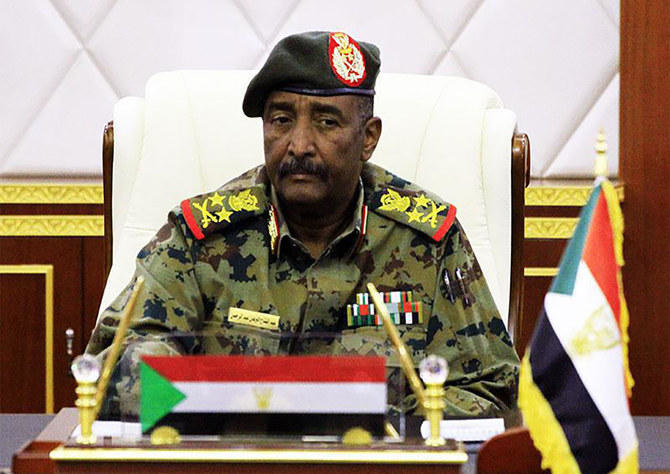
CAIRO: Gen. Abdel Fattah Al-Burhan, head of Sudan’s ruling interim military council, arrived in Cairo on Saturday and met with President Abdel Fattah El-Sisi in the capital’s Ittihadia Palace, the Egyptian presidency said.

Al-Burhan is on his first trip abroad since taking power following the ouster in April of Sudanese President Omar Al-Bashir after months of protests.

El-Sisi and Burhan “agreed on the priority of supporting the free will of the Sudanese people and its choices,” Egyptian presidency spokesman Bassam Rady said.

El-Sisi also said Egypt was ready to “provide all means of support to the brothers in Sudan to overcome this stage in line with the aspirations of the Sudanese people, away from external interventions,” according to the spokesman. 

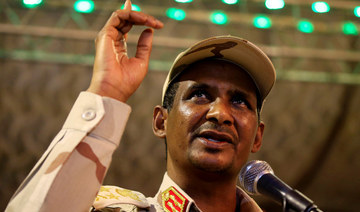
The visit comes a few hours after a visit paid by the vice chairman of the Sudanese Interim Military Council, Mohammad Hamdan Duklu, to Saudi Arabia to meet with Crown Prince Mohammed bin Salman.

Al-Burhan’s visit comes after Sudanese protest leaders announced a two-day strike from Tuesday, as talks with the military over installing civilian rule remain suspended.

At odds

The Alliance for Freedom and Change umbrella movement is at odds with the military council over whether the transitional body to rule Sudan should be headed by a military or civilian figure. The negotiations have been on hold since Monday.

Egypt, whose president currently chairs the African Union, has voiced support for Sudan’s military council.

Last month, El-Sisi hosted a summit where African nations urged the regional bloc to allow Khartoum “more time” for a handover to civilian rule.

Protest leaders were set to hold meetings with demonstrators at a sit-in outside the army headquarters in Khartoum on Saturday to discuss how to resolve the deadlock.

On Friday, they said their strike at “public and private institutions and companies,” accompanied by civil disobedience, was “an act of peaceful resistance with which we have been forced to proceed.”

Thousands of protesters remain at the sit-in to demand the departure of the generals, who seized power after ousting Al-Bashir.

Protest leaders have called for people to march on Sunday from residential areas of Khartoum toward the sit-in.

Several rounds of talks have so far failed to finalize the makeup of the new ruling body, although the two sides have agreed it will hold power for a transitional period of three years.

Western nations have called on the generals to hand power to a civilian administration, while the ruling army council has received support from regional powers.

Al-Burhan thanked Gulf states — including Saudi Arabia and the UAE — and Egypt for their support during the current tumultuous times.

(With Reuters)


Death toll rises to at least 10 in violence around Iran protests

Updated 58 min 48 sec ago
Follow

Death toll rises to at least 10 in violence around Iran protests

  • The weeklong protests, have become the biggest in Iran since 2022, when the death of 22-year-old Mahsa Amini in police custody triggered nationwide demonstrations

DUBAI: Violence surrounding protests in Iran sparked by the Islamic Republic’s ailing economy killed two other people, authorities said Saturday, raising the death toll in the demonstrations to at least 10 as they showed no signs of stopping.
The new deaths follow US President Donald Trump warning Iran on Friday that if Tehran “violently kills peaceful protesters,” the United States “will come to their rescue.” While it remains unclear how and if Trump will intervene, his comments sparked an immediate, angry response from officials within the theocracy threatening to target American troops in the Mideast.
The weeklong protests, have become the biggest in Iran since 2022, when the death of 22-year-old Mahsa Amini in police custody triggered nationwide demonstrations. However, the protests have yet to be as widespread and intense as those surrounding the death of Amini, who was detained over not wearing her hijab, or headscarf, to the liking of authorities.
The deaths overnight into Saturday involved a new level of violence. In Qom, home to the country’s major Shiite seminaries, a grenade exploded, killing a man there, the state-owned IRAN newspaper reported. It quoted security officials alleging the man carried the grenade to attack people in the city, some 130 kilometers (80 miles) south of the capital, Tehran.
Online videos from Qom purportedly showed fires in the street overnight.
The second death happened in the town of Harsin, some 370 kilometers (230 miles) southwest of Tehran. There, the newspaper said a member of the Basij, the all-volunteer arm of Iran’s paramilitary Revolutionary Guard, died in a gun and knife attack in the town in Kermanshah province.
Demonstrations have reached over 100 locations in 22 of Iran’s 31 provinces, the US-based Human Rights Activists News Agency reported.
Iran’s civilian government under reformist President Masoud Pezeshkian has been trying to signal it wants to negotiate with protesters. However, Pezeshkian has acknowledged there is not much he can do as Iran’s rial has rapidly depreciated, with $1 now costing some 1.4 million rials. That sparked the initial protests.