

INTERVIEW: Khaled bin Alwaleed bin Talal, the prince who wants everyone to be part of Saudi Arabia’s forward trajectory

Illustration by Luis Grañena
Updated 26 May 2019
Follow

INTERVIEW: Khaled bin Alwaleed bin Talal, the prince who wants everyone to be part of Saudi Arabia’s forward trajectory

  • The Saudi royal is a venture capitalist and a key supporter of entrepreneurship in the Kingdom

JEDDAH: Arab News recently got up close and personal with Prince Khaled bin Alwaleed, a name that is often associated with successful business, entrepreneurial and humanitarian ventures.

Khaled bin Alwaleed has never conformed to the typical image of what a royal should be like, and he says this was down to his parents.

“It stems from how I grew up and what my parents instilled in me. They really emphasized how important it is to connect with people no matter what position in life they hold.”

He said that his mother used to get on with everyone in their household, from kitchen staff to gardeners, on a very personal level, giving each person importance and inclusion. “That connection — that characteristic — is probably one of the best examples of how I grew up.

“Sometimes I don’t act in the ‘proper’ manner that people expect. I’m here to do what I believe is right, and what I believe is right is being myself.”

He admits that in the past he had struggled with the conflict of how he should act to suit the persona expected of him. 

He admits that he struggled in the past to manage people’s expectations of him.

“I thought I should act in a certain way, do certain things that were expected of me, but were really alien to my personality and what I wanted to do for myself. In the end, what has worked best for me is being as honest and as genuine as possible.”

The Investor 

Prince Khaled founded his holding and investment company, KBW Ventures, in 2014, and he has made it his purpose to invest in a broad range of businesses, from technology start-ups to successful companies.

Prince Khaled doesn’t consider himself a renowned entrepreneur — he says calling him this would steal the thunder from everyone who started from scratch. He thinks of himself as more of a venture capitalist who supports entrepreneurship in Saudi Arabia and elsewhere.

Before taking on a project, what he looks for most is the drive, knowledge, and commitment of the entrepreneur. 

“I look at how well they understand how to scale a particular business, and the business itself. It is important to know how well the founder (of the business) knows the industry, the numbers, competition, and how to best showcase their product or service and put it in front of the right audience.”

BIO

Name: Khaled bin Alwaleed bin Talal bin Abdul Aziz Al-Saud

Date of Birth: 21 April 1978

Education: Bachelor in business from the University of New Haven.

Current position: • Founder and CEO of KBW Ventures • Founder and Chairman of KBW Investments.

His advice to local businesses (and this applies to young entrepreneurs, as well) is to do their homework on the industry of the start-up, the potential verticals that exist, scalability, and to assess everything through due diligence before jumping into a project — at least that’s how he runs things.

“We should all want to be part of Saudi’s forward trajectory. My ideal situation is to put Saudi Arabia on the map as having the most successful track record for venture-backed companies. KBW Ventures has thankfully had a very good start but it doesn’t stop there. I want to partner with more Saudis to expose our entrepreneurs and our venture capitalists to international markets and international venture-backed companies. We’re not just an oil-rich country; we’re rich in entrepreneurship, we’re rich in innovation, and hopefully, quickly getting richer in terms of our history with venture-backed companies.”

He thinks the future is in the hands of the youth,  basing this view on how Crown Prince Mohammed bin Salman has changed things in Saudi Arabia.

“Mohammed bin Salman is the face of Saudi youth and its future — he has mobilized and invigorated the younger generation like no one before. I’ve never seen so many young people looking for a way to support the country and get involved — it is the best time for us as Saudis.”
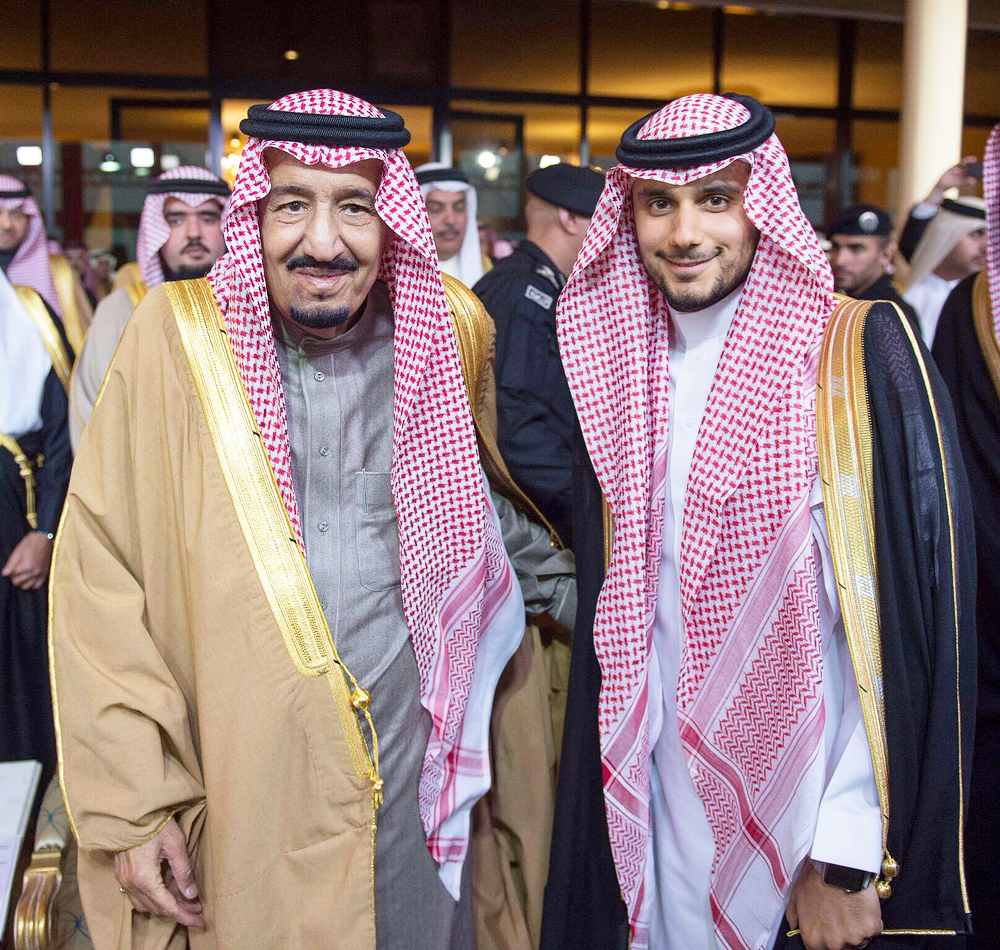


Prince Khaled with King Salman

Prince Khaled has much more on his agenda, focusing on causes where he can make a difference such as “climate change, sustainability and animal welfare,” he said.

With KBW Ventures, he hopes to act as an ambassador to a healthier, more sustainable society.

The prince is also an enthusiastic humanitarian and vocal vegan, who has chosen to apply his beliefs to his lifestyle first.

“I started as a vegetarian many years ago and gradually transitioned my lifestyle completely; I’ve talked extensively about the health benefits and I think if people even adopt reducetarian measures it is great for the planet and for overall health and wellbeing.”

He said that at this point, maintaining a healthy lifestyle is no longer an option but a necessity. “I really feel the need to incorporate physical activity into my day and it’s matched with clean eating. No matter how busy you are, your health is the most necessary aspect as obviously if that isn’t a priority things fall apart very quickly. I work out daily and I eat well; that’s what fuels me to do what I do.

He has noticed the onslaught of GCC individuals going plant-based. He thinks that they are motivated by a combination of factors: the desire to live healthier and to live more humanely, in terms of being kinder to animals and reducing our damage to the earth. He is fully supportive of the General Sports Authority Chairman Prince Abdul Aziz bin Turki Al-Faisal with its mission of promoting mass sports participation and working on educating the health care system and citizens in general. “I’m not naïve enough to think the world is going to go vegan, it is not practical. Saudi is a very meat-centric culture; for the Saudi health problems of obesity and heart-related issues, I really encourage everyone to try a reducetarian diet by incorporating more fresh vegetables, legumes, basically just expand your eating horizons.”


Saudi Humane Society 

Prince Khaled’s latest move on a very resolute chessboard is taking on the role of the presidency at the Saudi Humane Society (Rifq, or SHS) in January 2019. He told Arab News: “I happily accepted the role as I believe I can add value there.”

Acting as one of the first NGOs in Saudi, SHS was dormant for the past few years, he said. Under his leadership, SHS now has two, five and 10-year goals across various tenets. 

SHS will be introducing TNR [Trap-Neuter-Release] programs, as some Saudi cities have issues with strays. 

“This issue wasn’t dealt with humanely in the past, and the important thing is that moving forward we work toward preventing these incidents from happening again. 

The Minister of Municipal and Rural Affairs, HE Eng. Abdullatif bin Abdulmalik Al-Sheikh, banned animal poisoning; a noteworthy first step in the right direction, followed by TNR.”

SHS will also work with the Convention on International Trade in Endangered Species of Wild Fauna and Flora (CITES), on the legislation to prevent the import of exotic animals, as well as with other organizations to deal with exotic animals in Saudi and returning them to the wild.

“We’ll be collaborating with the government on recommendations on how to best operate the sanctuaries, introduce animals back into the wild, and also educate the public on the importance and absolute necessity of biodiversity,” he said.

SHS also led a campaign recruiting young volunteers in different regions of the Kingdom to participate in rescuing animals. Prince Khaled is a firm believer in the youth’s effect on the advancement of society.

“Activating our youth across everything we do is how we really activate Saudi, whether it is for animal welfare or for our work with health and wellness. There has been a slew of volunteers coming to donate their time, effort and their emotion to these animals. We are so blessed to have a relationship with these people, they’re passionate and they really care. They will work on a TNR program in Madina, starting from the university in Taibah where they’ll trap, neuter then relocate the animals in other areas.”

Decoder

Trap-Neuter-Release

A program that traps stray cats, spays or neuters them, and then returns them to where they were found or, if the place isn’t secure, relocates them to a better home.


Saudi Arabia’s $346 million lifeline for Yemen

Updated 20 sec ago
Follow

Saudi Arabia’s $346 million lifeline for Yemen

  • New SR 1.3 billion package targets salaries, liquidity shortages and state stability at pivotal moment for Aden government
  • Economic backing reinforces reform momentum and positions security as a foundation for Yemen’s long-term recovery

LONDON: When Riyadh announced on Wednesday a new SR 1.3 billion ($346.6 million) package to support Yemen’s government budget, salaries, and operational costs, it underscored more than a financial gesture. It reaffirmed a steady doctrine: diplomacy through economic stabilization.
Saudi Arabia’s military and humanitarian engagement in Yemen has long drawn global attention. Yet its economic role — through direct budgetary support, deposits, and large development projects — has been equally central to shaping the country’s fragile path toward recovery.
The latest aid signals Riyadh’s conviction that fiscal stability underpins enduring political and security progress.
The Kingdom has rolled out numerous economic and humanitarian initiatives in recent years.
Project Masam, a Saudi-funded demining program launched in June 2018 under KSrelief and in partnership with Yemen’s Executive Mine Action Center, has cleared more than 450,000 explosive devices.
In September 2025, KSrelief and the UN migration agency, IOM, launched two $4.45 million projects: one replacing costly water trucking in Ma’rib with permanent water systems and the other rehabilitating education facilities in Aden, Lahj, and Taiz for conflict-affected communities.
This builds on the Saudi Program for Development and Reconstruction of Yemen’s portfolio of hundreds of infrastructure projects spanning education, health, water, energy, transport, agriculture, fisheries, and governance capacity-building, offering a lifeline to millions amid what the UN has often called the world’s worst humanitarian crisis.
Yet this directive, guided by the Saudi leadership and channeled through the SDRPY, comes at a turning point for Yemen’s governance.
Fresh from recent leadership changes, the country faces acute economic strain. Public institutions grapple with severe liquidity shortages and salary arrears that threaten to erode what little trust remains in the state.
The SDRPY package is intended to strengthen economic, financial and monetary stability, enhance government capacity, improve governance and transparency, and empower the private sector to drive sustainable growth.
With a gross domestic product of just $19-20 billion, ranking roughly 125th in the world, the package is designed to kickstart Yemen’s derelict economy and break the vicious cycle whereby collapse fuels aid dependency, rendering the state all but ungovernable.
“There is no doubt that the recent Saudi support to the Yemeni government comes at an important time, following the formation of the new government headed by Dr. Shaea Al‑Zandani and its return to the interim capital Aden to manage affairs from within the country,” Gulf analyst Abdulhadi Al-Habtoor told Arab News.
“As Saudi Defense Minister Prince Khalid bin Salman announced, the support is meant to cover operational expenses and salaries, responding to the urgent needs of the Yemeni government.
“In my view, this assistance will also help the government continue the economic reforms it began in the past period, with a focus on transparency, combating corruption, and unifying state revenues under the Yemeni central bank.”
Yemen’s public payroll — the lifeline of any society — has nearly collapsed. Teachers, soldiers, medical staff, and administrative workers in government-controlled areas have gone months without pay.
Even when salaries do arrive, rampant depreciation of the Yemeni rial has eroded their value, forcing families to borrow money, sell belongings, or skip meals to survive.
Economically, the package targets Yemen’s gravest structural challenge: the inability to pay around half a million civil servants regularly.
Saudi officials said the funds will bolster the salary component of Yemen’s budget, ensure consistent disbursements, and lay the foundations for long-term financial stability.
“Yemen remains Saudi Arabia’s top regional priority,” Salman Al-Ansari, a Saudi geopolitical researcher, told Arab News. “Saudi Arabia is the world’s largest humanitarian and development partner to Yemen, providing more than $20 billion in support over the past decade.
“More than two million Yemenis live and work in the Kingdom, reflecting the deep human ties between our peoples. Paying salaries to our brothers and sisters in Yemen is only one part of a broader Saudi commitment to help Yemenis rebuild their lives and restore stability.”
The implications stretch beyond payroll. By circulating liquidity across Yemen’s regions, the package aims to restore purchasing power, stabilize household incomes, and revive confidence in local markets.
Over time, this could reactivate small businesses, strengthen supply chains, and weaken parallel economies run by militias and informal networks — bringing a semblance of normalcy to a country where despair once seemed all-consuming.
“We should also not forget that this Saudi support came after the recent events in eastern Yemen (Hadramout and Al‑Mahra) and the unrest caused there by the Southern Transitional Council before its dissolution — developments that negatively affected the living conditions of residents,” said Al-Habtoor.
“This latest support is expected to restore normalcy across the liberated provinces, reinforce the unity of the legitimate government’s ranks, and strengthen efforts to confront the Houthi terrorist group, which still controls the Yemeni capital, Sana’a.”
Riyadh’s approach stands out for its continuity.
Since 2012, Saudi Arabia has injected an estimated $12.6 billion in economic assistance to Yemen — through deposits at the central bank, monetary transfers, and direct grants — to avert fiscal collapse and curb the inflationary spiral that has undermined local governance.
The aid aligns with the Kingdom’s core regional narrative: security and development are inseparable.
Saudi Defense Minister Prince Khalid bin Salman recently emphasized that Riyadh’s support “embodies the Kingdom’s commitment to strengthening security and stability and contributing to building a better future for Yemen and its people.”
This logic has shaped much of Saudi Arabia’s current strategy in Yemen: prioritizing gradual economic rehabilitation — through liquidity support and targeted projects — over grand reconstruction pledges.
The Defense Ministry’s statement in January that Saudi Arabia had launched 28 developmental projects worth SR 1.9 billion across key sectors including health, energy, and education solidified this integrated approach: stabilizing essential services while re‑energizing public infrastructure.
In Yemen, such measures carry profound social and political weight. Regular salaries and operational funding signal legitimacy, keeping public employees connected to the state apparatus and preventing the hollowing out of governance.
In a landscape long defined by fractured authority, financial continuity becomes a simple act of state‑building.
Critics, however, note that the scale of need dwarfs the amount of aid. Yemen’s economy — operating at a fraction of pre-conflict capacity amid oil export blockades, inflation spikes, and declining donor support — is projected to have shrunk 1.5 percent in real GDP in 2025 and remains institutionally divided.
Yet, from Riyadh’s perspective, short‑term stabilization must precede structural change, a philosophy that echoes its domestic economic doctrines alike, where fiscal buffers unlock diversification.
The $346 million support, then, functions on two intertwined fronts: a humanitarian lifeline for millions facing wage insecurity, and a geopolitical anchor preserving Yemen’s sovereignty against further collapse.
Analysts view it as calibrated diplomacy: less transactional relief, more sustained leadership in a volatile neighborhood vital to Saudi interests.
As Yemen navigates yet another uncertain year, Saudi Arabia’s latest support may not solve the crisis, but it reiterates a principle increasingly central to Riyadh’s foreign policy: that economic endurance is the cornerstone of security.