

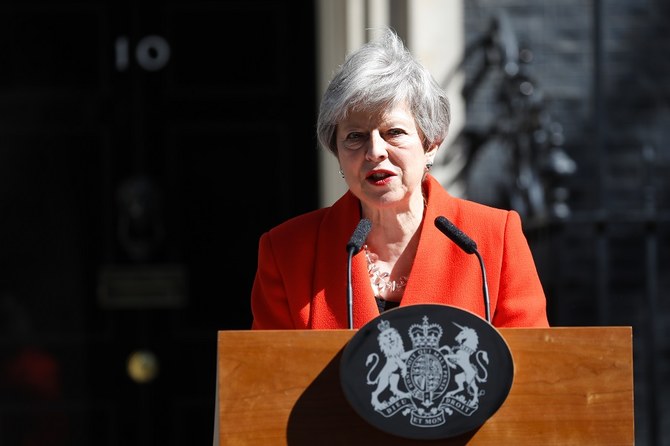

LONDON: Theresa May announced Friday that she will step down as U.K. Conservative Party leader on June 7, admitting defeat in her attempt to take Britain out of the European Union and sparking a contest to become the country's next prime minister.
She will stay as caretaker prime minister until the new leader is chosen, a process likely to take several weeks. The new Conservative leader will become prime minister without the need for a general election, and will take up the task of trying to secure Britain's exit from the EU.
Her voice breaking, May said in a televised statement outside 10 Downing St. that she would soon be leaving a job that it has been "the honor of my life to hold."
May became prime minister the month after Britons voted in June 2016 to leave the European Union, and her premiership has been consumed by the attempt to deliver on that verdict.
Now she has bowed to relentless pressure from her party to quit over her failure to take Britain out of the EU on the scheduled date of March 29. Britain is currently due to leave the EU on Oct. 31, but Parliament has yet to approve divorce terms.
--------
RELATED: TIMELINE: Theresa May's three tumultuous Downing Street years
--------
"I feel as certain today as I did three years ago that in a democracy, if you give people a choice you have a duty to implement what they decide," May said.
"I have done my best to do that. ... But it is now clear to me that it is in the best interests of the country for a new prime minister to lead that effort."
US President Donald Trump told reporters on the White House lawn, “I feel badly for Theresa. I like her very much. She is a good woman,”
“She’s a good woman. She worked very hard. She’s very strong.”
Multiple contenders are already jockeying to replace her and take up the challenge of securing Britain's EU exit. The early front-runner is Boris Johnson, a former foreign secretary and strong champion of Brexit.
Conservative lawmakers increasingly see May as an obstacle to Britain's EU exit, although her replacement will face the same issue: a Parliament deeply divided over whether to leave the EU, and how close a relationship to seek with the bloc after it does.
May spent more than a year and a half negotiating an exit agreement with the EU, only to see it rejected three times by Britain's Parliament.
Pressure on May reached breaking point this week as House of Commons Leader Andrea Leadsom quit and several Cabinet colleagues expressed doubts about the bill she planned to put before Parliament in a fourth attempt to secure Parliament's backing for her Brexit blueprint.
Leadsom, another likely contender to replace May, joined colleagues in paying tribute to the departing leader. She tweeted that May's "dignified speech" had been "an illustration of her total commitment to country and duty. She did her utmost, and I wish her all the very best."
Johnson, whose relentless criticism helped push May out of the door, tweeted: "Thank you for your stoical service to our country and the Conservative Party. It is now time to follow her urgings: to come together and deliver Brexit."
A very dignified statement from @theresa_may. Thank you for your stoical service to our country and the Conservative Party. It is now time to follow her urgings: to come together and deliver Brexit.
— Boris Johnson (@BorisJohnson) May 24, 2019
But Johnson, or any other successor, will face a tough challenge to unite a country and a Parliament still deeply divided over the country's relationship with Europe.
The next British leader is likely to be a staunch Brexiteer, who will try to renegotiate the divorce deal, and if that fails to leave the bloc without an agreement on departure terms.
Most businesses and economists think that would cause economic turmoil and plunge Britain into recession. Parliament has voted to rule out a no-deal Brexit, though it remains the legal default option.
European Commission President Jean-Claude Juncker praised May as "a woman of courage" for whom he has great respect.
EU spokeswoman Mina Andreeva said Juncker will "equally respect and establish working relations" with any new British leader.
But the bloc insists it will not renegotiate the Brexit deal.
Dutch Prime Minister Mark Rutte tweeted that the "agreement reached between the EU and the United Kingdom for an ordered Brexit remains on the table."
Angela Merkel's spokeswoman, Martina Fietz, said the German chancellor noted May's decision "with respect" and would continue to work closely with her successor for "an orderly exit."
In an emotional departure speech, with close aides and her husband Philip looking on, May said she was Britain's "second female prime minister but certainly not the last."
She said she was leaving "with no ill-will, but with enormous and enduring gratitude to have had the opportunity to serve the country I love."


