Bahrain says conference co-hosted with US aimed at helping Palestinians

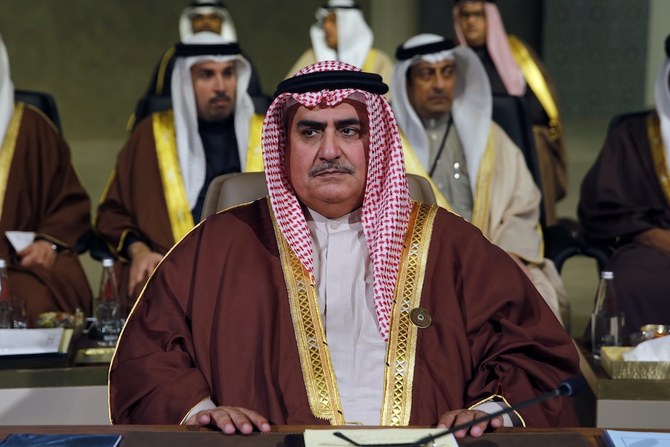
Bahrain’s foreign minister, Sheikh Khalid bin Ahmed Al-Khalifa, defended his country’s decision to host a White House-engineered summit to address the Israeli-Palestinian crisis, saying Bahrain’s only objective is to support the “brotherly Palestinian people.” (File/AP)
Updated 21 May 2019
Follow

Bahrain says conference co-hosted with US aimed at helping Palestinians

DUBAI: Bahrain said Tuesday a peace conference it is co-hosting next month with the US is aimed at helping the Palestinians, who have criticized the kingdom for failing to consult them about the event.
The conference “serves no other purpose” than to help the Palestinian people “through developing their abilities and enhancing their resources,” said Foreign Minister Khalid bin Ahmed Al-Khalifa.
The kingdom “remains supportive of the brotherly Palestinian people in restoring their legitimate rights on their land as well as establishing an independent state with east Jerusalem as its capital,” Bahrain’s top diplomat said in a statement.
The White House announced Sunday it would co-host the June 25-26 conference with Bahrain focusing on economic aspects of the long-delayed US peace plan, with the declared aim of achieving Palestinian prosperity.
“We were not consulted by any party on the announced meeting to take place in Manama, Bahrain,” Saeb Erekat, secretary general of the Palestine Liberation Organization, said in a statement.
“We have not mandated any party to negotiate on our behalf.”
The Palestinians have boycotted the US administration since President Donald Trump broke with decades of consensus and recognized Jerusalem as Israel’s capital in December 2017.
They consider the eastern part of the city the capital of their future state and have shown little interest in the US peace plan, which they fear will be heavily biased in favor of Israel.
Dubbed “Peace for Prosperity,” the conference is expected to bring together leaders from several governments, civil society and the business sector.
Trump’s office said the conference was a “pivotal opportunity... to share ideas, discuss strategies, and galvanize support for potential economic investments and initiatives that could be made possible by a peace agreement.”
The Palestinians see this as offering financial rewards in exchange for accepting ongoing Israeli occupation.
“Attempts at promoting an economic normalization of the Israeli occupation of Palestine will be rejected,” Erekat said.


Turkish and Greek leaders set for talks on migration, maritime borders

Updated 4 sec ago
Follow

Turkish and Greek leaders set for talks on migration, maritime borders

  • Fifteen migrants died in a shipwreck off the Greek island of Chios last week after their boat collided with a Greek coast guard vessel and sank in the Aegean Sea off the Turkish coast
ANKARA: Turkish President Tayyip Erdogan ‌will host Greek Prime Minister Kyriakos Mitsotakis on Wednesday for talks likely to focus on migration and longstanding maritime disputes, as the ​NATO allies and historic rivals try to build on warming ties.
Fifteen migrants died in a shipwreck off the Greek island of Chios last week after their boat collided with a Greek coast guard vessel and sank in the Aegean Sea off the Turkish coast.
Mitsotakis will be accompanied by ministers responsible for foreign affairs, finance, ‌development and migration, ‌Greek officials said.
Developments in the Middle ​East, ‌Iran ⁠and ​Ukraine, migration, trade ⁠and organized crime are also likely to be on the agenda.
Greek Foreign Ministry spokeswoman Lana Zochiou said on Tuesday the aim was “to assess the progress of bilateral cooperation” and “to keep communication channels open to defuse any potential crises.”
Turkiye is a transit country for migrants seeking to ⁠reach the European Union via Greece. Ankara ‌says the EU has not ‌fully delivered on commitments under a ​2016 migration deal and ‌Athens wants Turkiye to do more to curb irregular ‌crossings.
Despite a thaw in rhetoric since a 2023 declaration on friendly relations, the neighbors are at odds over maritime boundaries in the Aegean, an area widely believed to hold energy resources ‌and with implications for airspace and military activity.
Ankara said last month it had issued ⁠a maritime ⁠notice urging Greece to coordinate research activities in areas of the Aegean that Turkiye considers part of its continental shelf.
Greece’s foreign minister had said Athens planned to extend its territorial waters further, including potentially in the Aegean.
In 1995, Turkiye’s parliament declared a casus belli — a cause for war — should Greece unilaterally extend its territorial waters beyond six nautical miles in the Aegean, a stance Athens says violates international maritime law. Greece says it wants ​only to discuss ​demarcation of maritime zones.