Pompeo says ‘quite possible’ Iran behind Gulf attacks

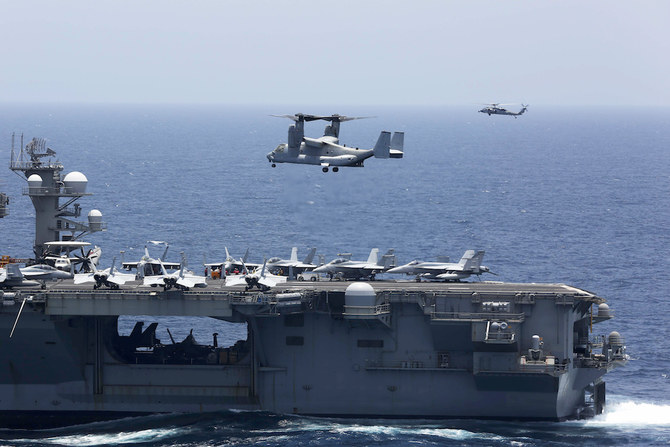
An MV-22 Osprey prepares to land on the aircraft carrier USS Abraham Lincoln last week after being deployed to the region in response to the threat from Iran. (US Navy)
Updated 23 May 2019
Follow

Pompeo says ‘quite possible’ Iran behind Gulf attacks

  • US response had made an impact but warned of continued risks, Pentagon warns
  • Sabotage of oil tankers off UAE and drone strikes on Saudi crude pipeline still being investigated

WASHINGTON: President Donald Trump's administration charged Tuesday it was "quite possible" Iran was responsible for sabotage of Gulf oil interests but said its robust response had stopped potential attacks on Americans.
Secretary of State Mike Pompeo said the United States has not made "a definitive conclusion" that can be presented publicly over sabotage incidents of oil tankers off the UAE or drone strikes on a crude pipeline in Saudi Arabia.
"But given all the regional conflicts that we have seen over the past decade and the shape of these attacks, it seems like it's quite possible that Iran was behind these," Pompeo told a US radio show before heading to Congress.
"Most importantly, we will continue to take acts that protect American interests and that work to deter Iran from misbehavior in the region, which has the real risk of escalating the situation such that crude oil prices rise," he said.
Yemen's Houthi militants, who are allied with Iran and are being hit hard by Arab coalition airstrikes, claimed responsibility last week for a drone strike on a major east-west pipeline in the Kingdom, which was forced to shut down temporarily.
John Bolton, Trump's hawkish national security adviser, earlier this month warned of "unrelenting force" if Iran strikes US interests as he announced the deployment to the region of an aircraft carrier strike group, followed by nuclear-capable B-52 bombers.

Top Trump officials delivered a classified briefing to the full Congress, where rival Democrats have accused the administration of hyping intelligence and pushing the United States dangerously close to war.

The US defense chief said Trump's administration was seeking to deter Iran but not start a war, after he took part in the briefing.
"This is about deterrence, not about war. We are not about going to war," Acting Defense Secretary Patrick Shanahan told reporters after exiting the closed-door meeting with Pompeo.
"We have deterred attacks based on reposturing of assets, deterred attacks against American forces," Shanahan said. "Our biggest focus at this point is to prevent Iranian miscalculation. We do not want the situation to escalate."
Pompeo said that he and Shanahan placed Iranian actions within the context of "40 years of terrorist activity," since the 1979 Islamic revolution.
The briefing did not satisfy many of the Democrats, who say that the heightened tensions are the results of the Trump administration's shunning of diplomacy.
"I worry very much that, intentionally or unintentionally, we can create a situation in which a war will take place," Senator Bernie Sanders, an independent running for the Democratic presidential nomination, said


Syria Kurds chief says ‘all efforts’ being made to salvage deal with Damascus

Updated 25 December 2025
Follow

Syria Kurds chief says ‘all efforts’ being made to salvage deal with Damascus

  • Abdi said the Syrian Democratic Forces (SDF), the Kurds’ de facto army, remained committed to the deal
  • The two sides were working toward “mutual understanding” on military integration and counter-terrorism

DAMASCUS: Syrian Kurdish leader Mazloum Abdi said Thursday that “all efforts” were being made to prevent the collapse of talks on an agreement with Damascus to integrate his forces into the central government.
The remarks came days after Aleppo saw deadly clashes between the two sides before their respective leaders ordered a ceasefire.
In March, Abdi signed a deal with Syrian President Ahmed Al-Sharaa to merge the Kurds’ semi-autonomous administration into the government by year’s end, but differences have held up its implementation.
Abdi said the Syrian Democratic Forces (SDF), the Kurds’ de facto army, remained committed to the deal, adding in a statement that the two sides were working toward “mutual understanding” on military integration and counter-terrorism, and pledging further meetings with Damascus.
Downplaying the year-end deadline, he said the deal “did not specify a time limit for its ending or for the return to military solutions.”
He added that “all efforts are being made to prevent the collapse of this process” and that he considered failure unlikely.
Abdi also repeated the SDF’s demand for decentralization, which has been rejected by Syria’s Islamist authorities, who took power after ousting longtime ruler Bashar Assad last year.
Turkiye, an important ally of Syria’s new leaders, sees the presence of Kurdish forces on its border as a security threat.
In Damascus this week, Turkish Foreign Minister Hakan Fidan stressed the importance of the Kurds’ integration, having warned the week before that patience with the SDF “is running out.”
The SDF control large swathes of the country’s oil-rich north and northeast, and with the support of a US-led international coalition, were integral to the territorial defeat of the Daesh group in Syria in 2019.
Syria last month joined the anti-IS coalition and has announced operations against the jihadist group in recent days.