

At Cannes, Syrian docu filmmaker highlights Assad regime’s continuing attacks on hospitals 

1 / 6
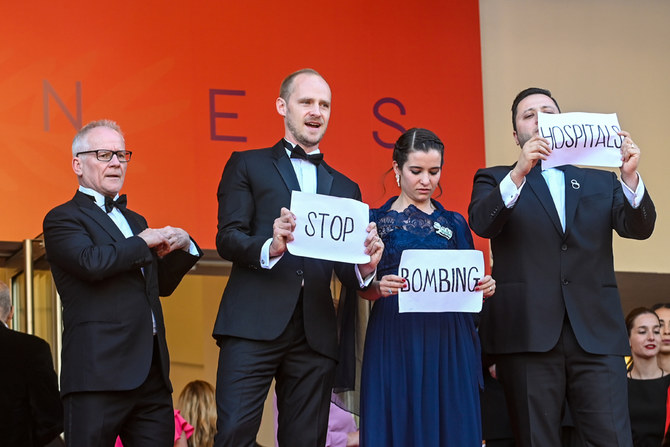
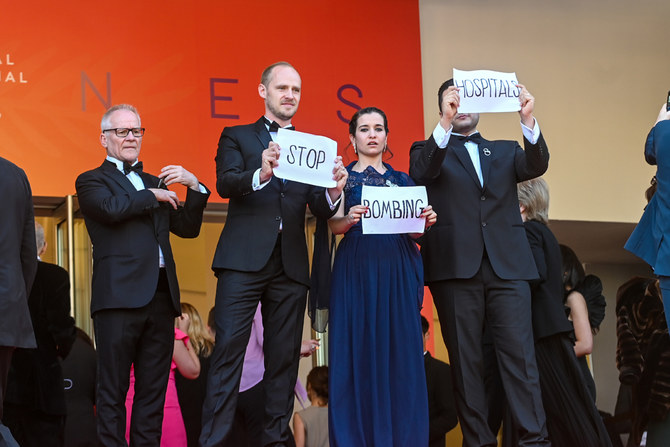
Waad Al-Kateab and her colleagues stage a poster protest against the Syrian regime's excesses on the sidelines of the Cannes Film Festival in Cannes, France, on Wednesday. (Ammar Abd Rabboo/Arab News)
2 / 6
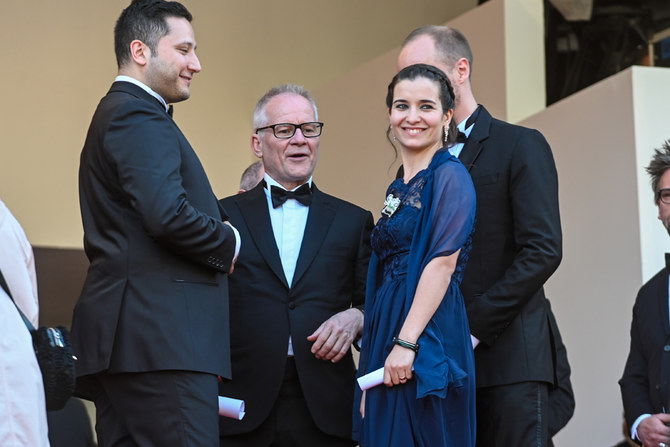
Waad Al-Kateab and her colleagues stage a poster protest against the Syrian regime's excesses on the sidelines of the Cannes Film Festival in Cannes, France, on Wednesday. (Ammar Abd Rabboo/Arab News)
3 / 6
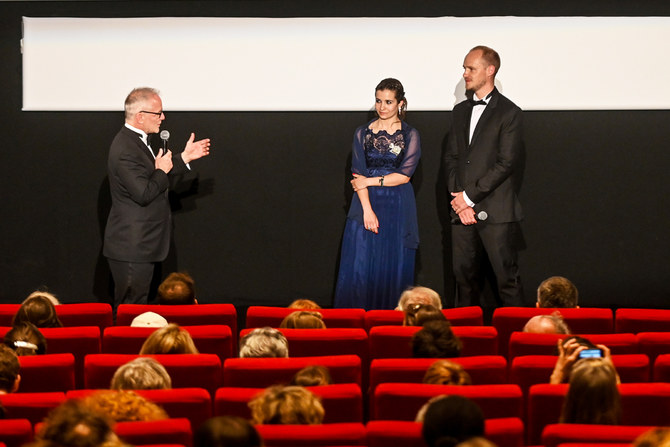
Waad Al-Kateab and her colleagues stage a poster protest against the Syrian regime's excesses on the sidelines of the Cannes Film Festival in Cannes, France, on Wednesday. (Ammar Abd Rabboo/Arab News)
4 / 6
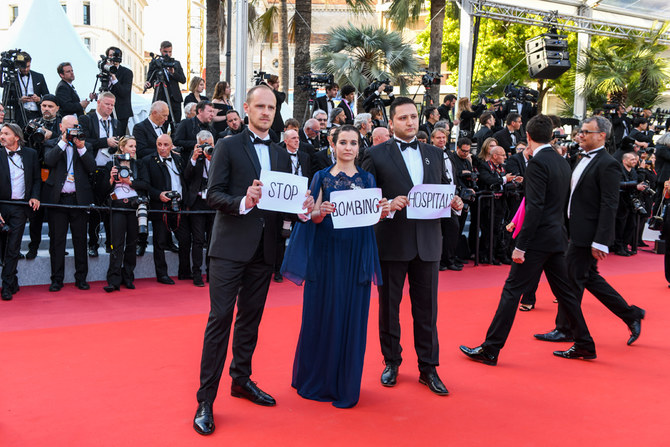
Waad Al-Kateab and her colleagues stage a poster protest against the Syrian regime's excesses on the sidelines of the Cannes Film Festival in Cannes, France, on Wednesday. (Ammar Abd Rabboo/Arab News)
5 / 6
Waad Al-Kateab and her colleagues stage a poster protest against the Syrian regime's excesses on the sidelines of the Cannes Film Festival in Cannes, France, on Wednesday. (Ammar Abd Rabboo/Arab News)
6 / 6
Waad Al-Kateab and her colleagues stage a poster protest against the Syrian regime's excesses on the sidelines of the Cannes Film Festival in Cannes, France, on Wednesday. (Ammar Abd Rabboo/Arab News)
Updated 16 May 2019
Follow

At Cannes, Syrian docu filmmaker highlights Assad regime’s continuing attacks on hospitals 

  • Syrian docu film maker highlights systematic destruction of hospitals by Assad regime at Cannes
  • Waad Al-Kateab documentary film "For Sama" is considered among the "rising stars" to watch for at the annual film festival

JEDDAH: Arab documentary maker Waad Al-Kateab led a protest on the sidelines of the Cannes Film Festival Wednesday to highlight the Assad regime's continuing attacks on hospitals in Syria.
The film director and her colleagues posed with protest posters on the red carpet calling on the Syrian regime to stop its systematic destruction of medical facilities in opposition-held areas.
"Stop bombing hospitals," the posters screamed.
Al-Kateab is in Cannes where her documentary film "For Sama" is considered among the "rising stars" to watch for at the annual film festival.
“For Sama” records five years of Al-Kateab’s own life as an aspiring journalist in her besieged hometown of Aleppo, marrying one of the last doctors in the city and giving birth to her daughter, to whom the film is dedicated.
The documentary is a kind of letter to the little girl, explaining how she was born into the conflict and what happened to her home.
Al-Kateab, who now lives in London, won an Emmy award in 2017 for her films from inside Aleppo for Britain’s Channel 4 News, which are believed to be the most watched of any reports from the war.
Her shocking footage of the struggle to save babies and children in the city’s final hospital — in which she ended up living — brought home the horror inflicted on civilians.
The Syrian government had been accused of attacking hospitals starting in 2012 as the "Arab Spring" style peaceful protests, which began in 2011, degenerated into a civil war after dictator Bashir Al-Assad opted to fight it to cling to power.
Amnesty International documented "more than 300 attacks on medical facilities by Syrian and Russian forces" in 2015 alone.
In 2016, the Syrian American Medical Society recorded 252 attacks on Syrian health care centers, among them a facility run by the Medicins Sans Frontieres (Doctors Without Borders), which was hit in an airstrike in the morning of February 15, leaving 25 people dead, including nine health care workers and five children.
An article on Wikipedia compiled numerous incidents of attacks on Syrian hospitals, citing various news reports, and put the blame of Syrian and Russian forces. Moscow and Damascus officials have repeatedly denied deliberately targeting medical facilities.

The war in Syria has killed more than 370,000 people and displaced millions since it started with the brutal repression of anti-government protests in 2011.
 

(With AFP)


‘Palestine 36’ set for Saudi cinemas this week

Updated 23 sec ago
Follow

‘Palestine 36’ set for Saudi cinemas this week

DUBAI: Filmmaker Annemarie Jacir’s “Palestine 36,” which screened at Jeddah’s Red Sea International Film Festival, is scheduled for release in Saudi cinemas on Thursday.

The sweeping historical epic — Palestine’s official entry to the Oscars this year, which made it to the official longlist — is a deep exploration of resistance, resilience and the struggle of the Palestinian people. 

“Palestine 36” is set during the 1936 Arab Revolt and follows five interconnected narratives as villages across Palestine confront British colonial rule.

With rising numbers of Jewish immigrants escaping antisemitism in Europe, and the Palestinian population uniting against Britain’s 30-year dominion, all sides spiral toward inevitable collision in a decisive moment for the British Empire and the future of the entire region. 

The film won the Best Film award at the Tokyo International Film Festival.

Jacir — whose three previous feature films “Salt of this Sea,” “When I Saw You,” and “Wajib” were also official Palestinian Oscar entries — hopes “Palestine 36” will provide a mirror for audiences, particularly those from colonized or war-affected countries.  

“I hope people see themselves in the film,” she told Arab News in December. “I don’t want to teach anyone anything. There’s a lot of history in the film and there’s a lot of history that’s been erased. I hope that’s something that comes through.” 

The film features an ensemble cast, including Oscar-winner Jeremy Irons, “Game of Thrones” star Liam Cunningham, and Tunisian actor Dhafer L’Abidine, alongside Palestinian talents Hiam Abbass, Yasmine Al-Massri, Kamel El Basha, and Saleh Bakri.

At the Red Sea International Film Festival premiere of the film in December, Jacir walked the red carpet with Palestinian Jordanian designer Reema Dahbour, who dressed the director for the event.

Dahbour created a custom piece titled “From the River to the Sea,” which she described on social media as “a dress born from our narrative, our symbols, and our enduring connection to the land. A garment that mirrors the spirit showcased so powerfully in the film.”