

KAUST’s Red Sea Farms closes $1.9m investment

Red Sea Farms is uniquely positioned to serve the growing food security needs of the Middle East.
Updated 14 May 2019
Follow

KAUST’s Red Sea Farms closes $1.9m investment

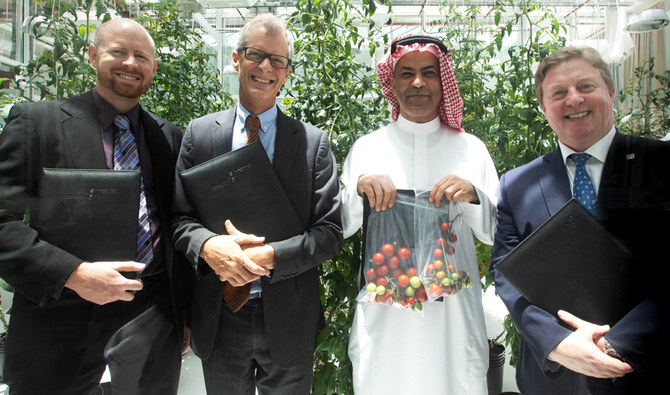
Red Sea Farms, an agriculture technology spinout company from King Abdullah University of Science and Technology (KAUST) specializing in saltwater greenhouse technology, has secured $1.9 million of co-investment from the KAUST Innovation Fund and Research Products Development Co. (RPDC). 

Red Sea Farms is uniquely positioned to serve the growing food security needs of the Middle East. A combination of irrigation water scarcity and hot, arid lands are constant barriers to the region’s ability to achieve agricultural self-sufficiency. 

For Red Sea Farms co-founder and KAUST professor of plant science, Mark Tester, food security has always been central to his research. “The Middle East is one of the most water-scarce regions of the world. Here we often rely on unsustainable sources of water for irrigation, such as groundwater, which is being rapidly depleted, or desalinated water,” said Tester. 

“Desalinated water requires large amounts of energy to produce which is costly — at least $1 for every cubic meter -— and has a high environmental impact.” 

With its combination of engineering and plant science, Red Sea Farms has developed solutions to grow saltwater-tolerant crops in greenhouses cooled using saltwater. In their saltwater greenhouse, 80 to 90 percent of freshwater is substituted with saltwater, massively reducing both the water and carbon footprint of food production. The result is a system where both fresh water and energy requirements are reduced up to 10-fold.

The seed investment will enable the company to build a 2,000 square meter saltwater greenhouse on the KAUST campus in Saudi Arabia and realize plans to produce 50 tons of tomatoes annually by 2020. Building on six years of research at KAUST, the tomatoes that will be grown have significantly higher salinity tolerance. The resulting crops can be grown using up to 30 percent diluted seawater, which will save further freshwater; it also makes the fruits exceptionally sweet, with higher levels of vitamins and antioxidants. 

The new patent-pending system can be retrofitted to existing greenhouses, allowing for evaporative cooling with saltwater resources to save precious fresh water. The company is aiming to retrofit 5 percent of greenhouses in the Kingdom, offering a return on investment for farmers in less than two years. 

“RPDC and KAUST share common interests in commercializing intellectual property and supporting high-tech startups in Saudi Arabia. This investment marks a shining example of the transition of KAUST academic research to commercial application, with the potential to revolutionize the future of food production in Saudi Arabia and the region,” said Kevin Cullen, vice president of KAUST Innovation and Economic Development.

“RPDC has a strong track record of bringing technology to market in Saudi Arabia and looks forward to supporting Red Sea Farms as they scale,” said Abdulmohsen Almajnouni, RPDC CEO. “Red Sea Farms will use this investment to pilot their saltwater greenhouse cooling technology in the Kingdom. It will also enable them to scale-up their crop production of the saltwater tomatoes.”


LuLu marks Founding Day with ‘Made in Saudi’ campaign

Updated 25 February 2026
Follow

LuLu marks Founding Day with ‘Made in Saudi’ campaign

The Ministry of Industry and Mineral Resources honored LuLu Hypermarket in recognition of its pivotal role as the exclusive retail partner of the “Najoud Bikhairna 2026” initiative, commending its continued efforts in supporting and empowering national industries while showcasing the quality and competitiveness of locally manufactured products.

The initiative, led by the ministry in partnership with the Saudi Export Development Authority, represented by the Made in Saudi program, stands as a pioneering model of public-private sector collaboration in activating community-driven initiatives with sustainable impact. Through this program, more than 280,000 Saudi-made products were distributed to 10,000 families across various regions of the Kingdom during the holy month of Ramadan, reinforcing the presence of national products and strengthening the values of social solidarity among individuals and institutions alike.
The ministry’s recognition of LuLu Hypermarket coincided with the official launch of its Saudi Founding Day celebrations at the Dharat Laban branch in Riyadh, marked by the unveiling of a comprehensive promotional campaign dedicated to Saudi-made products. On this occasion, a wide range of special offers was introduced on local products, available across all LuLu Hypermarket branches throughout the Kingdom.
The inauguration ceremony was attended by Mohammed bin Dayel, general supervisor of the Made in Saudi program at the Saudi Export Development Authority, and Mohamed Haris, director of LuLu Saudi Arabia, alongside members of LuLu’s executive management team. The event featured a ribbon-cutting ceremony to officially open the specially designed Founding Day gateway.
Following the inauguration, guests toured several dedicated zones and exhibitions highlighting national products. The tour commenced at the grocery and “Made in Saudi” consumer goods sections, showcasing the diversity and quality of local brands. It also included the “Made in Saudi” dates pavilion, presenting a premium selection of the finest locally sourced dates in celebration of one of the Kingdom’s most iconic national symbols.
The visit continued to the fruits and vegetables section under the theme “From Our Land,” featuring an exceptional assortment of Saudi agricultural products, reflecting the richness and excellence of the local agricultural sector. Guests also explored the LuLu private label corner, which features products exclusively manufactured within the Kingdom for LuLu, reaffirming the company’s commitment to supporting local manufacturing.
The tour concluded with a presentation of “Made in Saudi” products within the chilled and frozen categories, underscoring the rapid growth and qualitative advancement of the Kingdom’s food manufacturing sector, and further reinforcing the strong market position and competitiveness of Saudi products.