

Saudi envoy launches Ramadan food aid program in Pakistan

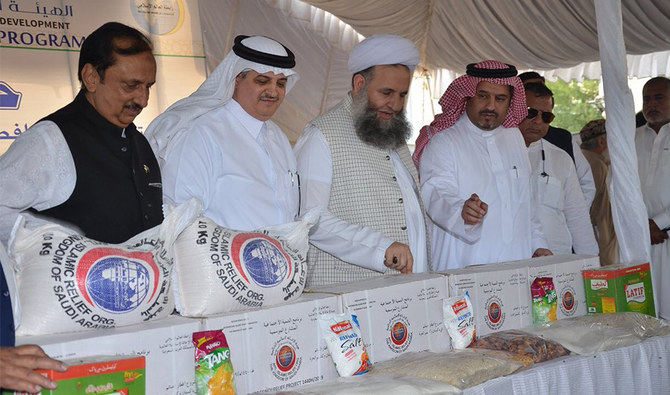
Saudi Ambassador to Pakistan, Nawaf bin Said Al-Malki, along with Pakistan’s Minister of Religious Affairs, Noor-ul-Haq Qadri inaugurated the Muslim World League program – an initiative to distribute food packages across Pakistan. (Saudi Embassy Twitter)
Updated 13 May 2019
Follow

Saudi envoy launches Ramadan food aid program in Pakistan

  • Al-Malki inaugurated the initiative on behalf of the Muslim World League
  • Move to see 4,700 food baskets distributed across the country and Pakistan-administered Kashmir

ISLAMABAD: Saudi Ambassador to Pakistan Nawaf bin Said Al-Malki inaugurated the Muslim World League’s “Iftar Saem” program on Monday, as part of an initiative to distribute food packages to fasting Muslims during the month.
Al-Malki was accompanied by Pakistan’s Minister of Religious Affairs Noor-ul-Haq Qadri for the ceremony.


Saudi Ambassador to Pakistan Nawaf bin Said Al-Malki addresses a gathering. (Saudi Embassy Twitter)

Under the program, 4,700 food baskets will be distributed in the country and Pakistan-administered Kashmir, the Saudi Embassy tweeted on May 10.
The inauguration ceremony was held in Islamabad and is part of the International Organization for Relief, Welfare and Development on behalf of Muslim World League.


Trucks loaded with food packages were also sent to other parts of the country. (Saudi Embassy Twitter)

As an annual feature, the Saudi Embassy in Pakistan hands out Ramadan food packages to the needy in various regions and provinces of the country, while the Saudi government distributes tons of dates during the month.
Fasting during Ramadan is one of the five pillars of Islam, where Muslims abstain from food and drink from sunrise to sunset for a month. This is followed by the sighting of the new moon and is marked by Eid-ul-Fitr, a religious holiday and celebration that is observed by Muslims across the world.


Pakistan’s Punjab launches tech-driven shrimp estates plan with Saudi, UAE expertise

Updated 4 sec ago
Follow

Pakistan’s Punjab launches tech-driven shrimp estates plan with Saudi, UAE expertise

  • Project to include hatcheries, aqua malls, processing plants, cold storage facilities and logistics chain
  • Pakistan’s seafood exports declined in FY 2024, with export value dropping by 17.4 percent to $410 million

ISLAMABAD: The chief minister of Pakistan’s most populous Punjab province this week launched a plan to establish technology-driven shrimp estates in Muzaffargarh and Sargodha by March 2026 with the expertise of Saudi Arabia and the United Arab Emirates (UAE).

The project will include hatcheries, aqua malls, processing plants, cold storage facilities, and an integrated transport and logistics chain. Shrimp estates are designated zones for large-scale shrimp farming and processing, designed to cluster the entire value chain in one location to improve efficiency, biosecurity and export capacity.

"Phase-I will establish 5,300 acres of shrimp estates in Muzaffargarh and Sargodha by March 2026, Insha’Allah," Punjab Chief Minister Maryam Nawaz Sharif said in a post on X on Sunday.

"The initiative is built on global R&D, advanced aquaculture technologies and world-class expertise from the UAE, Saudi Arabia, Thailand, Ecuador, Australia and Mexico," she added.

"The project has been formally launched, with machinery already on the ground and dedicated teams working day and night to ensure timely execution."

Sharif said the development followed the successful completion of a 100-acre shrimp pilot and research project last year, highlighting that a feasibility study is underway for an additional 26,000 acres.

Pakistan’s fish and fishery product exports declined in FY 2024, with export value dropping by 17.4 percent to $410 million and quantity decreasing by 6.9 percent to 199,738 metric tons compared to FY 2023, according to the Pakistan Bureau of Statistics.

The country's 1,046-km coastline along a major trade route remains underutilized, with a maritime economy held back by limited fleets, outdated ports and falling seafood exports.