

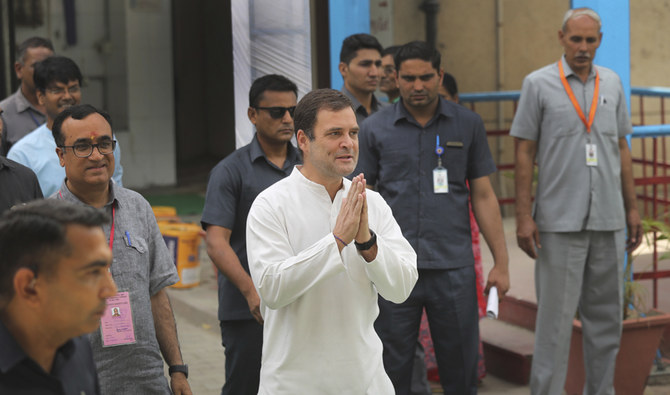

With India voting in the sixth round of elections on Sunday, speculation is rife about the next government in the absence of a clear win for any political party. Both the opposition and the government have started positioning themselves for the next political moves, according to political experts.
On Sunday, 59 constituencies in seven states went to the polls and with this, the voting was completed in 483 out of 543 seats.
The ruling Bharatiya Janata Party (BJP) holds the majority of the seats in states such as Bihar, Uttar Pradesh, Delhi, Haryana, Jharkhand and Madhya Pradesh, where ballots were cast.
The party is facing a resurgent opposition Congress party and the combined might of some of the regional parties in electorally crucial states such as Uttar Pradesh and Bihar.
In 2014, Prime Minister Narendra Modi rode a strong wave of hostility to Manmohan Singh regime. The fragmented opposition in different states gave him an added electoral advantage with the BJP securing 282 seats in the Lower House, a majority which no government in the past three decades had secured.
However, in 2019, the chances of the BJP repeating its performance appears bleak in the changed political landscape. Some of the recent utterances of the party leaders betray nervousness in the BJP.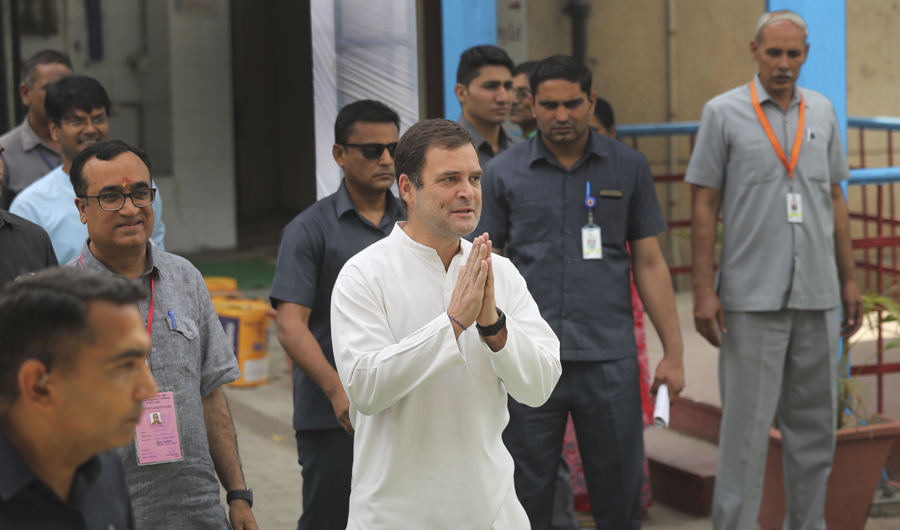
Last week Ram Madhav, a senior general secretary of the party, told the media that “if we get 271 seats (the halfway mark) on our own, we will be very happy.”
He said that with the help of the alliance partners “we will have a comfortable majority.”
Naresh Gujral, a senior leader of Akali Dal, a strong regional ally of the BJP from the northern Indian state of Punjab, said on Friday that “it seems the BJP will not be able to cross the halfway mark on its own this time.”
Congress President Rahul Gandhi said on Sunday that “Narendra Modi used hatred, we (Congress) love. And, I think love is going to win.”
This confidence in the opposition camp stems from the open nervousness displayed by some of the BJP leaders and Modi’s campaign rhetoric, where he constantly shifted from one issue to another and avoided the issue of development, which had been his big selling point.
According to some media reports, more than 20 opposition parties plan to give a signed letter to the president announcing their support for an alternative government if the BJP falls short of a majority.
On May 21, two days before the counting of votes, opposition parties plan to meet and discuss their future course of action in the case of a hung parliament.
Political analyst Prof. Shashi Shekhar, of Delhi University, says that “the chances are high that the BJP would struggle to pass the 200 mark, and even with the alliance it will fall short of the majority.”
“States like Uttar Pradesh, where the BJP won 73 out of 80 seats (last time), and Bihar, where they won 32 out of 40, could deliver a big shock to the party. The murmuring in the ruling party gives a signal,” Shekhar told Arab News.
Dr. Hilal Ahmed, of the Center for the Study of Developing Societies (CSDS), a New Delhi-based think tank on social science, says that “the trend based on the logic of the campaign indicates that there is no wave in the election and the BJP might emerge as a single largest party in the election.”
“In its bastion in the North, Central and Western India, where the BJP got the majority of its seats last time, it is not going to perform well this time. The regional parties are going to do very well, so this is not going to be a battle between the Congress party and the BJP. The regional parties are going to play a major role,” Ahmed told Arab News.
He underlines that “it would be interesting to watch how the institutions like the Election Commission and the office of the President behave after the elections.”
“I feel that the Congress party leadership under Rahul Gandhi is getting more professional. It depends how Congress makes positive configurations with regional parties after the elections.”
The last round of voting takes place on May 19, with counting scheduled to begin on May 23.


