UN monitors Houthi withdrawal from Yemen’s Hodeidah

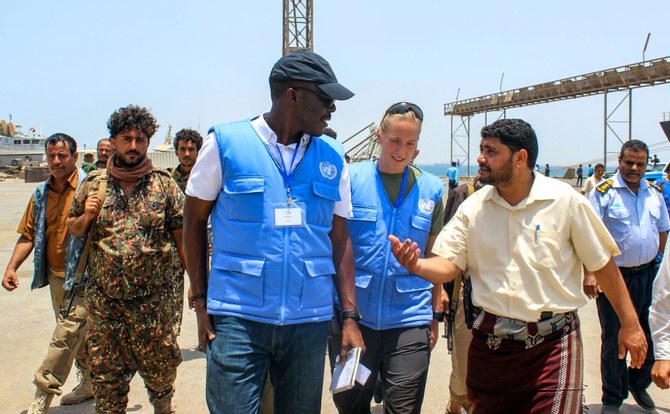
Members of the United Nations observer mission meet with local officials during the Yemeni Houthi withdrawal from Saleef port in the western Red Sea Hodeida province, on May 11, 2019. (AFP)
Updated 12 May 2019
Follow

UN monitors Houthi withdrawal from Yemen’s Hodeidah

  • Yemen's information minister dismissed the Houthis' withdrawal announcement, accusing them of "a policy of deception"
  • The governor of Hodeidah, Al-Hasan Taher, said Saturday the Houthis were merely reshuffling personnel

CAIRO: The UN says it is monitoring the redeployment of Houthi forces from three key ports in Yemen after the government dismissed the withdrawal as a “farce.”
Lt. Gen. Michael Lollesgaard, the head of a UN mission monitoring the cease-fire in Hodeidah, said Sunday that monitors will verify the Houthi withdrawal from the ports of Hodeida, Salif and Ras-Issa on Tuesday.
The Houthis say they began withdrawing on Saturday, in line with a long-delayed agreement reached in in December. Both sides agreed to withdraw from Hodeidah, which handles 70 percent of Yemen’s food imports and humanitarian aid, but remain divided over who will administer the ports after they leave.
The pullback is considered a first step in implementing a hard-won truce agreement for Hodeidah struck in Sweden in December between Yemen's internationally recognised government and the Iran-backed Houthis.
Yemen's information minister dismissed the Houthis' withdrawal announcement, accusing them of "a policy of deception."
"What the Houthi militia did is a repeated theatrical play of handing over control of the port to its own forces (in different uniforms)," Moammer Al-Eryani tweeted.
"This shows its continued manipulation and evasion to implement the Sweden agreement... by adopting a policy of deception."
The governor of Hodeidah, Al-Hasan Taher, said Saturday the Houthis were merely reshuffling personnel.
"The Houthis are staging a new ploy by handing over the ports of Hodeidah, Saleef and Ras Issa to themselves without any monitoring by the United Nations and the government side," said the official.
"This is totally rejected by us, and the agreement must be implemented in full, especially with regards to the identity of the troops that will take over from the Houthis," he added.


UN chief condemns Israeli law blocking electricity, water for UNRWA facilities

Updated 01 January 2026
Follow

UN chief condemns Israeli law blocking electricity, water for UNRWA facilities

  • The agency provides education, health and aid to millions of Palestinians in Gaza, the West Bank, Jordan, Lebanon and Syria

United Nations Secretary General Antonio Guterres condemned on Wednesday a move by Israel to ban electricity or water to facilities owned by the UN Palestinian refugee agency, ​a UN spokesperson said.
The spokesperson said the move would “further impede” the agency’s ability to operate and carry out activities.
“The Convention on the Privileges and Immunities of the United Nations remains applicable to UNRWA (United Nations Relief and Works Agency for Palestine Refugees in the Near East), its property and assets, and to its officials and other personnel. Property used ‌by UNRWA ‌is inviolable,” Stephane Dujarric, spokesman for the ‌secretary-general, ⁠said ​while ‌adding that UNRWA is an “integral” part of the world body.
UNRWA Commissioner General Phillipe Lazzarini also condemned the move, saying that it was part of an ongoing “ systematic campaign to discredit  UNRWA and thereby obstruct” the role it plays in providing assistance to Palestinian refugees.
In 2024, the Israeli parliament passed a law banning the agency from operating in ⁠the country and prohibiting officials from having contact with the agency.
As a ‌result, UNRWA operates in East Jerusalem, ‍which the UN considers territory occupied ‍by Israel. Israel considers all Jerusalem to be part ‍of the country.
The agency provides education, health and aid to millions of Palestinians in Gaza, the West Bank, Jordan, Lebanon and Syria. It has long had tense relations with Israel but ties have deteriorated ​sharply since the start of the war in Gaza and Israel has called repeatedly for UNRWA to ⁠be disbanded, with its responsibilities transferred to other UN agencies.
The prohibition of basic utilities to the UN agency came as Israel also suspended of dozens of international non-governmental organizations working in Gaza due to a failure to meet new rules to vet those groups.
In a joint statement, Canada, Denmark, Finland, France, Iceland, Japan, Norway, Sweden, Switzerland and the United Kingdom said on Tuesday such a move would have a severe impact on the access of essential services, including health care. They said one in ‌three health care facilities in Gaza would close if international NGO operations stopped.