Turkish Airlines’ quarterly loss more than doubles on higher costs

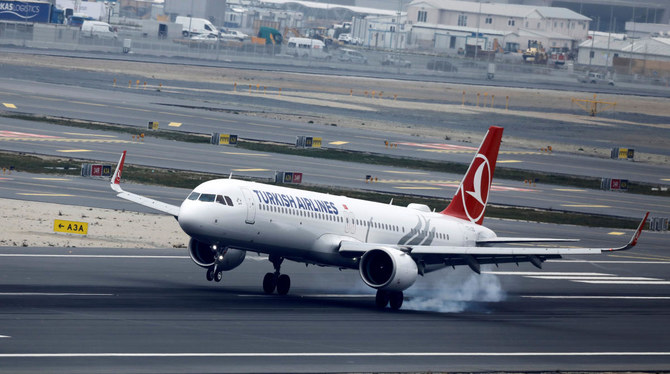
A Turkish Airlines Airbus A321neo plane lands at the city’s new Istanbul Airport. (Reuters)
Updated 10 May 2019
Follow

Turkish Airlines’ quarterly loss more than doubles on higher costs

  • The Turkish flag carrier, which operates flights to 306 destinations in 124 countries, reported a loss of 1.25 billion lira or $229 million in the first quarter
  • The carrier maintained its targets for the year, suggesting an expected recovery in the high season that starts at the end of May

ISTANBUL: Turkish Airlines’ first-quarter losses more than doubled, hit by higher fuel prices and other costs.
The Turkish flag carrier, which operates flights to 306 destinations in 124 countries, reported a loss of 1.25 billion lira or $229 million in the first quarter, compared with a loss of 314 million lira or $86 million in the same period a year earlier.
Analysts said the loss was wider than an average forecast of a 662 million lira loss. That reflected higher oil prices due to currency volatility and increased unit costs due to staff and marketing expenses, analysts said.
“Net loss is even way higher than the lowest estimate in the street,” Yatirim Finansman Securities said in a note, adding a loss on fixed asset sales also weighed on the results.
But the carrier maintained its targets for the year, suggesting an expected recovery in the high season that starts at the end of May, J.P. Morgan said.
The company said it targets revenue of $14.1 billion and an EBITDAR margin of 22-24 percent at the end of this year. It also aims to carry 80 million passengers this year.
The airline moved its hub last month from Istanbul’s old Ataturk Airport to the new Istanbul Airport to the north of the city. Completing the hub move ahead of the high season is expected to help the company achieve its targets, J.P. Morgan said.
Shares in Turkish Airlines were down 1.04 percent in early trade, while the BIST 100 Index was trading almost flat.


King Abdulaziz Airport among world’s busiest after record-breaking 2025

Updated 02 January 2026
Follow

King Abdulaziz Airport among world’s busiest after record-breaking 2025

RIYADH: King Abdulaziz International Airport has achieved a new historical milestone, reaching 53.4 million passengers in a single year.

This is the highest number ever recorded at a Saudi airport since the beginning of air travel in the Kingdom, placing it among the world’s mega airports in terms of passenger traffic, according to the Saudi Press Agency.

The airport handled a total of 310,000 flights and 60.4 million bags, representing a 12 percent increase compared to 2024. It also handled 9.57 million Zamzam water containers and 2,968 cargo flights. 

This achievement reflects the airport’s qualitative transformation and its position as a regional hub and national gateway connecting the Kingdom to the world. It also highlights its role in facilitating the movement of visitors and pilgrims, promoting tourism in line with the goals of Vision 2030, diversifying the economy, and providing a distinguished travel experience. 

For his part, CEO of Jeddah Airports Co. Mazen Johar, affirmed that reaching 53.4 million passengers confirms the airport’s high operational readiness and represents a pivotal milestone for moving to the next phase, in preparation for doubling this number, God willing, in the coming years. 

He pointed out that this national achievement would not have been possible without the grace of God Almighty, followed by the directives of the wise leadership and the continuous follow-up from the minister of transport and logistics, the president of the General Authority of Civil Aviation, and the CEO of Airports Holding Co. 

He explained that King Abdulaziz International Airport is strengthening its position as a major aviation hub in the region through expansions, increased capacity, and improved services, supporting the objectives of the aviation program and aligning with the goals of the Kingdom’s Vision 2030. 

The CEO of Jeddah Airports Co. expressed his gratitude to the partners in success from various government and private sectors for their fruitful cooperation through a collaborative work system that contributed to providing the best services.