ISLAMABAD: Pakistan has informed Iran in writing that it cannot execute the Iran-Pakistan gas pipeline project as long as Tehran is under a United States sanctions regime, a top official at Pakistan’s state-owned Inter State Gas Systems said on Friday, driving a final nail in the coffin of a project that was conceived in the 1990s to connect Iran’s giant South Pars gas field to India via Pakistan.
The US has steadfastly opposed Pakistani and Indian involvement in the $7 billion project, saying it violates sanctions. India quit the project in 2009, citing costs and security issues, a year after it signed a nuclear deal with Washington.
US sanctions against Iran are a major hindrance for most gas pipeline projects in the region. The President Donald Trump administration has warned countries around the world to stop buying Iranian oil or face sanctions of their own. Washington’s European allies have tried and failed to come up with ways to blunt the economic impact of the US move.
“Under present US sanctions on Iran, it is impossible to execute the IP [Iran-Pakistan] gas pipeline project and we have conveyed it to them [Iran] in writing recently,” Mobin Saulat, the managing director of Inter State Gas Systems told Arab News.
The company, which falls under the Pakistani Ministry of Energy’s Petroleum Division, has been mandated by the government to develop natural gas import projects, including the Iran-Pakistan pipeline.
A new round of negotiations was recently launched between Pakistan and Iran after Tehran formally issued a notice to Islamabad in February this year, saying it was moving an arbitration court against Pakistan for failing to lay down the pipeline in Pakistani territory in the timeframe stipulated in the bilateral agreement.
“We have time till August this year to legally respond to Iran’s legal notice and settle the issue through negotiations,” Saulat said. “We are hopeful to find a solution through discussions with Iranian officials.”
Under an agreement signed between the two countries in 2009, the project was to be completed by December 2014 and would deliver 21.5 million cubic meters (760,000 million cubic feet) of gas per day to Pakistan. It was to be constructed using a segmented approach – Iran had to lay down the pipeline on its side and Pakistan was supposed to build the pipeline on its territory.
Under a penalty clause, Pakistan is bound to pay $1 million per day to Iran from January 1, 2015 for failing to build its part of the pipeline. If Iran takes the case to an arbitration court, Pakistan will likely to have to pay billions of dollars as penalty.
Saulat said Pakistan was still committed to executing the project, but only if international sanctions on Iran were lifted.
“We cannot risk US sanctions by going ahead with the project as America has clearly said that anybody who will work with Iran will also be sanctioned,” Saulat said.
He said Iranian authorities were of the view that US sanctions did not apply to the IP gas project, adding that Pakistan had thus sent Tehran a questionnaire to ascertain exactly how that was the case.
“We may not have a weak case if Iran moves the international court,” Saulat said. “We are trying to handle it professionally.”


![]()

Gas pipeline project 'impossible' under US sanctions, Pakistan tells Iran
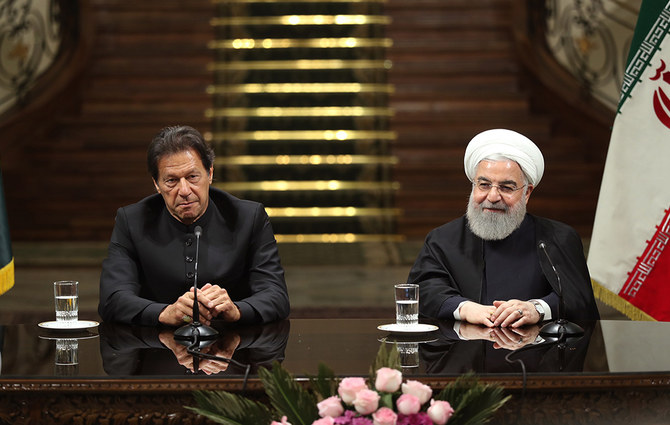
Gas pipeline project 'impossible' under US sanctions, Pakistan tells Iran
- Iran issued notice to Pakistan in February threatening international arbitration over failure to fulfil agreement
- Pakistan may have to pay billions in penalties if Iran goes to court, has until August to respond to Tehran
Latest updates


© 2026 SAUDI RESEARCH & PUBLISHING COMPANY, All Rights Reserved And subject to Terms of Use Agreement.