Even the Taliban danced: Famous Pashto musician Takkar sings once again in Pakistan

1 / 7
This file photo shows Sardar Ali Takkar dedicating a song to Malala Yousafzai during Nobel Peace Prize ceremony in Oslo, Norway, on Dec.10, 2014. (Photo Courtesy: BBC Pashto/Screengrab)
2 / 7
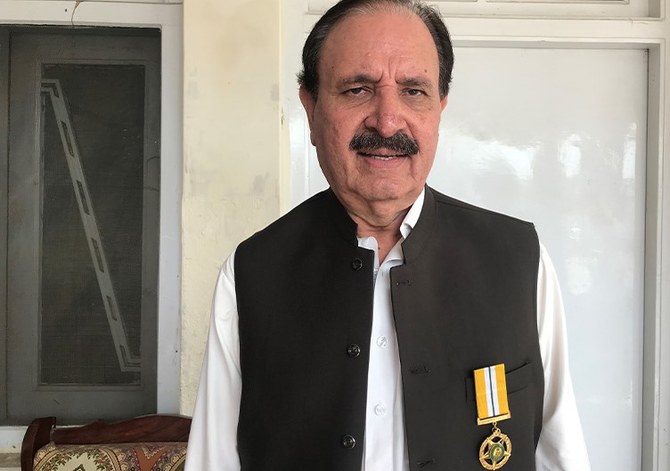
Sardar Ali Takkar at his guesthouse on April 04, 2019 in Peshawar in Pakistan's northwestern Khyber Pakhtunkhwa province. The 62-year-old singer came to Pakistan earlier this year to receive the country's highest civilian award, the Tamgha-e-Imtiaz, for services rendered for Pashto music. A decade ago, Takkar had migrated to Canada and the US with his family following a militant attack in 2009 in which his daughter was injured in Islamabad. (AN Photo)
3 / 7
Sardar Ali Takkar at his guesthouse on April 04, 2019 in Peshawar in Pakistan's northwestern Khyber Pakhtunkhwa province. The 62-year-old singer came to Pakistan earlier this year to receive the country's highest civilian award, the Tamgha-e-Imtiaz, for services rendered for Pashto music. A decade ago, Takkar had migrated to Canada and the US with his family following a militant attack in 2009 in which his daughter was injured in Islamabad. (AN Photo)
4 / 7
Sardar Ali Takkar at his guesthouse on April 04, 2019 in Peshawar in Pakistan's northwestern Khyber Pakhtunkhwa province. The 62-year-old singer came to Pakistan earlier this year to receive the country's highest civilian award, the Tamgha-e-Imtiaz, for services rendered for Pashto music. A decade ago, Takkar had migrated to Canada and the US with his family following a militant attack in 2009 in which his daughter was injured in Islamabad. (AN Photo)
5 / 7
Visitors come to see Sardar Ali Takkar, one of the greatest living Pashto singers, who was awarded Pakistan's highest civilian award, the Tamgha-e-Imtiaz, on March 23, 2019, for his services to Pashto music. Pictured here on April 04, 2019. (AN Photo)
6 / 7
Visitors come to see Sardar Ali Takkar, one of the greatest living Pashto singers, who was awarded Pakistan's highest civilian award, the Tamgha-e-Imtiaz, on March 23, 2019, for his services to Pashto music. Pictured here on April 04, 2019. (AN Photo)
7 / 7
A view Sardar Ali Takkar's house in Mardan, near Peshawar, in Pakistan's northwest, where hundreds of people come to visit the living legend of Pashto music on April 04, 2019. (AN Photo)
Updated 10 May 2019
Follow

Even the Taliban danced: Famous Pashto musician Takkar sings once again in Pakistan

  • Takkar moved to Canada and the US with his family following a militant attack in 2009 which injured his daughter
  • Came back earlier this year to receive the country’s highest civilian award for his services for Pashto music

PESHAWAR: Amid a crackdown on artists and musicians at the height of military ruler General Zia-ul-Haq’s regime in 80’s Pakistan, Sardar Ali Takkar sang lyrical poetry, called ghazals, to rooms packed full of ethnic Pashtun patrons in some of Peshawar city’s oldest mansions.
Earlier this year, the 62-year-old singer came to Pakistan to receive the country’s highest civilian award, the Tamgha-e-Imtiaz, for services rendered for Pashto music. It was a long overdue homecoming. A decade ago, Takkar had migrated to Canada and the US with his family following a militant attack in 2009 in which his daughter was injured in Islamabad.
“I thought to myself, if something bad happens to a single member of my family, they will ask me why I left them at the mercy of terrorists,” Takkar said during an interview last month with Arab News at a hujra, a traditionally all-male guesthouse in his hometown of Mardan near Peshawar in northwestern Pakistan, where men discuss social and political affairs through the day.
At least thirteen prominent artists, particularly women Pashtun singers, were killed by Pakistan’s indigenous Taliban between 2008 and 2017, the heyday of the insurgency, according to a report published by a major Pakistani newspaper, The News. Most of them were killed in or near Peshawar city, the capital of KP province near the Afghan border. 
In 2016, Amjad Sabri, one of Pakistan’s most famous singers, was gunned down by the Taliban in the southern city of Karachi. Although a non-Pashtun, he was a leading exponent of Sufi devotional music, known as Qawwali, and his message of tolerance was similar to Takker’s. Sufism, a tolerant, mystical form of Islam, has millions of followers in Pakistan but is opposed by the Taliban and militant factions as heretical. 
During the peak of violent militancy in Pakistan in 2010, a heartbroken Takkar left his home for Canada with his wife and three children. Soon, news of the famous Pashto singer’s arrival began making the rounds in Washington DC, where he was eventually offered a job with Voice of America’s Deewa Radio, a Pashto language service for which Takkar now hosts radio programs promoting music, tolerance and Sufi poetry. His audience are primarily Pashtuns living in the border areas between Pakistan and Afghanistan, who now hear his voice from half a world away, over the Internet.
“Music softens hearts,” Takkar said, quoting Imam Ghazali, one of Islam’s most influential philosophers, and added with a smile, that despite making music illegal in Afghanistan, even the Taliban would perform the traditional Attan folk dance to songs he had composed and sung. 
Trained as a mechanical engineer, Takker’s foray into Sufism and music began as a hobby. Ironically, his greatest hits came during the Zia regime of the 80’s and his ghazal, “Gila mai zaka okra,” (I make a complaint to you, O’ God), remains one of the most famous Pashto melodies of recent times.
Takkar often also sings the poetry of Khan Abdul Ghani Khan, a renowned Pashtun philosopher and poet of the 20th century, whose poetry declared clergymen as the culprits behind the spread of extremist Islamic ideology.
“He (Ghani) started writing poetry at the age of fifteen. Look at his vision,” Sher Alam Shinwari, a popular culture journalist from Khyber Pakhtunkhwa province, told Arab News, going on to quote some of Takkar’s most popular compositions of Ghani’s words.
“Che pe noor da Allah na ve ware daly,
No da Kaa’bay da shagu dak meenar bas a karham.”
“What really matters are the blessing of Allah Almighty, 
Without blessings, even the Holy Kaaba is a minaret of sands.”
At the hujra where Takkar stayed until his return to the US last month, hundreds of young people came every day to pay their respects to the native singer, many of them avid listeners of his radio shows.
“Look who are my visitors,” Takkar said proudly. “They are all young people under 30.”
Overcome with emotion at being back in Mardan among his own people, Takkar looked around him and told his guests: “Let’s give art and culture another chance. Let’s bury the past.” 
Then he sang for his audience a famous Sufi verse and the famed voice of one of Pashto’s most celebrated artists rose once more over a land he had fled ten years ago.


Pakistan accepts Trump’s invitation to join ‘Board of Peace,’ hopes for permanent ceasefire in Gaza

Updated 59 min 29 sec ago
Follow

Pakistan accepts Trump’s invitation to join ‘Board of Peace,’ hopes for permanent ceasefire in Gaza

  • Pakistan’s foreign office hopes board’s efforts lead to permanent ceasefire in Gaza, independent Palestinian state
  • UAE, Egypt, Israel, Bahrain and others have also accepted Trump’s invitation to join body that aims to resolve conflicts

ISLAMABAD: Pakistan’s foreign office announced on Wednesday that Islamabad has accepted US President Donald Trump’s invitation to join his Board of Peace (BoP), hoping it would lead to the implementation of a permanent ceasefire in Gaza and the establishment of a Palestinian state. 

The White House last week announced the names of some members of the BoP, a global body that aims to restore peace in areas affected by conflict including Gaza, where a fragile ceasefire has been in place since October 2025. Chaired by Trump, the board would include US Secretary of State Marco Rubio, Trump’s special envoy Steve Witkoff, former British prime minister Tony Blair and Trump’s son-in-law, Jared Kushner. 

Pakistan joins the UAE, Egypt, Bahrain, Albania, Armenia, Azerbaijan, Belarus, Hungary, Kazakhstan, Morocco and Vietnam in joining the BoP. Israel announced on Wednesday its Prime Minister Benjamin Netanyahu will also be a member of the board.

“In response to the invitation extended to Prime Minister Muhammad Shehbaz Sharif by the President of the United States, H.E. Donald J. Trump, Pakistan would like to announce its decision to join the Board of Peace (BoP) as part of its ongoing efforts to support the implementation of the Gaza Peace Plan under the framework of the United Nations Security Council Resolution 2803,” the Pakistani foreign office said in a statement. 

The foreign office said Pakistan hoped concrete steps will be taken toward the implementation of a permanent ceasefire, further scaling up of humanitarian aid for the Palestinians as well as reconstruction of Gaza with the creation of the board.

The statement said Islamabad also hopes these efforts will lead to the realization of the right to self-determination of Palestinians through a “credible, time-bound political process, consistent with international legitimacy and relevant UN resolutions, resulting in the establishment of an independent, sovereign, and contiguous State of Palestine, based on the pre-1967 borders with Al-Quds Al-Sharif as its capital.”

“Pakistan looks forward to continue playing a constructive role as part of the Board of Peace for the achievement of these goals as well as to end the suffering of our Palestinian brothers and sisters,” the statement concluded. 

Pakistan has consistently supported the demand for Palestinian statehood under UN resolutions and has publicly criticized Israeli military operations in Gaza, while also opposing broader regional escalations, including attacks on Iran.

According to the BoP’s charter seen by international wire agency AFP, the board is “an international organization that seeks to promote stability, restore dependable and lawful governance, and secure enduring peace in areas affected or threatened by conflict.”

As chairman of the BoP, Trump has the power to pick members of an executive board to be “leaders of global stature” to “serve two-year terms, subject to removal by the chairman,” the board’s charter as seen by AFP reads.