War-ravaged Bosnian mosque reopens in move toward reconciliation

1 / 6
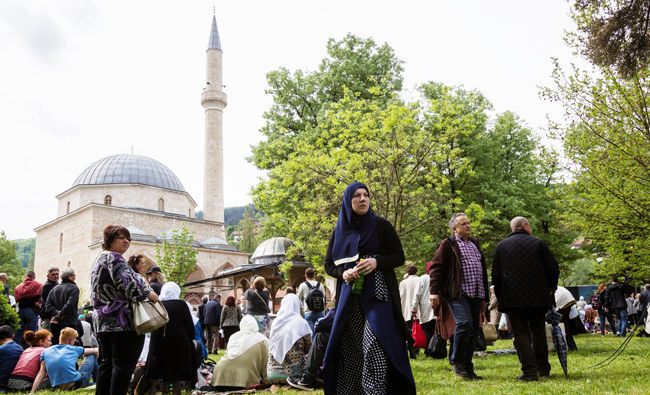
View of a renewed Aladza Mosque that was demolished at the beginning of the Bosnian war in Foca, Bosnia and Herzegovina, May 4, 2019. (REUTERS)
2 / 6
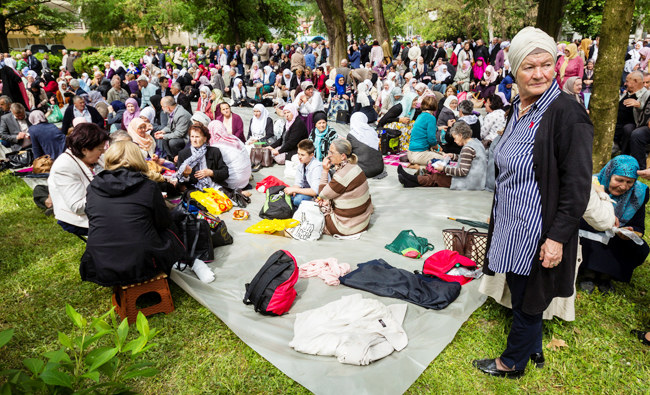
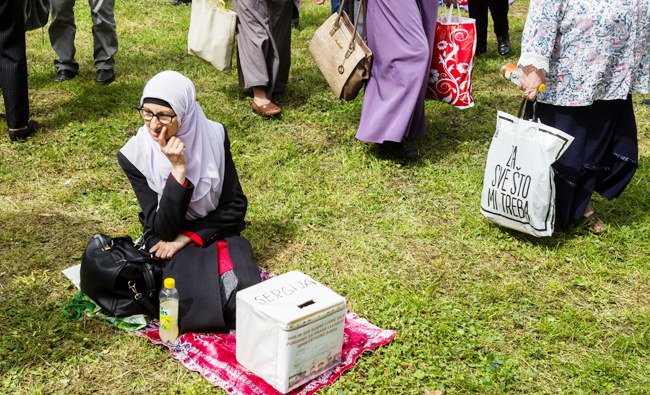
Believers wait for an opening ceremony of renewed Aladza Mosque that was demolished at the beginning of the Bosnian war in Foca, Bosnia and Herzegovina, May 4, 2019. (REUTERS)
3 / 6
Believers wait for an opening ceremony of the renewed Aladza Mosque that was demolished at the beginning of the Bosnian war in Foca, Bosnia and Herzegovina, May 4, 2019. (REUTERS)
4 / 6
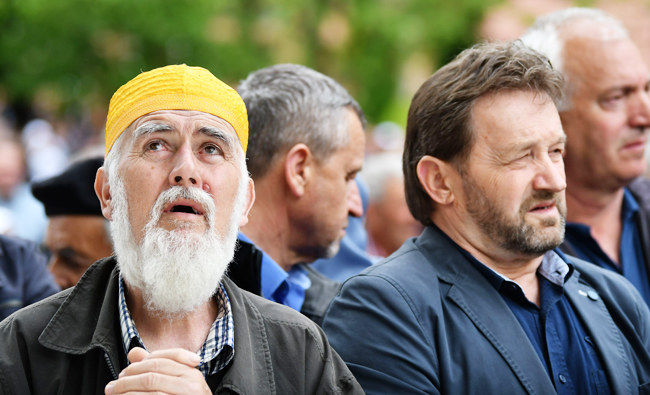
An elderly Bosnian Muslim, looks up at the minaret, as he joins others as they gather during the opening of the re-constructed Aladza mosque in the Eastern-Bosnian town of Foca on May 4, 2019. (AFP)
5 / 6
A bosnian Muslim cleric takes a selfie before the opening ceremony of Aladza Mosque that was demolished at the beginning of the Bosnian war in Foca, Bosnia and Herzegovina, May 4, 2019. (REUTERS)
6 / 6
Believers wait for an opening ceremony of the renewed Aladza Mosque that was demolished at the beginning of the Bosnian war in Foca, Bosnia and Herzegovina, May 4, 2019. (REUTERS)
Updated 07 May 2019
Follow

War-ravaged Bosnian mosque reopens in move toward reconciliation

  • Work on rebuilding the mosque started in 2012 and was financed by the governments of Turkey and the United States
  • Five mosques were destroyed during World War Two, while the 12 remaining were demolished during the 1990 war

FOCA, Bosnia: Thousands of Muslims flocked to the town of Foca on Saturday for the reopening of a historic mosque leveled at the beginning of the Bosnian war, in a ceremony aimed at encouraging religious tolerance between deeply divided communities.
The 16th century Aladza Mosque was one of the most prominent masterpieces of classical Ottoman architecture in the Balkans before its destruction in the 1992-95 war by Bosnian Serb forces trying to carve out an ethnically “pure” state.
The eastern town of Foca became notorious for the mass persecution and killings of non-Serbs that took place there during the conflict.
Before the war, the Bosnian Muslims, or Bosniaks, made up 51 percent of its 41,000 residents with the remainder mostly Serbs. Today, among some 18,000 residents, just over 1,000 Bosniaks remain.
“Everything that was connected to Islam, its civilization or culture was destroyed,” said 65-year-old Muslim worshipper Sulejman Dzamalija.
Sacred items dumped on rubbish tips have been restored and built into the mosque “to mark the start of a new era in this part of the country,” he said.
Nestled in the valley by the Drina river, Aladza, also known as the Colorful Mosque, was one of 17 Ottoman mosques in Foca. Five of them were destroyed during World War Two, while the 12 remaining were demolished during the 1990 war.
During the war, Bosnian Serbs authorities renamed the town Srbinje, but Bosnia’s top court ordered the reinstatement of the original name of Foca in 2004.
Muhamed Jusic, the Foca assembly speaker, said the reconstructed mosque offered hope for the return of pre-war residents and “a new beginning in Foca.”
Twenty four years on from the devastating war between its Muslim Bosniaks, Orthodox Serbs and Catholic Croats, Bosnia remains split along ethnic lines, with rival groups blocking reconciliation and reform needed to join the European Union.
“Today we are witnessing a hope that people will again find peace at this place,” the head of Bosnia’s Islamic Community Husein Kavazovic said at the ceremony.
Work on rebuilding the mosque started in 2012 and was financed by the governments of Turkey and the United States.
“Aladza should serve as a monument to resilience, reconciliation and diversity,” said US Ambassador Eric Nelson.
Turkish Culture Minister Mehmet Nuri Ersoy said reopening of the mosque demonstrates that “racism and hatred can make material damage but cannot destroy culture of co-estence nourished for centuries.”



Elysee Palace silver steward arrested for stealing thousands of euros’ worth of silverware

Updated 56 min 40 sec ago
Follow

Elysee Palace silver steward arrested for stealing thousands of euros’ worth of silverware

  • The Sevres Manufactory — which supplied most of the furnishings — identified several of the missing items on online auction websites
  • Investigators later found around 100 objects in the silver steward’s personal locker, his vehicle and their home

PARIS: Three men will stand trial next year after a silver steward employed at the official residence of the French president was arrested this week for the theft of items of silverware and table service worth thousands of euros, the Paris prosecutor’s office said.
The Elysee Palace’s head steward reported the disappearance, with the estimated loss ranging between 15,000 and 40,000 euros (($17,500-$47,000).
The Sevres Manufactory — which supplied most of the furnishings — identified several of the missing items on online auction websites. Questioning of Elysee staff led investigators to suspect one of the silver stewards, whose inventory records gave the impression he was planning future thefts.
Investigators established that the man was in a relationship with the manager of a company specializing in the online sale of objects, notably tableware. Investigators discovered on his Vinted account a plate stamped “French Air Force” and “Sevres Manufactory” ashtrays that are not available to the general public.
Around 100 objects were found in the silver steward’s personal locker, his vehicle and their home. Among the items recovered were copper saucepans, Sevres porcelain, a René Lalique statuette and Baccarat champagne coupes.
The two were arrested Tuesday. Investigators also identified a single receiver of the stolen goods. The recovered items were returned to the Elysee Palace.
The three suspects appeared in court Thursday on charges of jointly stealing movable property listed as part of the national heritage — an offense punishable by up to 10 years in prison and a 150,000-euro fine, as well as aggravated handling of stolen goods.
The trial was postponed to Feb. 26. The defendants were placed under judicial supervision, banned from contacting one another, prohibited from appearing at auction venues and barred from their professional activities.