DUBAI: Stronger relations between Saudi Arabia and Iraq will mean more stability in the region, particularly when it comes to stemming the influence of Iran, according to experts who commented on a recent agreement promoting co-operation between the two countries.
Exerting more influence in Iraq will prove crucial for the Kingdom, they explained, as Iran’s close relationship with the former causes concern among many neighboring countries. Security and intelligence are some of the areas in which Iraq and Saudi Arabia will cooperate in the near future, Iraqi Foreign Minister Mohamed Ali Alhakim was reported as saying.
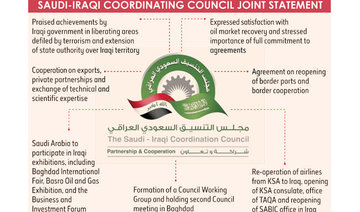
The announcement came during a state visit last month by an Iraqi delegation to Saudi Arabia led by Iraqi Prime Minister Adel Abdul-Mahdi, who met King Salman and Crown Prince Mohammed bin Salman. The leaders signed 13 agreements in areas such as trade, energy and political cooperation.
According to experts, Saudi Arabia may have the best chance of bringing stability and security to Iraq. “These actions are based on an economic and security approach, having intelligence as a key element to project all potential scenarios, including countering Iran’s possible actions to alter this relation,” said Johan Obdola, president of the International Organization for Security and Intelligence.
“Iran will be facing, from the United States and Europe, the hardest actions, including additional sanctions. On the other hand, there is a momentum in Iraq, with an increasing interest from a vast majority of Sunnis, Shiites and Kurds, to stop the influence of Iran in Iraq.”
Obdola said this will create an important opportunity for Saudi Arabia to establish a strong security and intelligence strategy with Iraq, along with economic investments, to stabilize it against the actions of Daesh.
“This toxic influence from Iran has reached a level of rejection within the Iraqi population,” he said. “With this announced security and intelligence cooperation between Saudi Arabia and Iraq, there is very much an opportunity to stabilize and reconstruct Iraq, strengthen military and intelligence capabilities, and get a better capacity to counter any actions from Iran in the region, and even abroad.”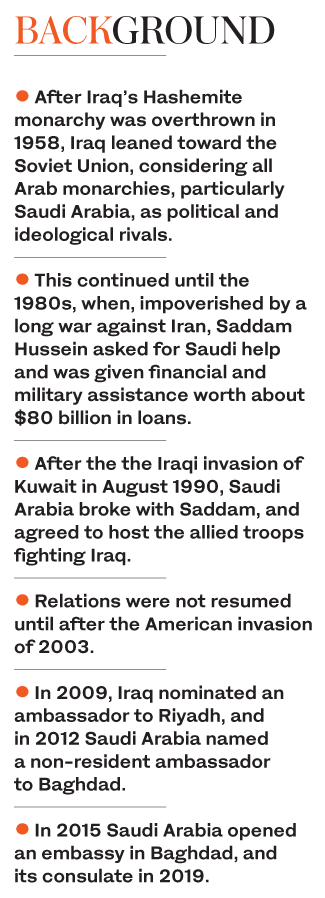
Obdola expressed concern about Iran implementing new low-intensity actions against the Arab Gulf states, with even more serious security implications for the rest of the region and abroad.
“The Iranian regime’s actions in Yemen, Lebanon and Iraq show its confidence regarding a lack of direct retaliation from the international community,” he said. “This will change if Iran keeps (up) this disruptive behavior. Iran is still building military and terrorist capabilities, and networks in other regions around the world to create conditions which will impact the US and European forces established in Africa, including Central Africa.”
On Yemen, he said, the Houthis had frequently stated their tactics were modelled on those of the Viet Cong and resistance movements in Latin America, as well as Lebanon’s Shia Hezbollah, with which they have obvious kinship.
“Both Hezbollah and Iran have increased their provision of guns, missiles, military training and funds for the Houthi war effort since 2014, (pleased) to see their Saudi enemies expend soldiers and money on the Yemeni stalemate,” he said. “We must also be aware that there are old and new alliances in this scenario, including Al-Qaeda, Hezbollah, Iran, among other actors, who must be closely watched.”
Obdola spoke of Saudi Arabia’s strong military capacity and intelligence, supported by its allies in the GCC, and military cooperation with other nations. “However, Iran has global intelligence and terrorist networks which must be analyzed and approached by traditional and non-traditional intelligence strategies,” he said. “Iran’s military apparatus will not be used against Saudi Arabia — it is not projected, at least — and it could be a huge mistake if there is any intention to. Its actions are and will continue to be based on a more low-level, low-intensity, and irregular warfare, and as such, the intelligence strategy of Riyadh must be developed and implemented accordingly.”
According to Dr. Albadr Al-Shateri, politics professor at the National Defense College in Abu Dhabi, the Saudi Arabia-Iraq rapprochement was born out of domestic change within Iraq. He mentioned the demonstrations by the Shiite majority region of Basra, which have shown the extent of general Iraqi discontent with Iran’s hegemony over their country. “The assertiveness of Kurds, especially the uncompromised new president Barham Salih, and determination not to be a pawn (of) any geopolitical competition, led to Iraq’s willingness to get closer to the Saudi-led order,” he said. “Finally, Iran’s gradual weakening as a result of the US pressure and sanctions may have contributed to Baghdad’s hedging its bets.”
He said both Saudi Arabia and Iraq stood to benefit from cooperation in many fields, especially security in the post-Daesh Middle East. “As the terrorist group is splintering into smaller cells, monitoring and coordination by all countries are necessary to avoid a repetition of the Al-Qaeda post-Afghanistan situation,” he said. “Another issue of the smuggling of narcotics between the two countries is of increasing demand. The security cooperation between Saddam’s Iraq and Saudi Arabia, prior to the former’s invasion of Kuwait, could serve as a model of security cooperation between the two countries.”
Funding is also a key element of the cooperation. Raffaello Pantucci, director of International Security Studies at the Royal United Services Institute for Defense and Security Studies in London, foresees much financial support from the Kingdom for Iraq. “There could also be capacity-building and worrying about the regional threat — Saudis are worrying about groups emanating from Iraq, and about managing their relationship with Iran, as Iraq has a strong relationship with Iran.”
He said it would be complicated, with militias involved in the Iraqi government. “But Saudi Arabia has money, and they can use that to get themselves access and influence,” he said. “Saudis are trying to make sure they are buying themselves an influence in a neighboring country where Iran has a lot of influence — there is a big push happening in Iran, and a part of that is for Saudi Arabia to have an influence in Baghdad.”
Iraq is of great geostrategic importance for Iran, Obdola said. “So a multi-dimensional intelligence component, along with a strong military cooperation, are the most fundamentally important elements for any security cooperation to be effective,” he said.
“This is truly the key component here, having the facts of not only regional players in any scenario to be considered, but potentially more global actors who could, in any particular situation, be used against Saudi Arabia. If all intelligence and security scenarios are projected in a local, regional and even international arena, then Saudi Arabia will be successful in this needed security cooperation with Iraq.”