

Lebanon stock trading suspended over central bank strike

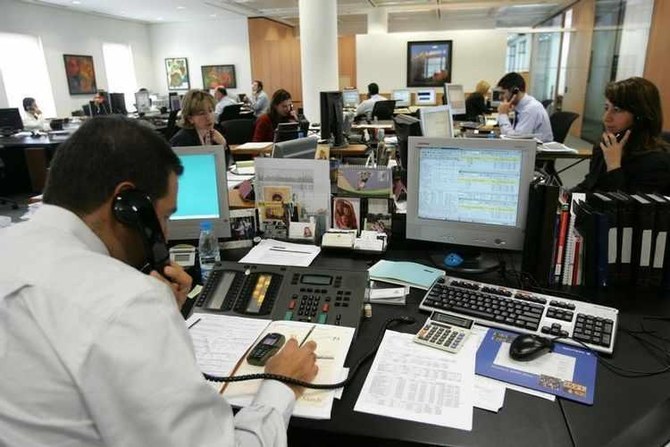
BEMO Bank’s dealing room before the end of a trading session at the Beirut Stock Exchange. (Reuters)
Updated 06 May 2019
Follow

Lebanon stock trading suspended over central bank strike

  • Hundreds of Lebanese public employees are on strike amid concerns that their salaries and benefits might be cut as the government discusses an austerity budget
  • Employees of the Lebanese central bank will decide their next step regarding the strike at a meeting on Tuesday

BEIRUT: The Beirut Stock Exchange suspended trading on Monday due to the open strike declared by employees of Lebanon’s central bank.

Hundreds of Lebanese public employees are on strike amid concerns that their salaries and benefits might be cut as the government discusses an austerity budget.

A statement posted on the stock market’s website Monday said the clearance and settlement of transactions cannot be done on time “during the period of open strike.”

“In order to protect the interest of all investors, the Beirut Stock Exchange declares the suspension of trading in its markets till further notice,” it said.

Employees of the Lebanese central bank will decide their next step regarding the strike at a meeting on Tuesday, the head of their syndicate Abbas Awada said.

In an interview with the Lebanese broadcaster Al-Jadeed, Awada said “a positive decision” may be taken to “facilitate matters” but added that if the government approved the budget in its existing form “we will proceed in an open strike.”

Awada said there had been negative effects and pressure “on the market, on the governor of the central bank, and on all Lebanese,” so “we might have a little positivity to relieve the matter.”

He said central bank governor Riad Salameh opposed the strike action and had asked for it to be lifted.

The draft budget has proposed annulling performance-linked bonuses paid in some state-run institutions including the central bank. In some cases, these have amounted to several months extra salary a year.


Closing Bell: Saudi main index closes in red at 10,947 

Updated 19 February 2026
Follow

Closing Bell: Saudi main index closes in red at 10,947 

RIYADH: Saudi Arabia’s Tadawul All Share Index dipped on Thursday, losing 208.20 points, or 1.87 percent, to close at 10,947.25. 

The total trading turnover of the benchmark index was SR4.80 billion ($1.28 billion), as 14 of the listed stocks advanced, while 253 retreated. 

The MSCI Tadawul Index decreased, down 25.35 points, or 1.69 percent, to close at 1,477.71. 

The Kingdom’s parallel market Nomu lost 217.90 points, or 0.92 percent, to close at 23,404.75. This came as 24 of the listed stocks advanced, while 43 retreated. 

The best-performing stock was Musharaka REIT Fund, with its share price up 2.12 percent to SR4.34. 

Other top performers included Al Hassan Ghazi Ibrahim Shaker Co., which saw its share price rise by 1.18 percent to SR17.20, and Saudi Industrial Export Co., which saw a 0.8 percent increase to SR2.51. 

On the downside, Abdullah Saad Mohammed Abo Moati for Bookstores Co. was among the day’s biggest decliners, with its share price falling 9.3 percent to SR39. 

National Medical Care Co. fell 8.98 percent to SR128.80, while National Co. for Learning and Education declined 6.35 percent to SR116.50. 

On the announcements front, Red Sea International said its subsidiary, the Fundamental Installation for Electric Work Co., has entered into a framework agreement with King Salman International Airport Development Co. 

In a Tadawul statement, the company noted that the agreement establishes the general terms and conditions for the execution of enabling works at the King Salman International Airport project in Riyadh.  

Under the 48-month contract, the scope of work includes the supply, installation, testing, and commissioning of all mechanical, electrical, and plumbing systems.  

Utilizing a re-measurement model, specific work orders will be issued on a call-off basis, with the final contract value to be determined upon the completion and measurement of actual quantities executed.  

The financial impact of this collaboration is expected to begin reflecting on the company’s statements starting in the first quarter of 2026, the statement said. 

The company’s share price reached SR23.05, marking a 2.45 percent decrease on the main market.