Most Wanted Man On Earth: Abu Bakr Al-Baghdadi, self-proclaimed leader of the murderous Daesh ‘caliphate’

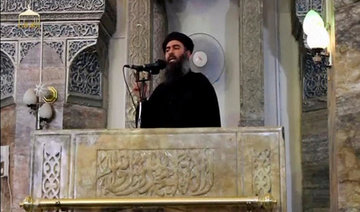
Ibrahim Awwad Ibrahim Al-Badri, a.k.a. Abu Bakr Al-Baghdadi, self-proclaimed leader of the Daesh “caliphate” and the most wanted man on earth. (AFP)
Updated 05 May 2019
Follow

Most Wanted Man On Earth: Abu Bakr Al-Baghdadi, self-proclaimed leader of the murderous Daesh ‘caliphate’

  • Far from a show of strength, the Daesh leader’s reappearance in a propaganda video is a sign of desperation, security analysts say
  • Since he first declared the Daesh caliphate at Mosul’s central mosque July 4, 2014, Al-Baghdadi has been occasionally heard but never seen

BAGHDAD: Sitting cross-legged, the overweight man with a gray-streaked beard spoke slowly and softly. Clad in quasi-military clothes, an AK-47 assault rifle by his side, he could have passed for just another aging Daesh militant, spouting the hatred that has brought parts of the Middle East to its knees over the past five years.

But this was no ordinary paramilitary. The man in the video was the one who started it all: Ibrahim Awwad Ibrahim Al-Badri, who calls himself Abu Bakr Al-Baghdadi, self-proclaimed leader of the Daesh “caliphate” and the most wanted man on earth.

Since he first made that declaration at Mosul’s central mosque July 4, 2014, Al-Baghdadi has been occasionally heard but never seen. Some thought him dead, or at least wounded, and certainly in hiding. To understand why he would suddenly reappear in 18 minutes of propaganda video after five years of invisibility, it is necessary to go back to the beginning.
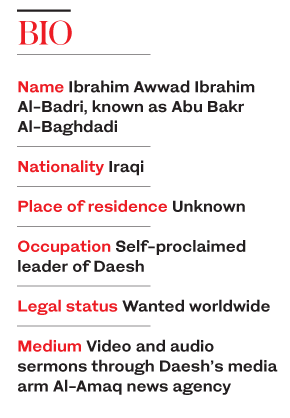
Al-Baghdadi was born in July 1971 in the Iraqi city of Samarra on the east bank of the Tigris, 125 km north of Baghdad. He had relatives who worked in Saddam Hussein’s feared intelligence service and army, which he was unable to join because of his nearsightedness.

An average student, he enrolled at the Saddam University for Islamic Studies. In the mid-1990s he joined the Muslim Brotherhood. Contemporaries say he left the organization around the turn of the century to mix with determined militants — a path many have followed since.

Al-Baghdadi gained a master’s in Islamic studies and a PhD in Islamic laws in 2000. He loved football, and lived in a small room adjacent to the mosque.

His exact involvement in the insurgency and civil war that gripped Iraq after the US invasion is disputed. He was arrested in Fallujah and held at the infamous Camp Bucca detention camp from early 2004. The ideology that fired Daesh dates back centuries, but its operational origins can be traced to this prison in the mid-2000s. It mixed militants with former Saddam military intelligence officers who together plotted the group’s eventual rise. Al-Baghdadi entered the prison as a mid-level militant and left with enhanced connections and a reputation for religious knowledge.

In 2002, an organization called Tawhid wal-Jihad began to operate in northern Iraq, led by a Jordanian, Abu Musab Al-Zarqawi. Following the 2003 invasion, Al-Zarqawi’s group grew and became part of Al-Qaeda in 2004, under the banner Al-Qaeda in Iraq. Among its recruits was Al-Baghdadi. He rose through the ranks as the US surge started in 2007 and successive leaders were killed. Judged as having sufficient religious authority, he was made leader in 2010. 

In 2011, Al-Baghdadi created Jabhat Al-Nusra and said it would join the expanded Islamic State of Iraq and Al-Sham (Daesh). The name is important —   “Al-Sham”/Greater Syria evoked memories of previous caliphates. After a dispute, the Al-Qaeda leadership disowned Daesh.

Under Al-Baghdadi’s leadership Daesh rapidly gained and held ground. Raqqa and Fallujah fell in early 2014, followed by Mosul. Daesh was no longer a terrorist group, but an army with occupied territory. 

On July 4, 2014, after the world had been shocked by the group’s lightning military advances, Al-Baghdadi seized his moment with the address at Mosul’s central mosque in which he deliberately highlighted mannerisms and stylistic elements to evoke the style of previous caliphs.

Before he spoke he used a miswak to clean his teeth in the traditional way. He wore a black turban, and spoke classical Qur’anic Arabic, claiming to be implementing God’s law.

As the so-called “caliphate” established itself, Al-Baghdadi was a looming, if not visible, figure. Audio recordings were released intermittently. In the spring of 2015, he laid bare his twisted religious views, saying Islam was never a peaceful religion but was “the religion of fighting.”

In September 2017, Al-Baghdadi reiterated his call for global jihad, calling for “soldiers of Islam in every location to increase blow after blow.”

Opinion

This section contains relevant reference points, placed in (Opinion field)

Nevertheless, by February 2019, Daesh had been reduced to a bleak encampment in Baghouz, Syria, where the last remaining fighters were killed or taken prisoner. Even before that, Iraqi security officials told Arab News, many Daesh fighters and commanders “had become skeptical of Al-Baghdadi, and accused him of being lazy.”

However, tanks and bombs had failed to kill Al-Baghdadi himself, or his group’s ideas. His new propaganda video was a wake-up call to the world’s intelligence community, but it was addressed mainly to his remaining followers.

“Al-Baghdadi was forced to appear at this time to respond to the charges against him by other leaders of his organization, especially that he abandoned his fighters,” an Iraqi national security official and psychological analyst told Arab News.


Another intelligence officer said: “There are real problems suffered by the organization, especially after losing Baghouz. Al-Baghdadi was trying to defend himself, and justify the loss of his fighters in Mosul and Sirte.

“He was denying the charges of cowardice and abandoning his fighters, and sought to give them new hope. These are psychological messages to raise their morale.

“The video clearly indicates the breakdown of confidence between Al-Baghdadi and his leaders.”

For those monitoring Daesh’s violence, it was a reminder that although the group may no longer hold territory, it is still a global threat, led by an ideologue who uses false religious justification to support its crimes.


Gaza’s living conditions worsen as strong winds and hypothermia kill 5

Updated 59 min 12 sec ago
Follow

Gaza’s living conditions worsen as strong winds and hypothermia kill 5

  • Hundreds of tents and makeshift shelters were blown away or heavily damaged, the UN humanitarian office reported

DEIR AL-BALAH, Gaza Strip: Strong winter winds collapsed walls onto flimsy tents for Palestinians displaced by war in Gaza, killing at least four people, hospital authorities said Tuesday.
Dangerous living conditions persist in Gaza after more than two years of devastating Israeli bombardment and aid shortfalls. A ceasefire has been in effect since Oct. 10. But aid groups say that Palestinians broadly lack the shelter necessary to withstand frequent winter storms.
The dead include two women, a girl and a man, according to Shifa Hospital, Gaza City’s largest, which received the bodies.
The Gaza Health Ministry said Tuesday a 1-year-old boy died of hypothermia overnight, while the spokesman for the UN’s children agency said over 100 children and teenagers have been killed by “military means” since the ceasefire began.
Meanwhile, Israel’s military said it exchanged fire Tuesday with six people spotted near its troops deployed in southern Gaza, killing at least two of them in western Rafah.
Family mourns relatives killed by wall collapse
Three members of the same family — 72-year-old Mohamed Hamouda, his 15-year-old granddaughter and his daughter-in-law — were killed when an 8-meter (26-foot) high wall collapsed onto their tent in a coastal area along the Mediterranean shore of Gaza City, Shifa Hospital said. At least five others were injured.
Their relatives on Tuesday began removing the rubble that had buried their loved ones and rebuilding the tent shelters for survivors.
“The world has allowed us to witness death in all its forms,” Bassel Hamouda said after the funeral. “It’s true the bombing may have temporarily stopped, but we have witnessed every conceivable cause of death in the world in the Gaza Strip.”
A second woman was killed when a wall fell on her tent in the western part of the city, Shifa Hospital said.
Hundreds of tents and makeshift shelters were blown away or heavily damaged, the UN humanitarian office reported.
The UN and its humanitarian partners were distributing tents, tarps, blankets and clothes as well as nutrition and hygiene items across Gaza, said the UN Office for the Coordination of Humanitarian Affairs.
The majority of Palestinians live in makeshift tents since their homes were reduced to rubble during the war. When storms strike the territory, Palestinian rescue workers warn people against seeking shelter inside damaged buildings for fears of collapse. Aid groups say not enough shelter materials are entering Gaza during the truce.
In the central town of Zawaida, Associated Press footage showed inundated tents Tuesday morning, with people trying to rebuild their shelters.
Yasmin Shalha, a displaced woman from the northern town of Beit Lahiya, stood against winds that lifted the tarps of tents around her as she stitched hers back together with needle and thread. She said it had fallen on top of her family the night before, as they slept.
“The winds were very, very strong. The tent collapsed over us,” the mother of five told AP. “As you can see, our situation is dire.”
On the shore in southern Gaza, tents were swept into the Mediterranean. Families pulled what was left from the sea, while some built sand barriers to hold back rising water.
“The sea took our mattresses, our tents, our food and everything we owned,” Shaban Abu Ishaq said, as he dragged part of his tent out of the sea in the Muwasi area of Khan Younis.
Mohamed Al-Sawalha, a 72-year-old man from the northern refugee camp of Jabaliya, said the conditions most Palestinians in Gaza endure are barely livable.
“It doesn’t work neither in summer nor in winter,” he said of the tent. “We left behind houses and buildings (with) doors that could be opened and closed. Now we live in a tent. Even sheep don’t live like we do.”
Residents aren’t able to return to their homes in Israeli-controlled areas of the Gaza Strip.
Child death toll in Gaza rises
Gaza’s Health Ministry said the 1-year-old in the central town of Deir Al-Balah was the seventh fatality due to the cold conditions since winter started. Others included a baby just seven days old and a 4-year-old girl, whose deaths were announced Monday.
The ministry, part of the Hamas-run government, says more than 440 people were killed by Israeli fire and their bodies brought to hospitals since the ceasefire went into effect. The ministry maintains detailed casualty records that are seen as generally reliable by UN agencies and independent experts.
UNICEF spokesman James Elder said Tuesday at least 100 children under the age of 18 — 60 boys and 40 girls — have been killed since the truce began due to military operations, including drone strikes, airstrikes, tank shelling and use of live ammunition. Those figures, he said, reflect incidents where enough details have been compiled to warrant recording, but the total toll is expected to be higher. He said hundreds of children have been wounded.
While “bombings and shootings have slowed” during the ceasefire, they have not stopped, Elder told reporters at a UN briefing in Geneva by video from Gaza City. “So what the world now calls calm would be considered a crisis anywhere else,” he said.
Gaza’s population of more than 2 million people has been struggling to keep the cold weather and storms at bay while facing shortages of humanitarian aid and a lack of more substantial temporary housing, which is badly needed during the winter months. It’s the third winter since the war between Israel and Hamas started on Oct. 7, 2023, when militants stormed into southern Israel and killed around 1,200 people and abducted 251 others into Gaza.
Gaza’s Health Ministry says more than 71,400 Palestinians have been killed in Israel’s retaliatory offensive.