Kuwait inaugurates massive causeway to free trade zone

1 / 3
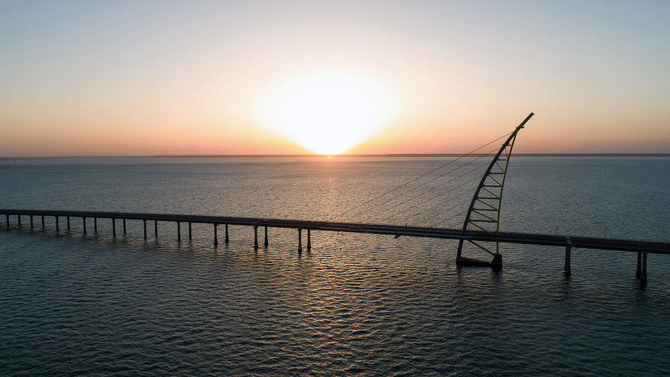
Sunset view of the arch pylon on the Sheikh Jaber al-Ahmad Al-Sabah Causeway which will lead to the Future Silk City, in Kuwait Bay, Kuwait April 23, 2019. (Reuters)
2 / 3
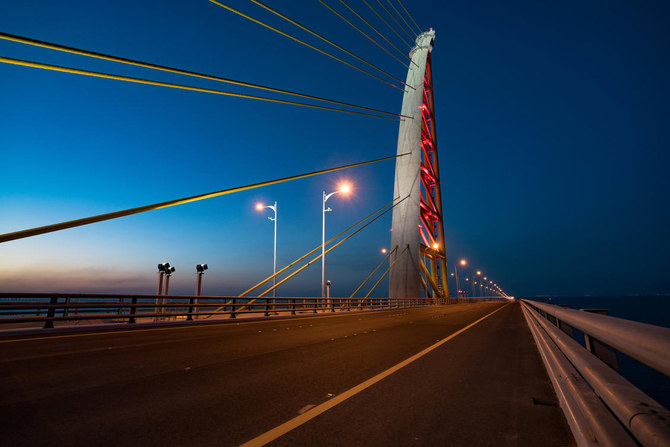
A night view of the arch pylon on the Sheikh Jaber al-Ahmad Al-Sabah Causeway which will lead to the Future Silk City, in Kuwait Bay, Kuwait April 23, 2019. Picture taken April 23, 2019. (Reuters)
3 / 3
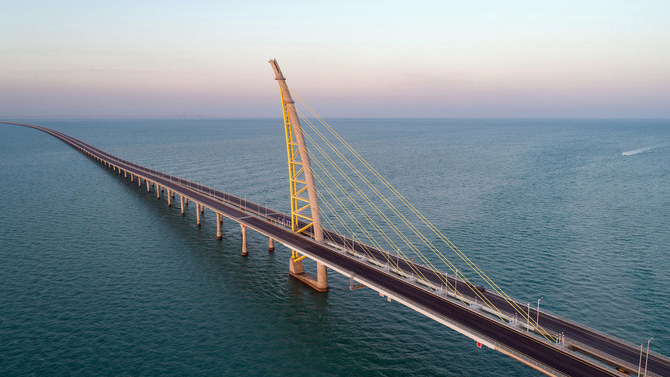
Aerial view of the arch pylon on the Sheikh Jaber al-Ahmad Al-Sabah Causeway which will lead to the Future Silk City, in Kuwait Bay, Kuwait April 23, 2019. (Reuters)
Updated 01 May 2019
Follow

Kuwait inaugurates massive causeway to free trade zone

KUWAIT CITY: Kuwait on Wednesday inaugurated one of the world’s longest causeways, linking the oil-rich Gulf state’s capital to an uninhabited border region set to become a major free trade hub.
The 36-kilometer (22-mile) bridge connects Kuwait City to the northern desert area of Subbiya, where Kuwait aims to create the “Silk City” project linking the Gulf to central Asia and Europe.
The “Jaber” bridge, named after late ruler Sheikh Jaber Al-Ahmad Al-Sabah, spans 36 kilometers (22 miles), three-quarters of it over water.
It cuts the driving time between Kuwait City and Subbiya, close to both Iraq and Iran, from 90 minutes to less than half an hour.
Investment in the Silk City project is expected to top $100 billion, and a 5,000-megawatt power plant has already been built in Subbiya.
The $3.6 billion causeway, designed by Paris-based engineering and consulting group Systra, took five years to build.
The work was carried out by a consortium led by South Korea’s Hyundai Engineering and Construction Co. along with Kuwait’s Combined Group Contracting Co.
The opening ceremony was attended by Kuwait’s emir, Sheikh Sabah Al-Ahmed Al-Sabah along with South Korean Prime Minister Lee Nak-yeon and the leader of the French senate, Gerard Larcher.
Lee Nak-yeon said Wednesday the causeway would establish Kuwait as an international trade center.


Six vital sectors drawing US investors to Saudi Arabia 

Updated 24 December 2025
Follow

Six vital sectors drawing US investors to Saudi Arabia 

RIYADH: Six vital sectors are drawing US investors, including entrepreneurs and small businesses, to Saudi markets as the Kingdom continues to develop its regulatory framework and foster innovation, Deborah Lehr, interim CEO of the Meridian International Center, said in an interview with Al-Eqtisadiah. 

Lehr, who is heading a trade and investment delegation to Saudi Arabia in her capacity as an economic advisor affiliated with the White House, stated that the six sectors include hospitality, luxury goods, and tourism, as well as culture, technology, and others. 

She noted that Saudi Arabia has significantly eased the process for foreign companies to establish a presence, a critical factor for small and medium-sized enterprises that may not yet have the scale to expand, making the Kingdom an attractive market for both large and innovative small companies. 

Following the success of the Saudi Crown Prince’s recent visit to Washington, she said, Meridian organized a US trade delegation to explore tangible and growing opportunities for US businesses in Saudi Arabia. 

Translating Vision 2030 priorities into real partnerships 

The delegation, which included representatives from Delta, Intel, Pernod Ricard, and Basilinna, among others, met a wide range of government officials, private-sector leaders, and entrepreneurs to explore how US companies can participate in Saudi market growth. 

According to Lehr, discussions were practical and forward-looking, focusing on translating Vision 2030 priorities into real business partnerships. 

She highlighted that most of the companies in the delegation were large enterprises operating across various sectors, underscoring the diversity of businesses active in Saudi Arabia. 

She pointed out that these companies joined the mission because they see the potential to scale their operations in Saudi Arabia — whether by increasing flight routes, enhancing airport security, offering advisory services to firms entering the Saudi or US markets, or exploring opportunities in the beverage sector. 

Relationship increasingly taking economic dimension 

Lehr hinted to the Saudi minister of investment that the US-Saudi relationship is also increasingly taking on an economic dimension. 

She noted that bilateral trade stands at around $40 billion, compared with Saudi-China trade of approximately $110 billion, highlighting untapped growth potential between the two countries, especially as diplomatic and political ties continue to strengthen. 

She said the reforms present valuable opportunities for US companies across multiple sectors, including advanced manufacturing, technology and logistics, as well as aviation, tourism and culture, alongside a wide range of services. 

With the regulatory environment being modernized and business stability increasing, the scope of US investment is set to expand further. More importantly, she added, the greater the engagement of companies, the stronger and more resilient the bilateral relationship will become in the years ahead. 

She emphasized that Saudi Arabia has undergone deep social and economic transformations, including increased female participation in the workforce and entrepreneurship, while emerging as a cultural hub with a thriving arts scene and new platforms for creative expression. 

Lehr further said that the world will witness growing global interest from companies and institutions eager to be part of Saudi Arabia’s remarkable transformation, amid increasing openness and a willingness to share its history, culture, and ambitions with the world. 

Saudi agenda offers tangible opportunities  

Lehr highlighted that during her visit, she focused on three key economic priorities. The first is Saudi Arabia’s strategic shift of capital from the oil and gas sector toward technology and innovation, a move that signifies not only economic diversification but also the Kingdom’s emergence as a globally competitive player. 

Second, the Kingdom’s reform agenda has provided tangible opportunities for foreign companies, reflecting real changes that facilitate international participation in Saudi growth. 

The third point she focused on was that the strong geopolitical and economic ties between the US and Saudi Arabia have bolstered investor confidence. As the Kingdom strengthens its global role and deepens relationships with partners such as the US, its attractiveness for long-term foreign direct investment continues to grow. 

She noted that sectors such as artificial intelligence, gaming and entertainment, advanced manufacturing, and the technology ecosystem are areas in which the US has strong competitive advantages, at a time when US firms are seeking new markets that offer stability and long-term potential. 

Giga-projects in Saudi Arabia, including AlUla and NEOM, have attracted global attention and highlighted emerging opportunities across the country. 

These projects demonstrate the Kingdom’s ambitious vision and its creation of entirely new sectors rather than merely expanding existing ones.