Beluga whale with Russian harness raises alarm in Norway

1 / 3
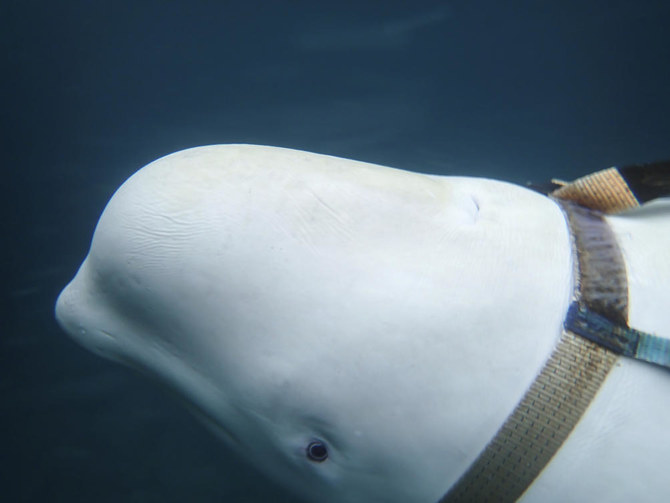
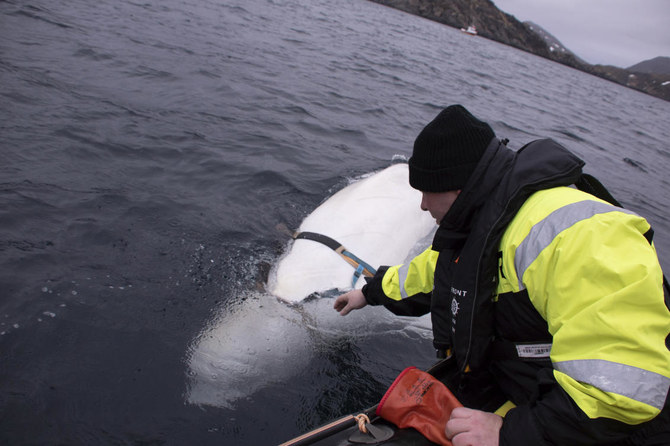
Norwegian fisherman Joar Hesten tries to attract a beluga whale swimming next to his boat before the Norwegian fishermen were able to removed the tight harness, off the northern Norwegian coast Friday, April 26, 2019. (AP)
2 / 3
A beluga whale seen as it swims next to a fishing boat before Norwegian fishermen removed the tight harness, swimming off the northern Norwegian coast Friday, April 26, 2019. (AP)
3 / 3
Joergen Ree Wiig tries to reach the harness attached to a beluga whale before the Norwegian fishermen were able to removed the tight harness, off the northern Norwegian coast Friday, April 26, 2019. (AP)
Updated 29 April 2019
Follow

Beluga whale with Russian harness raises alarm in Norway

  • “Equipment St. Petersburg” is written on the harness strap, which features a mount for an action camera

COPENHAGEN: A beluga whale found with a tight harness that appeared to be Russian made has raised the alarm of Norwegian officials and prompted speculation that the animal may have come from a Russian military facility.
Joergen Ree Wiig of the Norwegian Directorate of Fisheries says “Equipment St. Petersburg” is written on the harness strap, which features a mount for an action camera.
He said Monday fishermen in Arctic Norway last week reported the tame white cetacean with a tight harness swimming around. On Friday, fisherman Joar Hesten, aided by the Ree Wiig, jumped into the frigid water to remove the harness.
Ree Wiig said “people in Norway’s military have shown great interest” in the harness.
Audun Rikardsen, a professor at the Department of Arctic and Marine Biology at the Arctic University of Norway in Tromsoe, northern Norway, believes “it is most likely that Russian Navy in Murmansk” is involved. Russia has major military facilities in and around Murmansk on the Kola Peninsula, in the far northwest of Russia.
It wasn’t immediately clear what the mammal was being trained for, or whether it was supposed to be part of any Russian military activity in the region.
Rikardsen said he had checked with scholars in Russia and Norway and said they have not reported any program or experiments using beluga whales.
“This is a tame animal that is used to get food served so that is why it has made contacts with the fishermen,” he said. “The question is now whether it can survive by finding food by itself. We have seen cases where other whales that have been in Russian captivity doing fine.”
Hesten told Norwegian broadcaster NRK that the whale began to rub itself again his boat when he first spotted it.
Russia does not have a history of using whales for military purposes but the Soviet Union had a full-fledged training program for dolphins.
The Soviet Union used a base in Sevastopol on the Crimean peninsula during the Cold War to train the mammals for military purposes such as searching for mines or other objects and planting explosives. The facility in Crimea was closed following the collapse of the Soviet Union, though unnamed reports shortly after the Russian annexation of Crimea indicated that it had reopened.
The Russian Defense Ministry published a public tender in 2016 to purchase five dolphins for a training program. The tender did not explain what tasks the dolphins were supposed to perform, but indicated they were supposed to have good teeth. It was taken offline shortly after publication.


Arts festival’s decision to exclude Palestinian author spurs boycott

Randa Abdel Fattah. (Photo/Wikipedia)
Updated 12 January 2026
Follow

Arts festival’s decision to exclude Palestinian author spurs boycott

  • A Macquarie University academic who researches Islamophobia and Palestine, Abdel-Fattah responded saying it was “a blatant and shameless act of anti-Palestinian racism and censorship,” with her lawyers issuing a letter to the festival

SYDENY: A top Australian arts festival has seen ​the withdrawal of dozens of writers in a backlash against its decision to bar an Australian Palestinian author after the Bondi Beach mass shooting, as moves to curb antisemitism spur free speech concerns.
The shooting which killed 15 people at a Jewish Hanukkah celebration at Sydney’s Bondi Beach on Dec. 14 sparked nationwide calls to tackle antisemitism. Police say the alleged gunmen were inspired by Daesh.
The Adelaide Festival board said last Thursday it would disinvite Randa ‌Abdel-Fattah from February’s ‌Writers Week in the state of South Australia because “it ‌would not ​be ‌culturally sensitive to continue to program her at this unprecedented time so soon after Bondi.”

FASTFACTS

• Abdel-Fattah responded, saying it was ‘a blatant and shameless act of anti-Palestinian racism and censorship.’

• Around 50 authors have since withdrawn from the festival in protest, leaving it in doubt, local media reported.

A Macquarie University academic who researches Islamophobia and Palestine, Abdel-Fattah responded saying it was “a blatant and shameless act of anti-Palestinian racism and censorship,” with her lawyers issuing a letter to the festival.
Around 50 authors have since withdrawn from the festival in protest, leaving it in doubt, local media reported.
Among the boycotting authors, Kathy Lette wrote on social media the decision to bar Abdel-Fattah “sends a divisive and plainly discriminatory message that platforming Australian Palestinians is ‘culturally insensitive.'”
The Adelaide Festival ‌said in a statement on Monday that three board ‍members and the chairperson had resigned. The ‍festival’s executive director, Julian Hobba, said the arts body was “navigating a complex moment.”

 a complex and ‍unprecedented moment” after the “significant community response” to the board decision.
In the days after the Bondi Beach attack, Jewish community groups and the Israeli government criticized Prime Minister Anthony Albanese for failing to act on a rise in antisemitic attacks and criticized protest marches against Israel’s war in ​Gaza held since 2023.
Albanese said last week a Royal Commission will consider the events of the shooting as well as antisemitism and ⁠social cohesion in Australia. Albanese said on Monday he would recall parliament next week to pass tougher hate speech laws.
On Monday, New South Wales state premier Chris Minns announced new rules that would allow local councils to cut off power and water to illegally operating prayer halls.
Minns said the new rules were prompted by the difficulty in closing a prayer hall in Sydney linked to a cleric found by a court to have made statements intimidating Jewish Australians.
The mayor of the western Sydney suburb of Fairfield said the rules were ill-considered and councils should not be responsible for determining hate speech.
“Freedom ‌of speech is something that should always be allowed, as long as it is done in a peaceful way,” Mayor Frank Carbone told Reuters.