More than 270 died from overwork-related illnesses in Indonesia elections

1 / 2
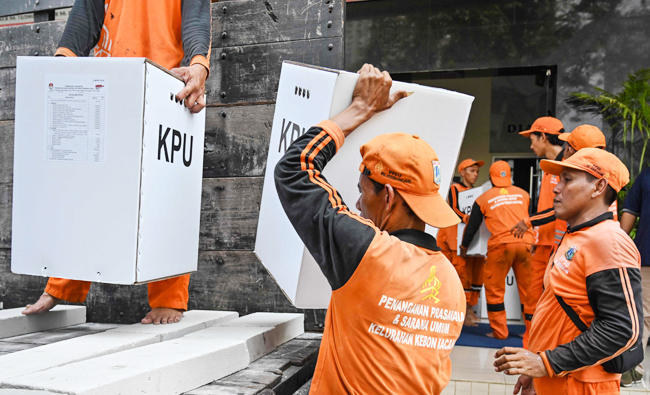
Officials load vote materials on a truck in Jakarta, on April 16, 2019, a day before the election. Indonesia goes to the polls on April 17, with over 190 million voters set to cast a ballot in the world's third-biggest democracy, with the opposition already threatening to challenge the results over voter-fraud claims. (AFP)
2 / 2
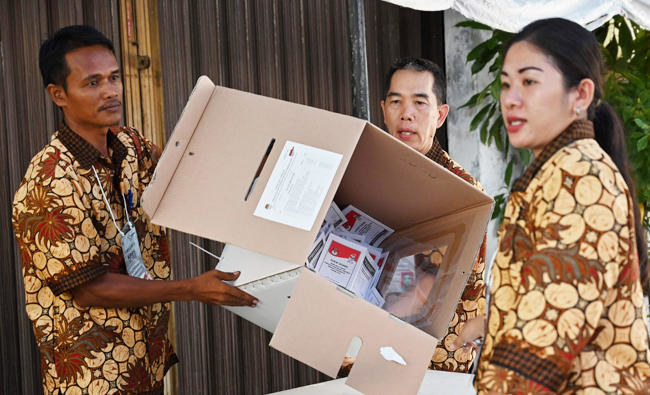
Indonesian election officials prepare to count ballots from the country's general election at a polling station in Jakarta on April 17, 2019. (AFP)
Updated 29 April 2019
Follow

More than 270 died from overwork-related illnesses in Indonesia elections

  • The KPU will conclude vote counting and announce winners of the presidential and parliamentary elections on May 22

JAKARTA: Ten days after Indonesia held the world’s biggest single-day elections, more than 270 election staff have died, mostly of fatigue-related illneses caused by long hours of work counting millions of ballot papers by hand, an official said on Sunday.
The April 17 elections were the first time the country of 260 million people combined the presidential vote with national and regional parliamentary ones, with an aim to cut costs.
Voting was largely peaceful and was estimated to have drawn 80 percent of the total 193 million voters, who each had to punch up to five ballot papers in over 800,000 polling stations.
But conducting the eight-hour vote in a country that stretches more than 5,000 km (3,000 miles) from its western to eastern tips proven to be both a Herculean logistical feat and deadly for officials, who had to count ballot papers by hand.
As of Saturday night, 272 election officials had died, mostly from overwork-related illnesses, while 1,878 others had fallen ill, said Arief Priyo Susanto, spokesman of the General Elections Commission (KPU).
The Health Ministry issued a circular letter on April 23 urging health facilities to give utmost care for sick election staff, while the Finance Ministry is working on compensation for families of the deceased, Susanto added.
The KPU has come under fire due to the rising death toll.
“The KPU is not prudent in managing the workload of staff,” said Ahmad Muzani, deputy chairman of the campaign of opposition presidential candidate Prabowo Subianto, reported by news website Kumparan.com.
Prabowo, who independent pollsters said was the loser of the 2019 polls based on quick counts, had alleged widespread cheating and his campaign claimed some officials punched ballots in favor of incumbent President Joko Widodo. Widodo’s security minister said the allegations were baseless.
Both candidates have declared victory, though quick counts suggested Widodo won the election by around 9-10 percentage points.
The KPU will conclude vote counting and announce winners of the presidential and parliamentary elections on May 22.


Russia-ally Touadera seeks third term in Central African Republic

Updated 1 sec ago
Follow

Russia-ally Touadera seeks third term in Central African Republic

BANGUI: Central African Republic President Faustin-Archange Touadera is seeking a third term in an election on Sunday, campaigning on security gains after signing deals with rebel groups and enlisting support from Russian mercenaries and Rwandan ​forces.
He faces six opposition candidates including Anicet-Georges Dologuele, a former prime minister and runner-up in the 2020 election, but is likely to win in part due to his control over state institutions, analysts say.
Such a result would likely further the interests of Russia, which has traded security assistance for access to resources including gold and diamonds. Touadera is also offering access to the country’s lithium and uranium reserves to anyone interested.
The 68-year-old mathematician took power in 2016 after the worst crisis in the chronically unstable country’s history, when three years of intercommunal strife forced a fifth of the population to flee their homes, either internally or abroad.
Touadera has signed peace deals this year with several rebel groups, while ‌others have been ‌weakened in the face of Russian mercenaries and troops from Rwanda deployed to ‌shore ⁠up Touadera’s ​government as ‌well as UN peacekeepers.
“During the 10 years that we have been working together, you yourselves have seen that peace is beginning to return, starting from all our borders and reaching the capital,” Touadera told a rally at a stadium in the capital Bangui this month.
His opponents, meanwhile, have denounced a constitutional referendum in 2023 that scrapped the presidential term limit, saying it was proof Touadera wants to be president for life.
They have also accused him of failing to make significant progress toward lifting the 5.5 million population out of poverty.
“The administrative infrastructure has been destroyed and, as you know, the roads are in a ⁠very poor state of repair,” Dologuele told a recent press conference.
“In short, the Central African economy is in ruins.”
SECURITY THREATS REMAIN DESPITE PEACE DEALS
The presidential ‌contest is taking place alongside legislative, regional and municipal elections, with provisional results ‍expected to be announced by January 5.
If no ‍candidate gets more than 50 percent of the vote, a presidential runoff will take place on February 15, while legislative ‍runoffs will take place on April 5.
A smooth voting process could reinforce Touadera’s claim that stability is returning, which was buttressed last year with the UN Security Council’s lifting of an arms embargo and the lifting of a separate embargo on diamond exports.
“The fact that these measures were lifted, it shows that we’re gradually getting back to normal. Or at least that’s the narrative,” said Romain ​Esmenjaud, associate researcher at the Institut Francais de Geopolitique.
The peace deals are credited with a decline in violence in some areas and an expected boost in economic growth projections to 3 percent this ⁠year, according to the International Monetary Fund. US President Donald Trump’s administration has said the UN should hand security back to the government soon.
But serious security threats remain. Rebels have not fully disarmed, reintegration is incomplete, and incursions by combatants from neighboring Sudan fuel insecurity in the east.
Pangea-Risk, a consultancy, wrote in a note to clients that the risk of unrest after the election was high as opponents were likely to challenge Touadera’s expected victory.
“The election will take place in an atmosphere marked by heightened grievances over political marginalization, increasing repression, and allegations of electoral fraud,” said chief executive Robert Besseling.
Dologuele alleged fraud after he was recorded as winning 21.6 percent of the vote in 2020, when rebel groups still threatened the capital and prevented voting at 800 polling stations across the country, or 14 percent of the total. A court upheld Touadera’s win.
Paul-Crescent Beninga, a political analyst, said voters will be closely scrutinizing the voting and counting processes.
“If they do not go well, it gives those ‌who promote violence an excuse to mobilize violence and sow panic among the population of the Central African Republic. So that is why we must ensure that the elections take place in relatively acceptable conditions,” he said.