

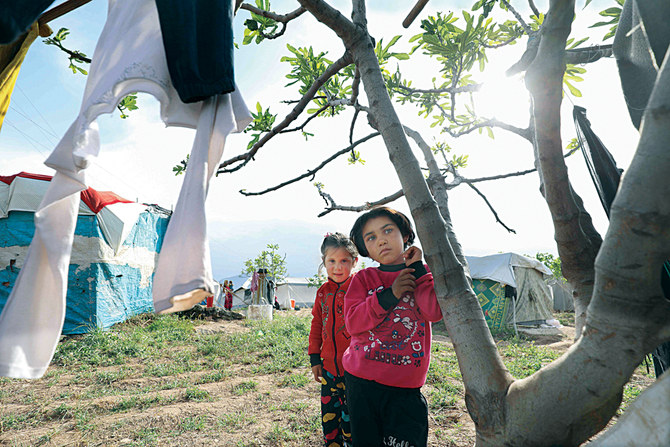

AMMAN: It was only when his children began to starve that Abdullah Al-Amour decided time had come to leave the sanctuary of Rukban camp with his family to face an uncertain fate back under Syria’s Bashar Assad.
The cattle trader from Palmyra fled to Rukban on the Syrian border with Jordan and Iraq more than three years ago after his home was destroyed in Russian airstrikes targeting areas that were held at the time by Daesh.
Conditions at Rukban are tough, but it offers one big advantage to the 36,000 people sheltering there: Protection from Russian airstrikes and pro-Assad forces thanks to its location near a US base.
But in recent weeks life in the camp has gone from bad to near impossible. Food shortages have got a lot worse as a result of a siege by regime and Russian forces that want to see Rukban dismantled and US forces out of Syria, according to people living in the camp and diplomats.
“Today you eat. Tomorrow there is nothing to eat,” said Amour, 46, speaking to Reuters by phone from the camp. Amour says his son Hamza, three, has become frail from being fed sugared water instead of powdered milk. Gravel and dirt are being added to dough to make flour supplies go further.
“No one is leaving out of their own will. I can no longer sleep with my children hungry,” he said.
Local sources say Russian and Syrian regime forces have choked off supplies to Rukban since mid-February, blocking access for smugglers who used to bribe their way through army checkpoints, and firing on some vehicles.
On Thursday, Washington urged Damascus and Moscow to allow international aid deliveries to Rukban and stop blocking commercial routes into the camp to “avert further suffering.”
As shortages have hit, a steady stream of people have crossed out of Rukban into regime territory.
OCHA, the UN humanitarian agency, said around 7,000 had left in the last month or so. Some were in shelters in Homs city where some of the men were settling their status with the authorities, and others had gone to their areas of origin in Homs governorate. Relatives say the Homs city shelters amount to internment centers for many of the men.
Power struggle
Rukban camp is at the heart of a struggle between Russia and the US for control of southeastern Syria and with it a land route to Iraq and Assad’s major regional ally, Iran.
Russia, whose military has helped Assad claw back control of much of Syria, views Rukban as a US pretext for maintaining its “illegal occupation in the south” and as a last pocket of anti-Assad rebels in southern Syria who must be wiped out.
The camp’s evacuation seems unlikely to lead the US to abandon its nearby garrison at Tanf and the surrounding “deconfliction zone” that envelops Rukban: Tanf is seen as useful to US aims of countering Iran.
But Russia is still determined to see Rukban gone. This would represent a gain for Moscow in Syria as its military advances have ground to a halt in other parts of the country, and would assert its influence over a US-controlled area.
Moscow and Damascus have accused Washington of holding the people of Rukban hostage and Russia has even compared its conditions to the concentration camps of the second world war.
The US has said it is not preventing anyone from leaving Rukban, while calling for a process of “safe, voluntary and dignified departures” from the camp.
The Russian defense ministry did not immediately respond to a request for comment.
With routes to the camp controlled by Damascus, Rukban has rarely received UN aid deliveries. Following a delivery in November, the US said it recognized Russia had played a role in persuading Damascus to authorize it. The last time a UN aid convoy reached Rukban was early February.
Many at Rukban fear returning to Assad’s Syria, saying they could be detained or forced to join the army. This concern is widely held among refugees, who are unconvinced by Russian assurances they face no threat.
Over the years, the camp has taken on some features of permanence including houses built of mud bricks, schools and markets. Ibrahim Al-Nasser ran a grocery at Rukban until he was forced to close it for lack of goods.
Speaking to Reuters as he was about to leave Rukban, he said he no longer cared about his own fate and only wanted to save his children from starving.
“People are gripped with fear of being arrested,” said Nasser. “But I am forced to leave even if I might face death or prison so that my children live,” he said.
Green buses
Abu Ahmad al Dirbas Khalidi, the head of an opposition-run civil council in the camp, said dwindling food supplies gave people at Rukban no choice but to leave.
“The regime and the Russians have succeeded in their siege, and with hunger and poverty people are leaving,” he said.
The camp’s only bakery stopped production this month. A bag of flour — if available — now costs 40,000 Syrian pounds ($70) — eight times its price in regime territory.
Reports in Syrian state-run media have shown people leaving Rukban on green buses like those used to evacuate civilians and rebel fighters from other parts of Syria recaptured from insurgents, such as eastern Aleppo and eastern Ghouta.
In an interview with the state news agency SANA, one man leaving Rukban accused militant groups “led by America of putting us under pressure, denying us food and water, just so that we join them.”
But sources in Rukban said men leaving had been detained for weeks at internment camps in Homs before being jailed, released or drafted into the army.
Mahmoud Al-Humeili, a camp official, said he had received reports that two dozen men had been arrested.
Shukri Shihab, a relief worker in the camp, said: “Death in the camp is better than dying behind prison bars.”


