

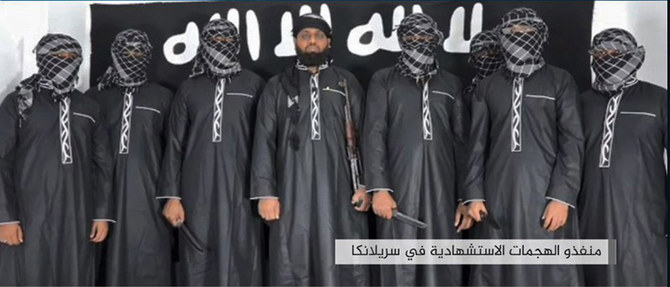


ISLAMABAD: A video that emerged following the Easter Sunday attacks in Sri Lanka showed seven black-clad, masked figures led by an eighth man, his face visible, pledging allegiance to Daesh.
That man is thought to be Mohammed Zahran Hashim, a little-known radical preacher from Sri Lanka believed by investigators and experts to have masterminded the terror attacks that have left 359 dead and more than 500 wounded.
On Tuesday, the Daesh terror group claimed responsibility for the bombings, and issued threats of future attacks in both Arabic and Tamil. It also released a video of eight bombers allegedly involved in the strikes.
However, even with Daesh claiming responsibility for the attacks, many questions remain, including whether the bombers were core fighters from the extremist group or members of local outfits who have pledged allegiance to the organization.
The Sri Lankan government has previously said the attacks were the work of a local Islamist group, the National Thowheed Jamath (NTJ), along with another group, Jammiyathul Millathu Ibrahim.
Now investigators are scrambling to determine if Daesh merely encouraged these groups to carry out the bombings or if the attackers included core extremists from the terrorist organization. Whatever the links, the Daesh claim suggests that the terror group remains a threat despite the recapture of its territory in Syria and Iraq. It has also heightened concerns about the organization’s growing influence in South Asia, reflected in the FBI, Interpol and other foreign intelligence services joining the investigation.
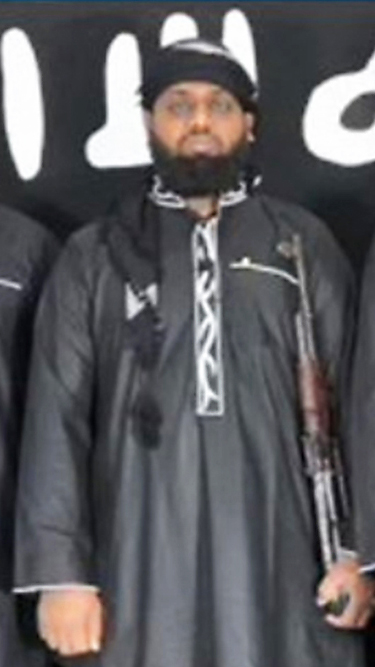
A close-up view of Mohammed Zahran Hashim. (AFP)
“Clearly a group as powerful as Daesh won’t go away quickly, and its role in this attack would suggest that it remains perfectly prepared to stage, or help stage, the deadliest attacks imaginable,” Michael Kugelman, a senior associate for South Asia at the Wilson Center in Washington, told Arab News.
Daesh has built networks in a number of Asian countries such as Afghanistan, Pakistan, the Maldives, the Philippines and Indonesia. In Sri Lanka, too, Daesh has been recruiting for years, according to Rohan Gunaratna, a Singapore-based expert on militancy in the region.
“Sri Lanka is the only country in Asia where Daesh has not carried out an attack despite having a network for a considerable amount of time,” he said. Gunaratna said that Daesh had received considerable help from the radical preacher Zahran Hashim, a former member of the NTJ who broke away and created the Al-Ghuraba group. “That is the Daesh branch in Sri Lanka,” he said.
The ‘main player’
With no history of Islamist extremism in Sri Lanka, NTJ was the main contender for involvement with Daesh.
A government official who declined to be named said that the NTJ had split into three groups in 2016 since many of its followers disapproved of Hashim’s “extremist ideology.”
Hashim’s increasingly militant views came from his growing “international connections and links with Islamic groups in southern India,” the official said.
The preacher is believed to have received his early schooling in Kattankudy, his hometown in eastern Sri Lanka. Unconfirmed media reports say he traveled to India to study Islamic theology, but abandoned his studies. Since then, he has reportedly traveled between India and Sri Lanka.
Last year, Hashim came on the radar of intelligence officials after three Buddhist statues were defaced in central Sri Lanka. Interrogation of the young men responsible revealed they were students of Hashim. That investigation also led officers to a large weapons cache, including 100 kg of explosives and detonators, on Sri Lanka’s northwest coast.
Hilmy Ahmed, vice president of the Muslim Council of Sri Lanka, said Hashim had been turned away by the people and moderate clerics of his native Kattankudy because of his hard-line views. It was then that he turned to YouTube. In the past two years, he gained thousands of followers with impassioned sermons against non-Muslims on YouTube and a Sri Lankan Facebook account, which he called Al-Ghuraba media.
According to Robert Postings, a researcher, Hashim had been a supporter of the group at least since 2017 when he began posting pro-Daesh propaganda on Facebook. In many of Hashim’s videos, the backdrop shows images of the Twin Towers burning after the Sept. 11, 2001 attacks.
Experts with knowledge of the investigations said that Hashim’s faction of the NTJ was almost certainly the “main player” in the Easter attacks.
Given the unprecedented scale, sophistication and coordination of the bombings, and the fact that foreigners were targeted, it was likely that he had worked with support from international “players,” they said.
“It’s hard to imagine that the attacks were purely domestic in nature,” said Taylor Dibbert, a Sri Lanka expert and fellow at the Pacific Forum. “Most Sri Lankans had not heard about National Thowheed Jamath before,” Jehan Perera, executive director of the National Peace Council of Sri Lanka, said.
The group lacked the power to coordinate the attacks, he said. “There is someone behind them, a handler.”
Specter of violence
Sri Lanka endured several suicide bombings targeting government officials and installations during the decades-long conflict with ethnic Tamil separatists that ended in 2009. Since then, the country has enjoyed relative calm. After a lull in violence for 10 years, the trauma and anger over Sunday’s suicide bombings have been heightened with revelations that top officials failed to order tighter security arrangements despite the threat of violence. “Sri Lanka was an easy target,” Perera said.
Most importantly, those behind the attack were aware of the deep dysfunction within the Sri Lankan government and exploited it, experts said.
According to an April 11 intelligence report seen by Arab News, police had received a tip-off of a possible attack on churches by the NTJ this month. Reuters also reported that Indian intelligence officers contacted their Sri Lankan counterparts two hours before the first attack to warn of a specific threat on churches.
A minister said Prime Minister Ranil Wickremesinghe had not been told about the warnings and had been shut out of top security meetings because of a feud with President Maithripala Sirisena.
Sirisena fired Wickremesinghe last year but was forced to reinstate him under pressure from the Supreme Court. Their relationship is said to be fraught. “The threat of an attack was known well in advance of Sunday, yet didn’t lead to any efforts to preempt it. That suggests you don’t have people communicating with each other at a high level,” said Kugelman.
“This government dysfunction, driven by tensions between the president and prime minister, could be something that the militants sought to exploit. In effect, they knew they would have a greater chance to pull off this horrific act because a hamstrung government wouldn’t be in a position to prevent it.”
The next few weeks will be critical for Sri Lanka as experts fear that festering tensions between Buddhists and Muslims could explode, raising the specter of the country descending into violence.
Isolated attacks on Muslim-owned property have already been reported in the past three days.
“The government will need to step up and try to bring together a grieving nation that risks becoming more divided,” Kugelman said. “That won’t be an easy task for an administration that is itself deeply divided.”
Dibbert added: “The government needs to conduct a thorough, transparent investigation in order to fully understand what transpired on Easter. A heavy-handed response targeting ethnic or religious minorities would exacerbate tensions and further destabilize the situation.”


