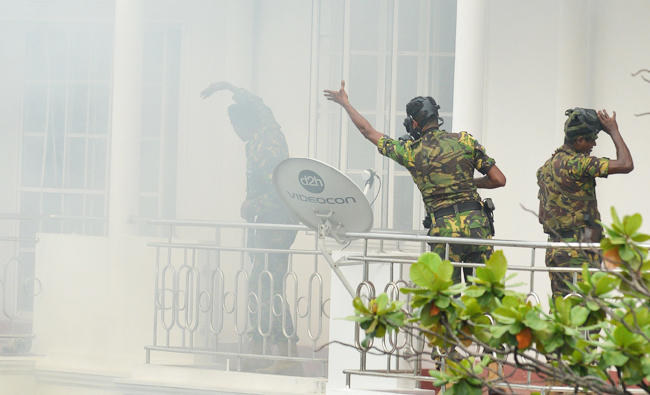
COLOMBO, Sri Lanka: At least 290 people were killed in a series of nine bombings of churches and hotels in Sri Lanka on Easter Sunday.
Sri Lankan authorities say at least 30 foreigners died in the attacks. A look at some of the countries whose citizens were among the victims:
SRI LANKA: The vast majority of the victims were believed to be Sri Lankan citizens, many of them members of the island nation’s Christian minority. Names of many victims and other details on their lives were slow to trickle in and difficult to report, in part because Sri Lankan authorities blocked most social media after the blasts.
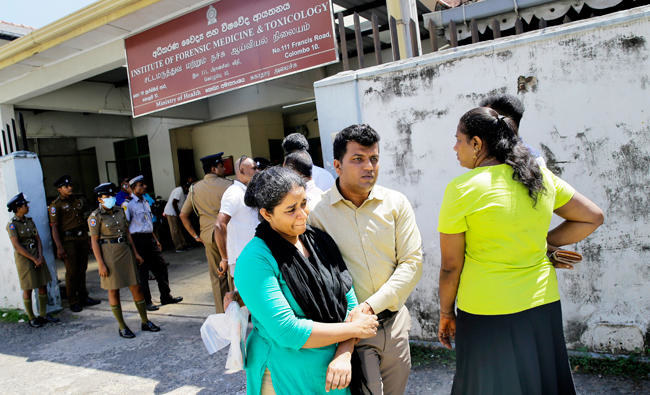
But among them was Dileep Roshan, 37, a carpenter who left behind a wife and daughter, his family told The Associated Press.
“His wife and daughter won’t be able to do much now because he is gone,” his older brother, Sanjeevani Roshan, said. “The real question is what will happen to their future.”
UK: Sri Lanka’s top diplomat in Britain says authorities know of eight British nationals killed in the bombings.
Among them were lawyer Anita Nicholson, son Alex Nicholson and daughter Annabel Nicholson, her husband, Ben Nicholson, confirmed in a statement. Nicholson said the family was on holiday, sitting at the table of the restaurant of the Shangri-la Hotel when they were killed. He said: “The holiday we had just enjoyed was a testament to Anita’s enjoyment of travel and providing a rich and colorful life for our family, and especially our children.”
INDIA: Indian officials say eight Indians died in the attacks.
DENMARK: The Bestseller clothing chain confirmed Danish media reports that three of the children of its owner, business tycoon Anders Holch Povlsen, were killed in the attacks. However, spokesman Jesper Stubkier gave no details in an emailed response to a query on the matter and said the company had no further comment.
SPAIN: Spain’s foreign ministry says a Spanish man and woman were killed but didn’t provide further details. The mayor of Pontecesures in northwest Spain, Juan Manuel Vidal, tells Radio Galega he knew the local pair and says they were in their 30s, according to a report by Spanish private news agency Europa Press.
AUSTRALIA: Australia’s prime minister says a mother and daughter from that country were killed. Manik Suriaaratchi and her 10-year-old daughter Alexendria were attending a church service in Negombo when they died.
CHINA: Chinese state media say two of the country’s citizens died in the blasts.
UNITED STATES: The State Department says at least four Americans were killed and several others seriously injured. It gave no details about the victims’ identities.
Fifth-grader Kieran Shafritz de Zoysa, spending a year in Sri Lanka on leave from the private Sidwell Friends School in Washington, D.C., was among those killed, the school said in an email to parents, according to the Washington Post . The email said: “Kieran was passionate about learning, he adored his friends, and he was incredibly excited about returning to Sidwell Friends this coming school year.”
Dieter Kowalski, who lived in Denver and worked for international education company Pearson, died in the blasts shortly after he arrived at his hotel for a business trip, the company and his family told AP . A Friday Facebook post reads “And the fun begins. Love these work trips. 24 hours of flying. See you soon Sri Lanka!“
SWITZERLAND: The foreign ministry says two Swiss nationals, one of whom also had the citizenship of another country it didn’t name, died in the attacks. It said a third member of the family, who had two non-Swiss citizenships, also was killed. It didn’t identify the victims.
OTHERS: The Netherlands, Japan and Portugal have also confirmed their nationals were among the dead.


Sri Lanka bombing victims were from at least 12 countries
Sri Lanka bombing victims were from at least 12 countries



Pakistani fighter jet crashes in Jalalabad, pilot captured: Afghan military, police
- Fighting between Pakistan and Afghanistan’s Taliban military entered its third day on Saturday
- Pakistan’s strikes on Friday hit Taliban military installations and posts, including in Kabul and Kandahar
JALALABAD: A Pakistani jet has crashed in Jalalabad city and the pilot captured alive, the Afghan military and police said Saturday, with residents telling AFP the man parachuted from the plane before being detained.
"A Pakistani fighter jet was shot down in the sixth district of Jalalabad city, and its pilot was captured alive," police spokesman Tayeb Hammad said.
Wahidullah Mohammadi, spokesman for the military in eastern Afghanistan, confirmed the Pakistani jet was downed by Afghan forces "and the pilot was captured alive".
The AFP journalist heard a jet overhead before blasts from the direction of the airport in Jalalabad, the capital of Nangarhar province, which sits on the road between Kabul and the Pakistani border.
Fighting between Pakistan and Afghanistan’s Taliban military entered its third day on Saturday, following overnight clashes as the international community expressed increasing concern about the conflict and called for urgent talks.
Pakistan’s strikes on Friday hit Taliban military installations and posts, including in Kabul and Kandahar, in one of the deepest Pakistani incursions into its western neighbor in years, officials said.
Islamabad accuses the Taliban of harboring Tehreek-e-Taliban Pakistan (TTP) militants, who it claims are waging an insurgency inside Pakistan, a charge the Taliban denies.
Pakistan described its actions as a response to cross-border assaults, while Kabul denounced them as a breach of its sovereignty, saying it remained open to dialogue but warned any wider conflict would result in serious consequences.
The fighting has raised the risk of a protracted conflict along the rugged 2,600-kilometer frontier.
Diplomatic efforts gathered pace late on Friday as Afghanistan said its foreign minister, Amir Khan Muttaqi, spoke by telephone with Saudi Arabia’s Prince Faisal bin Farhan about reducing tensions and keeping diplomatic channels open.
The European Union called for both sides to de-escalate and engage in dialogue, while the United Nations urged an immediate end to hostilities.
Russia urged both sides to halt the clashes and return to talks, while China said it was deeply concerned and ready to help ease tensions.
The United States supports Pakistan’s right to defend itself against attacks by the Taliban, a State Department spokesperson said.
Border fighting continues
Exchanges of fire continued along the border overnight.
Pakistani security sources said an operation dubbed “Ghazab Lil Haq” was ongoing and that Pakistani forces had destroyed multiple Taliban posts and camps in several sectors. Reuters could not independently verify the claims.
Both sides have reported heavy losses with conflicting tolls that Reuters could not verify. Pakistan said 12 of its soldiers and 274 Taliban were killed while the Taliban said 13 of its fighters and 55 Pakistani soldiers died.
Taliban deputy spokesman Hamdullah Fitrat said 19 civilians were killed and 26 wounded in Khost and Paktika. Reuters could not verify the claim.
Pakistan’s Defense Minister Khawaja Muhammad Asif said “our cup of patience has overflowed” and described the fighting as “open war,” warning that Pakistan would respond to further attacks.
Taliban Interior Minister Sirajuddin Haqqani said in a speech in Khost province that the conflict “will be very costly,” and that Afghan forces had not deployed broadly beyond those already engaged.
He said the Taliban had defeated “the world, not through technology, but through unity and solidarity,” and through “great patience and perseverance,” rather than superior military power.
Pakistan’s military capabilities far exceed those of Afghanistan, with a standing army of hundreds of thousands and a modern air force.
In stark contrast, the Taliban lacks a conventional air force and relies largely on light weaponry and ground forces.
However, the Islamist group is battle-hardened after two decades of insurgency against US-led forces before returning to power in 2021.


