How a suicide bomber at one Sri Lankan church turned Easter celebration into ‘hell’

1 / 5
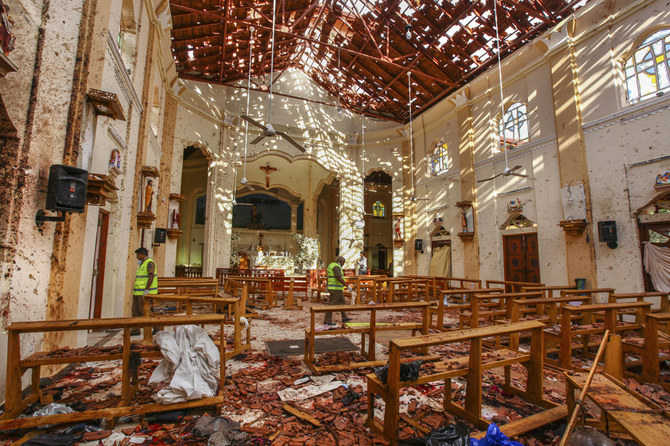
Security personnel inspect the interior of St Sebastian's Church in Negombo, Colombo, that was shattered by an Easter Sunday bomb attack. (AP Photo/Gemunu Amarasinghe)
2 / 5
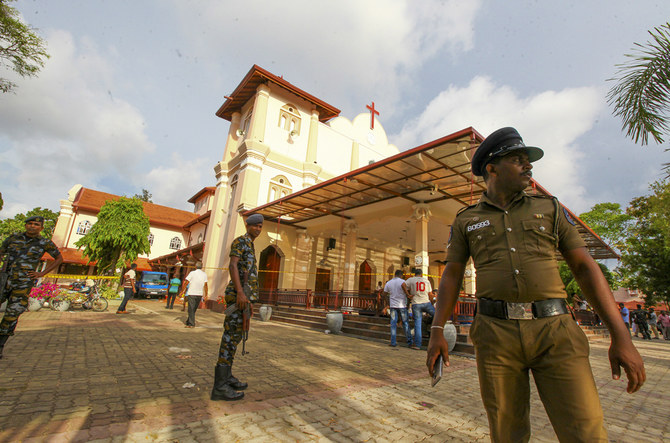
Sri Lankan army soldiers secure the area around St. Sebastian's Church that was damaged in bomb attack in Negombo, north of Colombo on Easter Sunday, April 21, 2019. (AP Photo/Chamila Karunarathne)
3 / 5
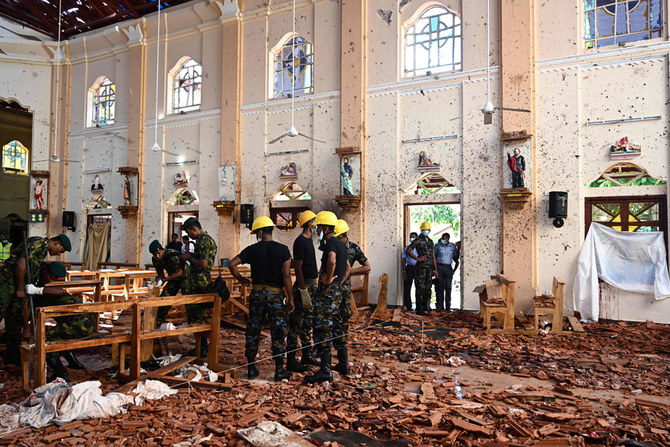
Security personnel inspect the interior of St Sebastian's Church in Negombo on April 22, 2019, a day after the church was hit in series of bomb blasts targeting churches and luxury hotels in Sri Lanka. (AFP / Jewel Samad)
4 / 5
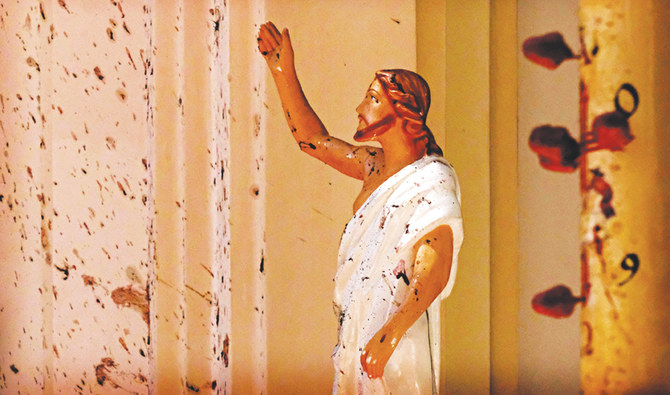
Blood stains are seen on the wall and on a Jesus Christ statue at St. Sebastian’s Church. (AP)
5 / 5
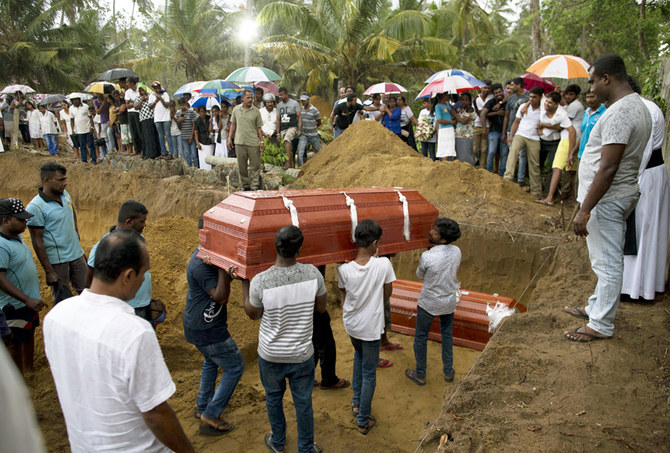
Relatives carry a coffin for burial during the funerals of three members of the same family, all died at Easter Sunday bomb blast at St. Sebastian Church in Negombo, Sri Lanka, on April 22, 2019. (AP Photo/Gemunu Amarasinghe)
Updated 23 April 2019
Follow

How a suicide bomber at one Sri Lankan church turned Easter celebration into ‘hell’

  • Priest from St. Sebastian’s parish and man who lost parents in the blast tell Arab News about the carnage
  • Two cabin crew from Saudi Arabian Airlines were among the foreign victims in Sunday’s attacks

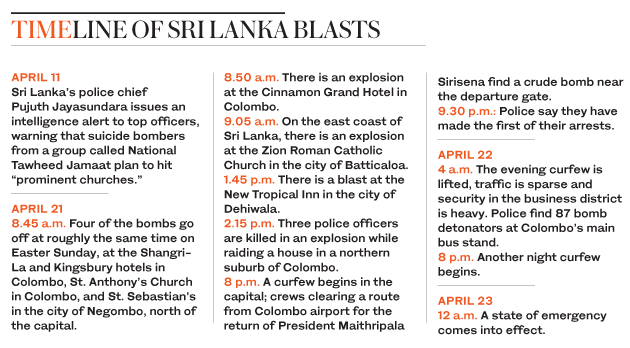
DUBAI/COLOMBO: The children would have been gathered in the middle of St. Sebastian’s church with their families during the Easter Sunday morning mass when the bomber detonated his device, killing more than 100 people.

Just months before, on Jan. 20, the church congregation had celebrated its 150th anniversary, the building having recently undergone a major renovation.

But with the flick of a switch, its interior was reduced to rubble, mutilated bodies strewn across the pews and the floor where they had previously knelt to pray.
 “It was supposed to be a day of celebration,” said Dubai-based priest Father Jude Angelo. “Instead, we’re mourning such a terrible loss.”

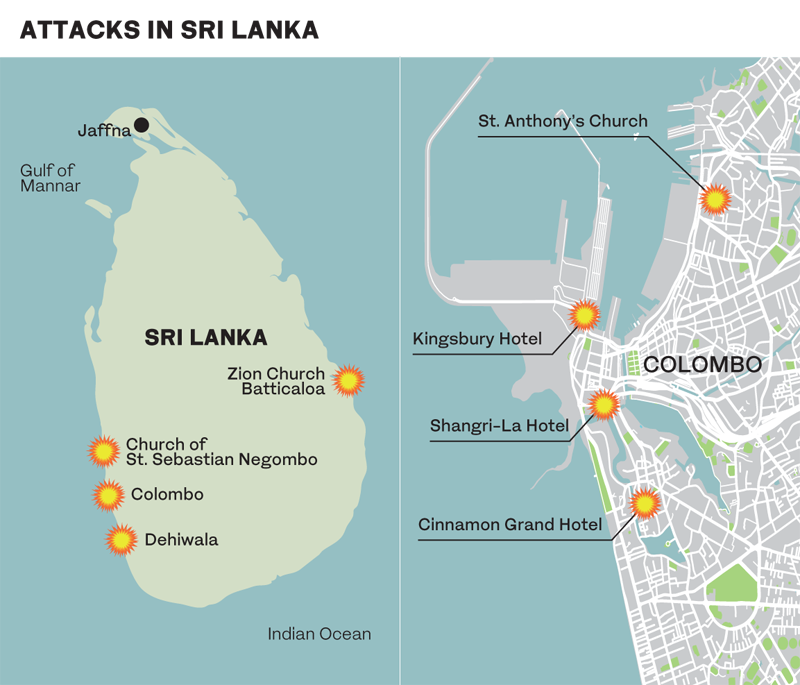
He is currently the assistant priest at Jebel Ali Church in Dubai, but his home is the Sri Lankan village of Katuwapitiya, where he was a member of St. Sebastian’s parish, the site of the deadliest of Sunday’s attacks, which killed at least 290 and injured more than 500 in churches and hotels across the country.

 “I’ve been told that the bomber detonated his device while standing in the middle of the church,” he said.

 “That’s where most of the children — some very young — and their families would’ve been congregated. I don’t understand the meaning of this attack … I just feel numb.”

Father Angelo found out about the blast via his mobile phone: People sent him images from inside the church.

“I have no words to express what I saw in those images. The church is broken. I saw images of dead bodies … parts of bodies … You couldn’t tell who these people were, their bodies were so badly mutilated,” he said.
The congregation now has to plan for dozens of funerals. The roads leading to St. Sebastian’s are lined with white flags and throngs of crowds despite the heat.

Almost every other home along the lanes have banners hanging outside the walls, announcing deaths of family members. The whole neighborhood is in mourning.

Malith Wimanna was due to fly out for a conference in Malaysia on Monday, and went for mass on Saturday evening instead. His parents attended the Sunday mass, and both lost their lives in the attack.

“I ran to the church as soon as I heard about the attack,” he said. “It was hell. I couldn’t think of anything else. There was nothing to feel, nothing came to mind.”

Wimanna identified both his parents in the debris. He said both had possibly died instantly, and his father was almost unidentifiable.  

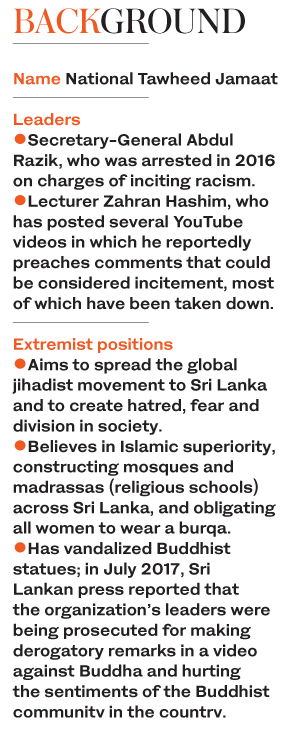
The government announced on Monday that the attackers were members of the National Tawheed Jamaath (NTJ), an extremist Muslim group that appeared after the Sri Lankan civil war ended in 2009. 

“The Catholics and Christians here are a very peaceful community,” said Father Anton Canisius, one of the many priests present at the funeral of Wimanna’s parents.

When asked about fears of the NTJ’s attacks propelling communal violence, the soft-spoken priest insisted that none of the Sri Lankan Catholic community would retaliate.

“There are people who’ll try to take advantage of these situations and try to make use of this. We’ve asked the government for security and for it to maintain peace,” he said.

Minister of Transport and Highways Kabeer Hashim on Monday announced compensation for those killed and injured in the blasts. He also said the damaged churches will be restored by the state to their original condition.

Easter is a popular time for holidaymakers to visit Sri Lanka from all over the world, and dozens of the victims of Sunday’s attacks were foreign tourists.

Among the foreigners killed were Mohamed Jafar and Hany Osman, cabin crew from Saudi Arabian Airlines, who were in transit at one of the three hotels hit. As of Monday evening their families, who had arrived in Colombo, had not yet finalized burial arrangements, though they were in consultation with the Saudi Embassy in Colombo, currently headed by Ambassador Abdulnasser Al-Harthi.

Tourism Minister John Amaratunga said in a statement that his ministry is working closely with the Foreign Ministry and local diplomatic missions to “ensure formalities with regard to the victims are sorted out as quickly as possible.”

He added: “The government has already offered assistance to all victims, the damaged places of worship as well as the hotels affected by Sunday’s attacks.”
Foreign victims were also from Japan, Australia, France, the US, India, Bangladesh, the UK, China, Turkey, Portugal, Spain, Belgium, the Netherlands and Denmark. They included three of the four children of Danish business tycoon Anders Holch Povlsen, who is the Nordic country’s richest man and a major private landowner in Britain. 

Seventeen foreigners injured in the attacks are also being treated at the Colombo National Hospital as well as a private hospital in Colombo, while others have been treated and discharged.

Many of the tourists were killed in suicide attacks that targeted four hotels. At the Cinnamon Grand Hotel in Colombo, a suicide bomber waited in a queue for the Easter Sunday breakfast buffet before setting off explosives strapped to his back.

 At the capital’s Shangri-La Hotel, Sri Lankan celebrity chef Shantha Mayadunne was enjoying breakfast with her family in the dining room. Her daughter Nisanga had posted a photo of the group on Facebook.

 Minutes later, a massive explosion ripped through the hall, killing several, including the mother and daughter.

 “It is with great sadness that we can confirm that we are aware of a number of casualties among our guests and colleagues. This includes three of our colleagues, who were fatally injured in the course of their duties,” a Shangri-La spokeswoman said in a statement.

 “We will continue to work closely with local authorities and emergency services to provide our fullest assistance and support to all affected parties,” she added.

 “Our hotel remains secured by the military and the police. We have also decided that the hotel will be closed until further notice.”

 The spokeswoman said the hotel is providing alternative accommodation for affected guests, and has set up a dedicated helpline for guests and their loved ones to call: +603 2025 4619.


With Iran war exit elusive, Trump aides vie to affect outcome

Updated 13 sec ago
Follow

With Iran war exit elusive, Trump aides vie to affect outcome

  • Aides debate when and how to declare victory even as the conflict spreads across the Middle East
  • In taking America to war, US President Donald Trump offered little explanation

WASHINGTON: A complex tug-of-war inside the White House is driving US President Donald Trump’s shifting public statements on the course of the Iran war, as aides debate when and how to declare victory even as the conflict spreads across the Middle East.

Some officials and advisers are warning Trump that surging gasoline prices could exact a political cost from the US-Israeli attacks on Iran, while some hawks are pressing the president to maintain the offensive against the Islamic Republic, according to interviews with a Trump adviser and others close to the deliberations.

Their observations to Reuters offer a previously unreported glimpse inside White House decision-making as it adjusts its approach to the biggest US military operation since the 2003 Iraq war.

Shifting messages, various internal viewpoints

The behind-the-scenes maneuvering underscores the high stakes Trump, who returned to office last year promising to avoid “stupid” military interventions, faces nearly two weeks after plunging the nation into a war that has rattled global financial markets and disrupted the international oil trade.

The jockeying for Trump’s ear is a feature of his presidency, but this time the consequences are a matter of war and peace in one of the world’s most volatile and economically critical regions.

Shifting from the sweeping goals he framed in launching the war on February 28, Trump in recent days has emphasized that he views the conflict as a limited campaign whose objectives have mostly been met.

But the message remains unclear to many, including the energy markets, which have lurched in both directions in response to Trump’s statements.

He told a campaign-style rally in Kentucky on Wednesday that “we won” the war, then abruptly pivoted: “We don’t want to leave early, do we? We’ve got to finish the job.”

Economic advisers and officials, including from the Treasury Department and the National Economic Council, have warned Trump that an oil shock and rising gasoline prices could quickly erode domestic support for the war, said the adviser and two others close to the deliberations, speaking on the condition of anonymity to disclose internal discussions.

Political advisers, including Chief of Staff Susie Wiles and deputy chief James Blair, are making similar arguments, focusing on the political fallout from higher gas prices and urging Trump to define victory narrowly and signal the operation is limited and nearly finished, the sources said.

Pushing in the other direction are hawkish voices urging Trump to sustain military pressure on Iran, including Republican lawmakers such as US Senators Lindsey Graham and Tom Cotton, and media commentators such as Mark Levin, according to people familiar with the matter.

They argue the US must prevent Iran from obtaining a nuclear weapon and respond forcefully to attacks on American troops and shipping.

A third force comes from Trump’s populist base and figures such as strategist Steve Bannon and right-wing television personality Tucker Carlson, who have been pressing him and his top aides to avoid getting dragged into another prolonged Middle East conflict.

“He is allowing the hawks to believe the campaign continues, wants markets to believe the war might end soon and his base to believe escalation will be limited,” the Trump adviser said.

Asked for comment, White House press secretary Karoline Leavitt said in a statement: “This story is based on gossip and speculation from anonymous sources who aren’t even in the room for any discussions with President Trump.

“The President is known for being a good listener and seeking the opinions of many people, but ultimately everyone knows he’s the final decision maker and his own best messenger,” she said. “The President’s entire team is focused on ensuring the objectives of Operation Epic Fury are fully achieved.”

Other people named for their roles in the deliberations did not immediately respond to Reuters’ questions.

Looking for an exit

In taking America to war, Trump offered little explanation, and the administration’s stated war aims have ranged from thwarting an imminent attack by Iran to crippling its nuclear program to replacing its government.

As he seeks an exit from an unpopular conflict, Trump is trying to juggle competing narratives that some critics say have complicated an already difficult situation, with Iran defiant despite the devastating US-Israeli air assault.

Top political aides and economic advisers, whose warnings before the war of the potential economic shock were largely ignored, appear to have played a major role in pushing Trump’s efforts this week to reassure skittish markets and contain rising oil and gas prices.

His public shift to downplaying the war’s impact, describing it as a “short-term excursion,” and his insistence that gas price hikes would be short-lived appeared aimed at calming fears of an open-ended conflict.

Some top aides have advised him to work toward a conclusion to the conflict that he can call a triumph, at least militarily, the sources said, even if much of the Iranian leadership survives, along with remnants of a nuclear program that the campaign was meant to target.

Wave after wave of US and Israeli air strikes have killed a number of top Iranian leaders among some 2,000 people overall – some as far away as Lebanon – devastated its ballistic missile arsenal, sunk much of its navy and degraded its ability to support armed proxies around the Middle East.

But the military achievements have been seriously undercut by Iran’s stepped-up attacks on oil tankers and transport facilities in the Gulf, driving up oil prices.

Trump has said he will decide when to end the campaign. He and his aides say they are far ahead of the four- to six-week timeframe Trump initially announced.

The shifting reasons for launching the conflict, which has spilled over into more than half a dozen other countries, have only made it more difficult to predict what comes next.

For their part, Iran’s rulers will claim victory, analysts say, for simply surviving the US-Israeli onslaught, especially after demonstrating their ability to fight back and inflict damage on Israel, the US and its allies.

Venezuela miscalculation

Critical to the war’s final trajectory will be the Strait of Hormuz. A fifth of the world’s oil shipments, which normally traverses the narrow waterway, has come to a near-standstill. Iran in recent days has struck tankers in Iraqi waters and other ships near the strait, and the new Supreme Leader Mojtaba Khamenei has vowed to keep it shut.

If Iran’s stranglehold on the waterway pushes US gas prices high enough, that could increase political pressure on Trump to end the military campaign to help his Republican Party, which is defending narrow majorities in Congress in November’s midterm elections.

Trump has recently refrained from pushing the idea that the war seeks to topple the government in Tehran. US intelligence indicates that Iran’s leadership is not at risk of collapse anytime soon, Reuters reported on Wednesday.

At least some of the confusion over the war’s trajectory appears rooted in the quick US military success in Venezuela.

Since the start of the war, some aides have struggled to convince Trump that the Iran campaign was unlikely to unfold in the same way as the January 3 Venezuela raid that captured President Nicolas Maduro, according to another source familiar with the administration’s thinking.

That operation opened the way for Trump to coerce former Maduro loyalists into giving him considerable sway over the country’s vast oil reserves – without requiring extended US military action.

Iran, by contrast, has proved a much tougher, better-armed foe with an entrenched clerical and security establishment.

Experts have rejected claims by Trump aides that Iran had been within weeks of being able to produce a nuclear weapon, despite the president’s insistence in June that US-Israeli bombing had “obliterated” its nuclear program.

Most of Iran’s stockpile of highly enriched uranium is believed to have been buried by the June strikes, meaning the material potentially could be retrieved and purified to bomb grade. Iran has always denied seeking nuclear weapons.

If the war drags on, American casualties mount and the economic costs multiply, some analysts say it could erode backing from Trump’s political base. But despite criticism from some supporters opposed to military interventions, members of his “Make America Great Again” movement have so far largely stayed with him on Iran.

“The MAGA base is going to give the president wiggle room,” said Republican strategist Ford O’Connell.