

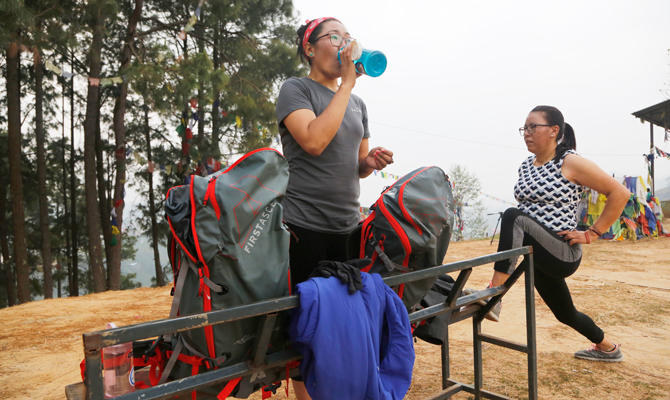
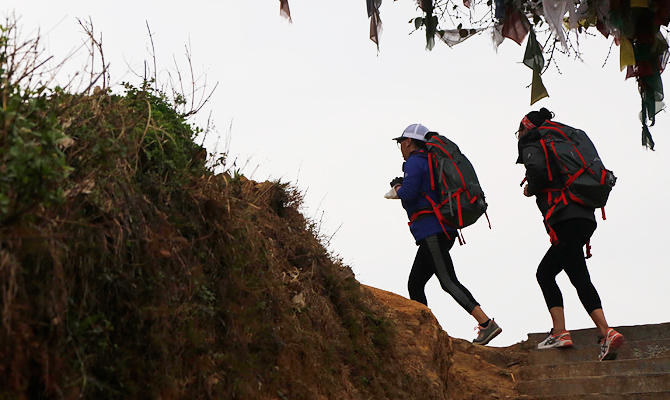
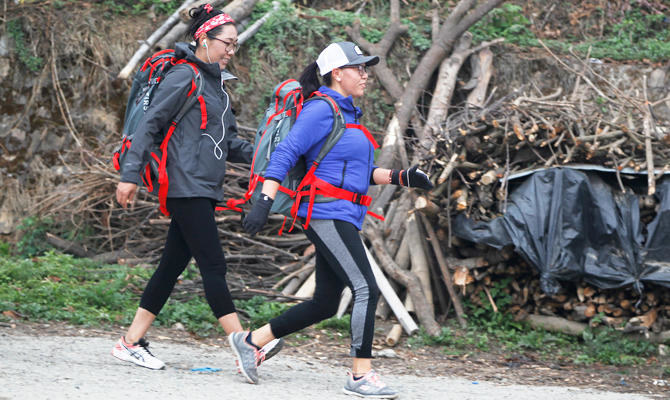
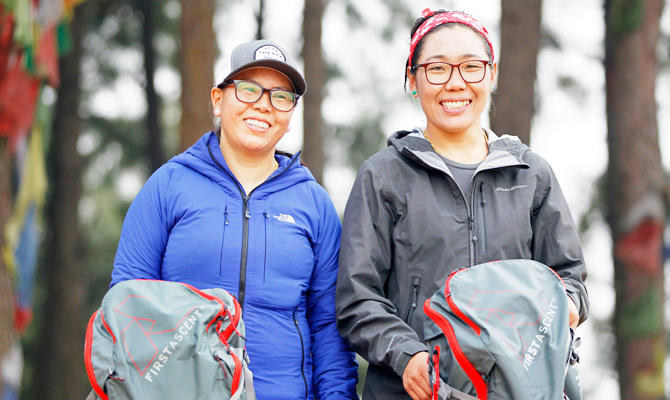

KATMANDU: Two Nepali Sherpa women hope to conquer Mount Everest next month, finishing off the job their husbands started in a bid to empower fellow widows and prove there is life after death.
In a conservative country — which routinely elevates men over women — widowhood can confine a bereaved wife to an even lower life of hostility, discrimination and outright abuse.
So the two women hope that by scaling the world’s highest mountain they can upturn perceptions about a widow’s worth and complete the unfinished ascent of their husbands, who died working as guides for foreign mountaineers.
“I felt like I had lost everything when he died. I couldn’t think or function like a normal human being. I had become insane,” said Furdiki Sherpa, as she readied for her big trip.
With a photo of her dead husband alongside, Furdiki sifted through a giant duffel bag crammed with climbing gear, from crampons to carabiners, boots to ropes.
It was while fixing ropes for his clients that her husband died on the 8,850-meter (29,035-ft) mountain in April 2013.
A year later, Nima Doma Sherpa’s husband was killed along with 15 other Sherpas in an avalanche near the base camp.
The grief of losing a partner — let alone sole breadwinner and father to their children — was further compounded, they said, by the social stigma that comes with being a widow.
“There is a huge difference between how society treats married women and widowed women,” Furdiki, a mother of three, told the Thomson Reuters Foundation in her cramped living room.
“If I hang out with my friends, especially men, that’s a problem. If I try to have fun, that’s a problem. If I ride pillion, that’s a problem ... Neighbours take photos, call me immoral and loose, and try to shame me,” said the 43-year-old.
Nima Doma’s situation has been no different.
“The taboo is still very much alive,” she said.
“Many people, even today, think we should be confined to our homes, restrict ourselves only to household work. That is just wrong,” said the 35-year-old widow.
Widows in South Asia are generally expected to mourn until the end of their lives, renouncing colorful clothes, jewelry, rich and spicy food, and even festivals as they are deemed inauspicious, say women’s rights experts.
According to The Loomba Foundation, a widows’ rights charity, widows in developing countries are routinely disinherited, enslaved or evicted by their in-laws, accused of witchcraft or forced to undergo abusive sexual rituals.
’WE CAN DO IT TOO’
Tired of conforming, Furdiki and Nima Doma — who like most Sherpa, go by their first name — decided to fight back after they met at an event in the capital of Katmandu in 2017.
“We realized we are not alone, all of us are facing these things. The two of us thought: ‘Why not break this tradition of mistreatment ... and actually change things? What’s wrong if we step out and live life?’,” said Nima Doma.
That meeting paved the way for their “Two Widow Expedition.”
“We decided that our slogan would be ‘We can do it too’ to tell people that widows can do anything,” said Nima Doma as her two children played in their dimly-lit home.
The women are not related but belong to the Himalayan ethnic group of Sherpas, who are renowned for endurance and an ability to operate at high altitudes.
While many Sherpa men risk their lives to help paying climbers to the highest Himalayan peaks, hundreds work as porters hauling up tents, ladders, food and oxygen cylinders during the main climbing season from March to May.
Like Furdiki and Nima Doma, many Sherpa women have been widowed by Everest.
Since the year 1900, nearly 100 Sherpas have died — about a third of all Everest deaths — according to the Himalayan Database, an archive tracking major Nepali climbs.
That is why many like Lily Thapa, founder of Nepal’s Women for Human Rights, are pinning hopes on this expedition to motivate other widows and help change attitudes. “This will encourage other women, especially widows,” she said.
’REST IN PEACE’
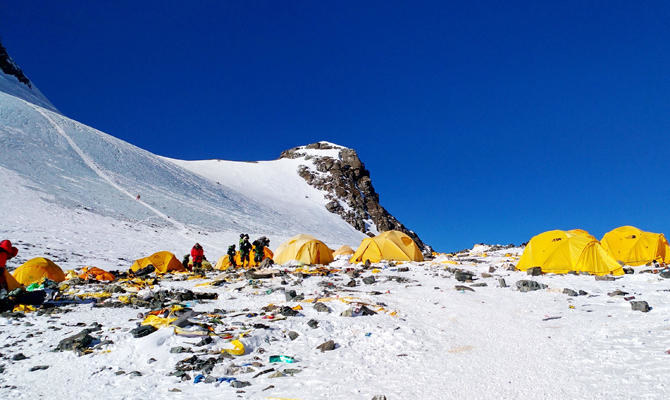
Furdiki and Nima Doma were expected to reach the Everest base camp by April 22, from where they will begin their ascent into a predominantly male domain.
Everest, which straddles the Nepal-China border, has been climbed by nearly 5,000 people since it was first scaled by New Zealander Sir Edmund Hillary and Tenzing Norgay Sherpa in 1953, according to a post by Everest blogger Alan Arnette.
About 550 of them were women.
The numbers make sense given women are not encouraged to climb but are groomed to keep house, said Nima Doma.
Attempting their Everest dream was an uphill battle.
With no steady income, zero climbing experience and deep family reluctance — now overcome — the two widows faced a tough choice: raise awareness or stay with loved ones.
They chose Everest.
“Nima and I were too determined. We both have the same vision, the same resolve. We are two bodies, one heart,” said Furdiki.
For six months, they traveled Nepal — home to eight of the world’s 14 highest mountains — to raise more than $40,000.
The money helped them get rigorous mountaineering training, which included a series of trekking and wall climbing courses. Both are now certified trekking guides.
In November, they successfully climbed Island Peak and Chulu Far East Peak, both more than 6,000 meters (19,700 feet) high.
“We are confident that we will make it to the top. But that is not the end goal. We have to come back down,” said Nima Doma.
After their descent, they plan to launch a charity to raise funds and help widows learn new skills.
“If I can empower widows through this expedition somehow, I think my husband’s soul will rest in peace,” she said.
“I’m sure he would be very proud of me.”


