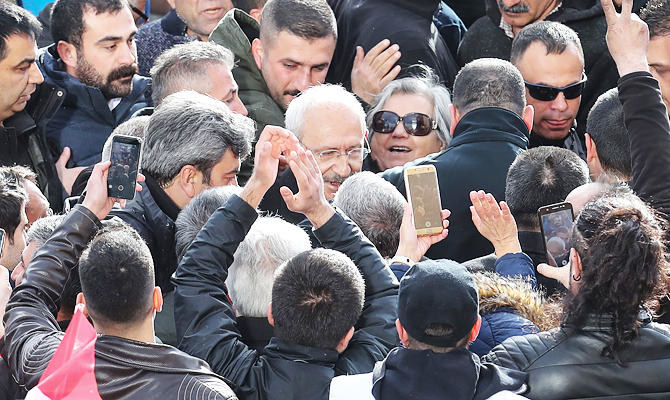
ANKARA: Kemal Kilicdaroglu, the leader of Turkey’s main opposition Republican People’s Party (CHP), was attacked by an angry mob at a military funeral on Sunday.
Kilicdaroglu was reportedly kicked and punched by a number of assailants at the ceremony for one of four soldiers killed in clashes with the Kurdish separatist terror group Kurdistan Workers’ Party (PKK) along the Turkey-Iraq border on Friday.
Turkish nationalists and pro-government supporters have accused the CHP of working with the pro-Kurdish People’s Democratic Party (HDP) during Turkey’s local elections on March 31, when Kurdish votes for opposition candidates were instrumental in the government losing major cities including Ankara and Istanbul — although it is contesting the latter result.
Even after Kilicdaroglu was taken to a safe house, the attack continued as the mob gathered outside, throwing stones and chanting, “Burn down the house.”
The opposition leader was taken away in an armored vehicle just one hour after arriving. Defense Minister Hulusi Akar traveled to the area to try and calm the crowd.
The Ankara governor’s office announced that legal action is being taken against the perpetrators of the attack and that additional security forces have been provided to protect Kilicdaroglu. But the governor’s definition of the attack as “a protest,” rather than an attempted lynching, drew criticism.
Burhanettin Bulut, a lawmaker and member of the CHP, said the attack was the result of long-running provocation from the ruling Justice and Development Party (AKP) and its nationalistic ally, the Nationalist Movement Party (MHP), as well as media outlets close to them.
“Unfortunately, the danger of further escalation of such hate speech and violence still prevails in the country, especially in rural areas,” he told Arab News.
Kilicdaroglu escaped an assassination attempt by PKK militants three years ago in northwestern Anatolia. In 2014, he was punched by a member of the public
in Parliament.
Several commentators have suggested that the ongoing climate of polarization in Turkey, where demonizing opponents of the government as “terrorists” has become the norm, ranks among the main reasons behind Sunday’s attack, after which the CHP called an extraordinary meeting of its members.
On the same day, the pro-government Turkish daily Gunes blamed Istanbul’s new mayor Ekrem Imamoglu for the deaths of the four soldiers, running the headline, “Are You Happy, Ekrem?”
Sunday’s attack coincided with a rally held by the new mayor of Istanbul, Imamoglu, to thank the city’s inhabitants. Hundreds of thousand of people reportedly attended.
In June last year, Interior Minister Suleyman Soylu announced the imposition of a ban on CHP officials attending soldiers’ funerals, suggesting that they should instead put in an appearance at the funerals of PKK militants killed by Turkish forces.


![]()

Turkey’s opposition leader attacked at soldier’s funeral
Turkey’s opposition leader attacked at soldier’s funeral
- Kilicdaroglu escaped an assassination attempt by PKK militants three years ago in northwestern Anatolia


Latest updates


© 2026 SAUDI RESEARCH & PUBLISHING COMPANY, All Rights Reserved And subject to Terms of Use Agreement.