KIEV: A comedian with no political experience won a landslide victory in Ukraine’s presidential election on Sunday, exit polls showed, dealing a stunning rebuke to the country’s political establishment.
Volodymyr Zelensky, whose only previous political role was playing the president in a TV show, trounced incumbent Petro Poroshenko by taking 73 percent of the vote, according to exit polls conducted by several think tanks.
It was an extraordinary outcome to a campaign that started as a joke but struck a chord with voters frustrated by poverty, corruption and a five-year war in eastern Ukraine that has claimed some 13,000 lives.
The 41-year-old star of the TV series “Servant of the People” will now take the helm of a country of 45 million people beset by challenges and having run on the vaguest of political platforms.
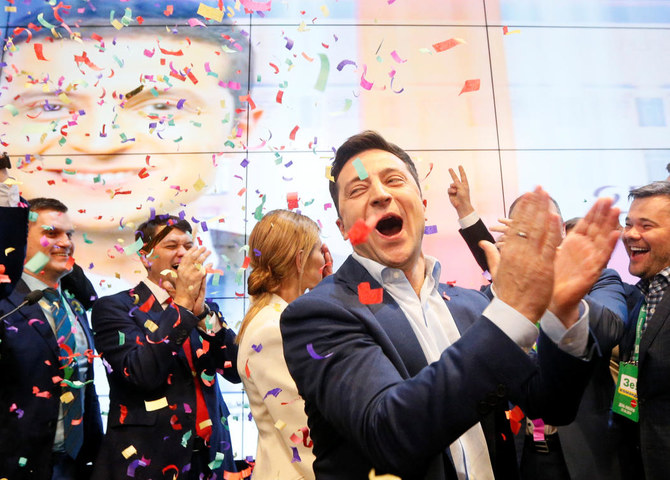
“I will never let you down,” Zelensky told jubilant supporters at his Kiev campaign headquarters where he was showered with glittering confetti after the exit polls were released.
“While I am not formally president yet, as a citizen of Ukraine I can tell all post-Soviet countries: ‘Look at us! Everything is possible!’.”
Zelensky won in all regions of the country, defeating Poroshenko even in the west where he traditionally enjoyed strong support.
Poroshenko, 53, conceded defeat in a speech at his campaign headquarters.
He said the results were “clear” and enough reason to “call my opponent and congratulate him.”
“I will leave office but I want to firmly stress — I will not quit politics,” Poroshenko said.
Preliminary results were expected in several hours but the same exit polls were accurate in the first round of the election.
After taking the most votes in last month’s first-round vote, Zelensky had enjoyed a strong lead going into Sunday’s poll.
From Ukrainian-speaking regions in the west of the country to Russian-speaking territories in the war-torn east, many voters said they feared uncertainty but yearned for change.
“We’re tired of all the lies,” said Marta Semenyuk, 26, who cast her ballot for the comedian.
“I think it just cannot get any worse and I hope he’ll live up to his promises,” said Larisa, an 18-year-old student from the government-held eastern port city of Mariupol.
Zelensky’s victory opens a new chapter in the history of a country that has gone through two popular uprisings in the last 20 years and is mired in a conflict with Moscow-backed separatists in the east.
His supporters say only a fresh face can clean up Ukraine’s politics and end the separatist conflict.
But others doubt the showman will be able to take on the country’s influential oligarchs, negotiate with the likes of German Chancellor Angela Merkel and stand up to Russia’s Vladimir Putin.
“People have gone mad,” Viktoriya Olomutska, a 39-year-old Poroshenko supporter, said in Kiev. “Cinema and reality are two different things.”
Poroshenko had previously mocked his rival’s lack of political experience and argued he was unfit to be a wartime commander-in-chief.
The outgoing leader came to power after a 2014 pro-Western uprising ousted a Kremlin-backed regime, triggering Moscow’s annexation of Crimea.
His supporters credited him with rebuilding the army and securing an Orthodox Church independent of Russia.
But many feel the country’s ruling elite have forgotten the promises of the revolution.
The comic shunned traditional campaign rallies and instead performed comedy gigs and used social media to appeal to voters.
The Ukrainian president has strong powers over defense, security and foreign policy but needs backing from parliament to push through reforms.
Poroshenko’s faction has the most seats in the current legislature and new parliamentary polls are due in October.
The West has closely watched the race amid concern a new government might undo years of economic reforms.
US Secretary of State Mike Pompeo called both Zelensky and Poroshenko on the eve of the run-off vote.


![]()

Comedian Zelensky wins Ukrainian presidency
Comedian Zelensky wins Ukrainian presidency
- Petro Poroshenko tried to rally Ukrainians around the flag and national identity
- Zelenskiy is a comedian with no political experience and few detailed policies


Latest updates


© 2026 SAUDI RESEARCH & PUBLISHING COMPANY, All Rights Reserved And subject to Terms of Use Agreement.