

Pakistan minister urges Iran to take action against terror camps inside its borders

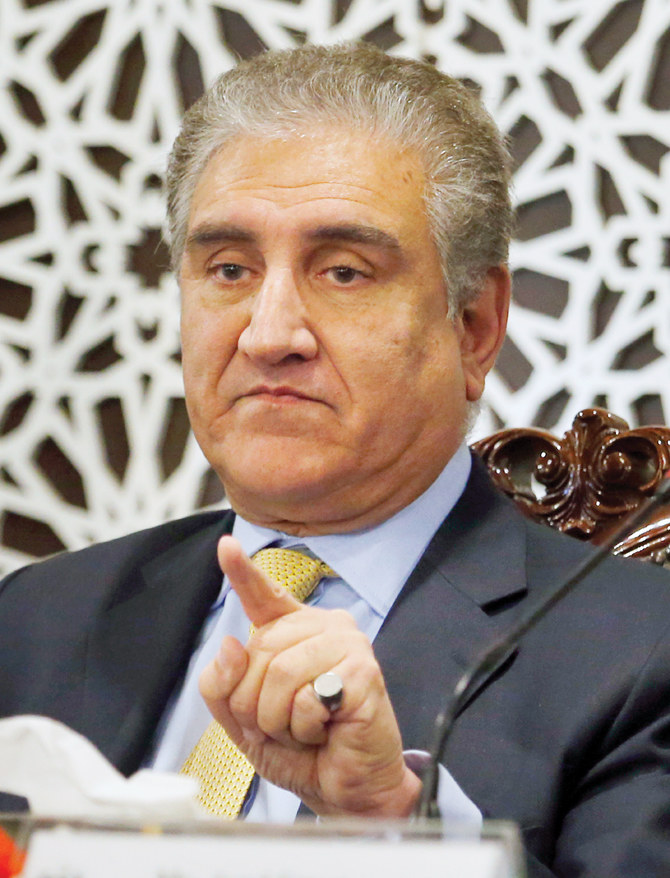
Pakistani Foreign Minister Shah Mahmood Qureshi . (AP)
Updated 21 April 2019
Follow

Pakistan minister urges Iran to take action against terror camps inside its borders

  • Pakistan doing ‘everything’ to facilitate peace process, says spokesperson

ISLAMABAD: Pakistan has demanded that neighboring Iran take action against “terrorist camps” in its border regions following an attack in Balochistan that left 14 army personnel dead.

The move comes amid fears that the situation could escalate into a full-blown conflict between the two countries if it is not resolved.

On Thursday, gunmen disguised as Pakistani security officials forced passengers off buses on the Makran coastal highway in the southwestern province bordering Iran and killed 14 Pakistani army personnel.

“We have identified terrorist camps that exist in Iran’s border areas,” Foreign Minister Shah Mehmood Qureshi said. 

“We are hopeful Iran will take action against these terrorists. Today, I had a detailed conversation with the Iranian foreign minister in which I conveyed Pakistan’s sentiments and expectations,” the foreign minister added. 

“The Iranian foreign minister has guaranteed his country’s full cooperation in the matter.”

BRAS, an alliance of three Baloch separatist organizations, was behind the attack, Qureshi said.

Pakistan has identified the alliance’s training and logistical camps inside Iran’s borders and shared details with Tehran, he said.

The foreign minister said Pakistan expected Iran to take action.

The separatist alliance also has a presence and leadership in Afghanistan, he added.

Qureshi’s comments came on the eve of Prime Minister Imran Khan’s two-day maiden visit to Iran which began on Sunday.

Retired Gen. Talat Masood, a security analyst, said that Islamabad has told Iran’s leadership that “its land was being used for terror activities within Pakistan.”

“Iran has been trying to strengthen its relationship with Pakistan to offset international pressure and sanctions over its nuclear program,” he told Arab News. 

“In this context, we can expect Iran to initiate action against terrorist outfits that are accused of (acting) against Pakistan.”

Another security analyst, Zaigham Khan, urged the Pakistani PM to raise the issue of terror camps with Iran’s leadership during his visit to Tehran.

“The use of Iranian territory by militants against Pakistan is worrying for our security institutions,” he told Arab News. 

“This could turn into a full-blown conflict if Tehran fails to initiate action against militants using its territory.”

On Friday, the foreign affairs minister lodged a formal protest with Iran for failing to take action against militant groups Islamabad believes use bases on Iranian territory to launch attacks against Pakistan.

“Pakistan awaits Iran’s response to its request for action against these groups, whose locations have been identified by Pakistan a number of times,” the Foreign Office said.

Giving details of Thursday’s attack, the foreign office said up to 20 gunmen in paramilitary uniforms stopped three or four buses at dawn on April 18 and, after identifying the passengers, killed 14 Pakistani troops.

“After the incident, the terrorists who arrived from border region (between Pakistan and Iran) returned to that area,” it said.

The Foreign Office said Islamabad had repeatedly shared “information about the hubs of these Baloch terrorist organizations in Iran.”

“Unfortunately, no action has been taken by Iran,” it said.

Separatist groups have been waging an insurgency in Balochistan for more than a decade, demanding an end to what they see as the exploitation of their resources by people from other parts of Pakistan.

In May 2015, gunmen wearing security forces uniforms killed at least 22 passengers after forcing them off buses traveling from the western city of Quetta to Karachi.

Militants and Balochi separatists frequently target civilians and security forces in Balochistan, which is at the center of the much-vaunted $62 billion China-Pakistan Economic Corridor that Pakistan is building with Chinese loans.


Nigerian police deny church attacks as residents insist 168 people are held by armed groups

Updated 11 sec ago
Follow

Nigerian police deny church attacks as residents insist 168 people are held by armed groups

Kaduna State Police Commissioner Muhammad Rabiu described news reports of the attacks as rumors
It is common for police and locals to have contradicting accounts of attacks in Nigeria’s hard-hit villages

KADUNA, Nigeria: Nigerian police denied reports of simultaneous church attacks in northwestern Kaduna state over the weekend, even as residents shared accounts of kidnappings at the churches in interviews Tuesday.
A state lawmaker, Usman Danlami Stingo, told The Associated Press on Monday that 177 people were abducted by an armed group Sunday. Eleven escaped and 168 are still missing, according to the lawmaker and residents interviewed by AP.
Kaduna State Police Commissioner Muhammad Rabiu described news reports of the attacks as rumors, saying the police visited one of the three churches in the district of Kajuru and “there was no evidence of the attack.”
It is common for police and locals to have contradicting accounts of attacks in Nigeria’s hard-hit villages.
“I am one of the people who escaped from the bandits. We all saw it happen, and anyone who says it didn’t happen is lying,” said Ishaku Dan’azumi, the village head of Kurmin Wali.
Nigeria is struggling with several armed groups that launch attacks across the country, including Boko Haram and Daesh-WAP, which are religiously motivated, and other amorphous groups commonly called “bandits.”
Rights group Amnesty International condemned the “desperate denial” of the attack by the police and government.
“The latest mass abduction clearly shows President Bola Tinubu and his government have no effective plan for ending years of atrocities by armed groups and gunmen that killed thousands of people,” the group said in a statement.
A Kaduna-based Christian group, the Christian Solidarity Worldwide Nigeria, said in a press release that security operatives did not allow its members to visit the sites of the attacks.
“The military officer who stopped the CSWN car said there was a standing order not to allow us in,” Reuben Buhari, the group’s spokesperson, said.
The Chikun/Kajuru Active Citizens Congress, a local advocacy group, published a list of the hostages. The list could not be independently verified by the AP. Police did not respond to a request for questions on the list.
The Christian Association of Nigeria also verified the attacks and has a list of the hostages, according to a senior Christian leader in the state who spoke on condition of anonymity for fear of his safety.
“This happened, and our job is to help them. These people came, attacked and picked people from churches,” he said. “But I think they prefer to play the politics of denying, and I don’t think that’s what we want.”
Attacks against religious worship centers are common in Nigeria’s conflict-battered north. They are a part of the country’s complex security crisis that also affects schools, such as in November when hundreds of schoolchildren and their teachers were abducted in another part of Kaduna.
In the past few months, the West African nation has been in the crosshairs of the US government, which has accused the Nigerian government of not protecting Christians in the country, leading to a diplomatic rift. The USlaunched an attack against an alleged Daesh group members on Nigerian territory on Dec. 25, an operation the Nigerian government said it was aware of.