




ISTANBUL: No meal in Turkey is complete without an indulgence of some sort — pide bread soaked up in the creamy, tart sauces of Iskandar kebab in the city of Bursa, perhaps, or a rich, minced meat Börek at the famed Meşhur Sarıyer Börekçisi by the Bosporus. Turkish cuisine is abundant in historical, regional, and seasonal influences. There is so much to devour and relish.
Robyn Eckhardt, author of “Istanbul and Beyond: Exploring the Diverse Cuisines of Turkey,” notes that there are two defining features of Turkish cuisine: locavorism or seasonality, and variety.
“Diets are determined by a region’s topography, climate, and what the land provides,” Eckhardt says. “Across Turkey, we find unique landscapes — salt and alkaline lakes, ocean coasts, and soaring mountains, all packed into a relatively small country. Also, Turkey borders several seas and countries, including Greece, Armenia, and Syria.”
She adds that culinary boundaries form the backbone of local diets. In the Black Sea region, hamsi pilavi (anchovy pilaf) is a specialty. With Syrian influences, the Hatay province’s staple dishes are hummus and muhammara. “In Kars, you are likely to eat piti (lamb and chickpea stew, spiced with turmeric and baked in an enamel metal cup). Piti originated from what is now Azerbaijan.”
“It should also be noted that thanks to rural-to-urban and east-to-west migration, some previously purely local dishes are now found everywhere in the country, like lahmacun (Turkish pizza) and mercimek corbasi (lentil soup),” Eckhardt says.
To learn more about Turkish cuisine and its defining ingredients, I visited the Hilton Istanbul Bomonti Hotel and Conference Center’s in-house restaurant, The Globe. In a live-cooking session, sous-chef Şenol Türkoğlu shares a few recipes from the restaurant’s new menu, “Local Tastes from Seven Regions.” The menu features local produce and specialties from seven different regions of Turkey.
First up, the Turkish mezze. “Vegetables cooked in olive oil (known as zeytinyağlı) are common in the Mediterranean regions of Turkey and make up a significant part of Aegean cuisine. Finely chopped herbs sourced from Izmir are mixed with thick yogurt and topped off with a generous drizzle of olive oil in the roasted Aegean herb and homemade yogurt dip,” Türkoğlu tells me.
The city of Çubuk in the Ankara region is renowned for its pickling. The Çubuk-style Gherkin Pickles pay homage to this specialty by using gherkins sourced from Çubuk, pickled with dill and vinegar, and served with red peppers. The Tarsus hummus (made with high-quality chickpeas brought in from Tarsus city in Mersin province) and Turkish muhammara (made with tahini, walnut, and allspice) look ordinary, but pack surprisingly piquant flavors.
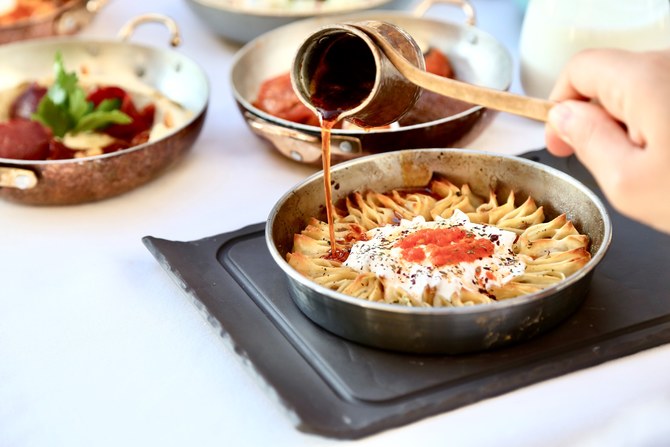
Although Aleppo is to the south of Gaziantep, antep kibbeh at The Globe is distinctively different from its Syrian counterpart. With an outer shell that is crisper than usual, it comes immersed in a light, meat broth and a dollop of yogurt.
A personal favorite is the smoked eggplant with crumbled beyaz peynir (white cheese) from Ezine, in the Çanakkale province; the flavors — including a sprinkling of pistachio — work wonderfully together.
The pièce de résistance, though, is an Antalya-special kuzu tandir (lamb shank). Using the choicest shoulder cuts, Türkoğlu lathers on simple seasoning including mustard paste, cumin and coriander seeds, salt and pepper, and places the shank on a bed of regional vegetables. After six hours in a traditional oven, the dish is transformed into a delicacy that once graced the tables of the Seljuk Turks. “Now, it has become a celebratory dish that is reserved for feast days, special occasions or national holidays, like the Eid celebration,” he says.
There is no better way to describe my culinary experience than the words of the Turkish novelist, Abdülhak Şinasi Hisar: “Do not underestimate the dish by calling it just food. The blessed thing is an entire civilization in itself!”


