

Foxconn chairman announces bid for Taiwan presidency

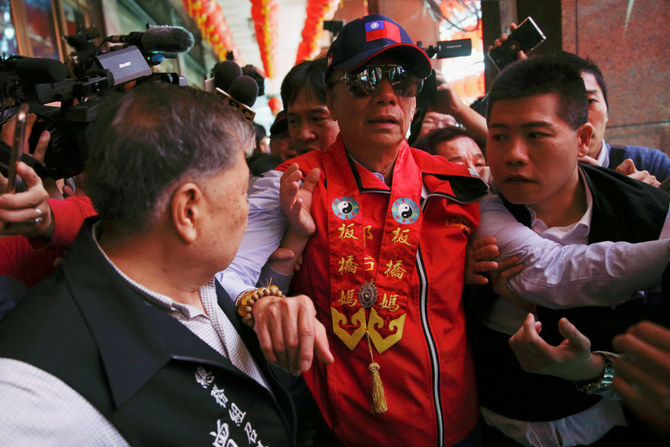
Terry Gou, founder and chairman of Foxconn, after praying at a temple, in New Taipei City, Taiwan on April 17, 2019. Gou announced his intention to run for the Taiwanese presidency. (Reuters)
Updated 17 April 2019
Follow

Foxconn chairman announces bid for Taiwan presidency

  • He will run under a ticket from the Beijing-friendly opposition Kuomintang party

TAIPEI: The boss of tech giant Foxconn said Wednesday he will be running for president of Taiwan — after securing the backing of a local Sea Goddess.

Gou, who announced this week he was stepping back from frontline operations at the Apple supplier, said he would seek the nomination of the Beijing-friendly Kuomintang (KMT) opposition party.

“I am willing to join the party’s primary. If I win, I will represent the KMT in the 2020 elections,” he said at a KMT meeting in Taipei.

Guo also said he would “fully support” the party’s candidate if he failed to secure the nomination.

Earlier Wednesday while visiting a temple of local sea goddess Matsu in New Taipei city, the 69-year-old said the goddess “told me to step forward ... to help the people.”

Gou is expected to face KMT heavyweights including former party chairman Eric Chu and former parliamentary speaker Wang Jin-pyng, who have announced their intentions to run for president.

Chu lost to incumbent President Tsai Ing-wen of the Beijing-skeptic Democratic Progressive Party (DPP) in the 2016 presidential elections.

Tsai, 62, has said she will seek re-election in the January 11 polls. She faces a challenge from pro-independence former premier William Lai in the party’s primary.

The DPP is set to announce its presidential candidate later this month.

Also known by its official name Hon Hai Precision Industry, Foxconn assembles Apple iPhones as well as parts and accessories for other international brands.

Known for his aggressive deal making, Gou has been snapping up investments from Japan to India in a bid to diversify from electronics assembly.

Gou was born in 1950 in Taipei to parents who had fled the Communist victory in China’s civil war. He studied shipping management in college while supporting himself with part-time jobs.

He started his business in 1974 making television parts with an investment of Tw$100,000 ($3,250 at current exchange rates) from his mother, and later began producing computer parts — eventually growing to become the world’s biggest contract electronics maker.



Pakistani fighter jet crashes in Jalalabad, pilot captured: Afghan military, police

Updated 28 February 2026
Follow

Pakistani fighter jet crashes in Jalalabad, pilot captured: Afghan military, police

  • Fighting between Pakistan and Afghanistan’s Taliban military entered its third day on Saturday
  • Pakistan’s strikes on Friday hit Taliban military installations and posts, including in Kabul and Kandahar

JALALABAD: A Pakistani jet has crashed in Jalalabad city and the pilot captured alive, the Afghan military and police said Saturday, with residents telling AFP the man parachuted from the plane before being detained.
"A Pakistani fighter jet was shot down in the sixth district of Jalalabad city, and its pilot was captured alive," police spokesman Tayeb Hammad said.
Wahidullah Mohammadi, spokesman for the military in eastern Afghanistan, confirmed the Pakistani jet was downed by Afghan forces "and the pilot was captured alive".

The AFP journalist heard a jet overhead before blasts from the direction of the airport in Jalalabad, the capital of Nangarhar province, which sits on the road between Kabul and the Pakistani border.

Fighting between Pakistan and Afghanistan’s Taliban military entered its third day on Saturday, following overnight clashes as the international community expressed increasing concern about the conflict and called for urgent talks.

Pakistan’s strikes on Friday hit Taliban military installations and posts, including in Kabul and Kandahar, in one of the deepest Pakistani incursions into its western neighbor in years, officials said.

Islamabad accuses the Taliban of harboring Tehreek-e-Taliban Pakistan (TTP) militants, who it claims are waging an insurgency inside Pakistan, a charge the Taliban denies.

Pakistan described its actions as a response to cross-border assaults, while Kabul denounced them as a breach of its sovereignty, saying it remained open to dialogue but warned any wider conflict would result in serious consequences.

The fighting has raised ‌the risk ‌of a protracted conflict along the rugged 2,600-kilometer frontier.

Diplomatic efforts gathered ‌pace ⁠late on Friday ⁠as Afghanistan said its foreign minister, Amir Khan Muttaqi, spoke by telephone with Saudi Arabia’s Prince Faisal bin Farhan about reducing tensions and keeping diplomatic channels open.

The European Union called for both sides to de-escalate and engage in dialogue, while the United Nations urged an immediate end to hostilities.

Russia urged both sides to halt the clashes and return to talks, while China said it was deeply concerned and ready to help ease tensions.

The United States supports Pakistan’s right to defend itself against attacks by ⁠the Taliban, a State Department spokesperson said.

Border fighting continues

Exchanges of fire continued along ‌the border overnight.

Pakistani security sources said an operation dubbed “Ghazab Lil Haq” was ongoing and that Pakistani forces had destroyed multiple Taliban posts and camps in several sectors. Reuters could not independently verify the claims.

Both sides have reported heavy losses with conflicting tolls that Reuters could not verify. Pakistan said 12 of its ‌soldiers and 274 Taliban were killed while the Taliban said 13 of its fighters and 55 Pakistani soldiers died.

Taliban deputy spokesman Hamdullah Fitrat ⁠said 19 civilians were ⁠killed and 26 wounded in Khost and Paktika. Reuters could not verify the claim.

Pakistan’s Defense Minister Khawaja Muhammad Asif said “our cup of patience has overflowed” and described the fighting as “open war,” warning that Pakistan would respond to further attacks.

Taliban Interior Minister Sirajuddin Haqqani said in a speech in Khost province that the conflict “will be very costly,” and that Afghan forces had not deployed broadly beyond those already engaged.

He said the Taliban had defeated “the world, not through technology, but through unity and solidarity,” and through “great patience and perseverance,” rather than superior military power.

Pakistan’s military capabilities far exceed those of Afghanistan, with a standing army of hundreds of thousands and a modern air force.

In stark contrast, the Taliban lacks a conventional air force and relies largely on light weaponry and ground forces.

However, the Islamist group is battle-hardened after two decades of insurgency against US-led forces before returning to power in 2021.