

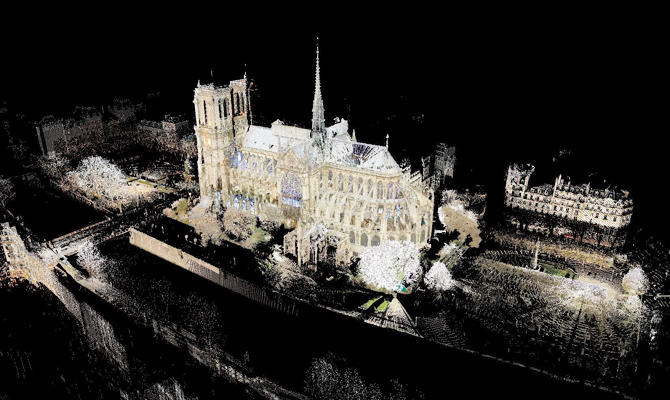
On American hard drives, the most accurate 3-D model of Notre-Dame

1 / 2
Photo obtained April 16, 2019 courtesy of Vassar College in Poughkeepsie, New York shows art historian Andrew Tallon's laser scan of Notre-Dame de Paris. (AFP)
2 / 2
Photo obtained April 16, 2019 courtesy of Vassar College in Poughkeepsie, New York shows art historian Andrew Tallon's longitudinal section laser scan of Notre-Dame de Paris. (AFP)
Updated 17 April 2019
Follow

On American hard drives, the most accurate 3-D model of Notre-Dame

  • The final computer-generated images reconstruct the cathedral down to the smallest detail, including its tiny defects, with a precision of about five millimeters (0.1 inches)

WASHINGTON: At Vassar College in the United States, a university team gathered the week before the devastating fire at Notre-Dame cathedral in Paris to plan an ambitious project: inventorying about a terabyte of 3-D modeling data of the famed Gothic masterpiece.
The precious data — the most accurate in the world — is the work of Andrew Tallon, a Francophile American art professor who loved medieval architecture and was passionate about Gothic cathedral. He died in November.
His technique was nothing new, but his application of the tools was innovative. In 2011 and 2012, funded by a foundation, Tallon used a laser device to accurately measure the interior and exterior of the cathedral, which was ravaged by flames this week.
He placed the device in about 50 places to measure the distance between each wall and pillar, recess, statue or other form — and to record all the imperfections intrinsic to any centuries-old monument.
The result is over a billion points in the “point cloud.” The final computer-generated images reconstruct the cathedral down to the smallest detail, including its tiny defects, with a precision of about five millimeters (0.1 inches).
These images, for example, confirmed how the west side of the cathedral was a “total mess... a train wreck,” Tallon told National Geographic in 2015, pointing to the misalignment of the interior columns.
He wanted to get “into the mind of the builders,” said his former student Lindsay Cook, a Francophile like Tallon who is now a visiting assistant professor of art at Vassar.
“He was interested in using laserscan data to find moments like small ruptures in the construction, places where things were not exactly straight or in plumb, where you could see the hand of an individual architect at work, and in that case the hand of individual masons,” Cook told AFP.

From these measurements were born the images published in a book in 2013 and shown in an exhibition at Notre-Dame in 2014. But the bulk of the data remains untapped in the form of 1s and 0s on some hard drives.
Notre-Dame can probably be reconstructed without this data, but laser modeling brings precision to the photographs and drawings held by architects in France.
This is particularly useful for elements such as roofing and the spire, which were more difficult to measure physically. The 19th-century spire collapsed in the fire, and the roof is largely devastated.
The modeling will help restorers to identically recreate the part of the vault that has collapsed inside.
“If eventually the authorities wish to use this, then of course it would be shared with them,” said Cook.
The data is currently on external hard drives at Vassar, with copies at Columbia University, where academics collaborated with Tallon as part of the “Mapping Gothic” project.
If architects ask for the data, it would have to be delivered in person, as it is too large to be transmitted over the Internet.
If Tallon’s “scholarly work can somehow inform those who will be taking on the daunting task of restoring a cathedral to its former glory, it will be a fitting memorial for a very wonderful scholar who devoted so much to Notre-Dame,” said Vassar dean Jon Chenette.
On other hard drives, historians will also find, if they wish one day, another inheritance from Tallon: laser modeling of the cathedrals of Beauvais, Chartres, Canterbury and even the Basilica of Saint-Denis.


Why some women choose Galentines over Valentines and how they might celebrate

Updated 09 February 2026
Follow

Why some women choose Galentines over Valentines and how they might celebrate

  • O’Sullivan is one of many women who find it empowering to focus on female friendship rather than relationship pressures
  • Other ways to mark Galentine’s Day include going to a play, hiking, karaoke, playing cards or just having coffee

Christie O’Sullivan of Trinity, Florida, has spent 21 Valentine’s Days with her husband, but her favorite celebration was one spent with a girlfriend before she got married.
They took the day off work, got massages, and went out for cocktails and a fancy dinner.
“For me, it was 10 out of 10. That whole day was intentional,” said O’Sullivan. She remembers it as empowering “on a day that’s usually filled with pressure to be in a relationship, or sadness because I wasn’t currently in one.”
Galentine’s Day became a pop culture phenomenon with a 2010 episode of the TV comedy “Parks and Recreation” that celebrated female friendships around Valentine’s Day. Amy Poehler’s character, Leslie Knope, gathered her gal pals on Feb. 13.
“What’s Galentine’s Day? Oh, it’s only the best day of the year,” said Knope.
Honoring female friendships can happen any day of the year, of course. Whether on Feb. 13 or another day, here are some ways to create a fun-filled experience:
Making it a party
Chela Pappaccioli of Franklin Lakes, New Jersey, has been hosting a Galentine’s Day bash at her home for the last three years. She has a bartender and a DJ hired, and this year invited 45 of her nearest and dearest. So far, she has 34 confirmations, and is assembling gift bags for her guests to take home. There are no men allowed “unless the bartender happens to be male.”
The event may be extravagant, but Pappaccioli says it’s worth it.
“It’s an escape to just be with your girls, be silly, do something fun and just focus on the friendships you’ve created and enjoying each other’s company,” she says.
Learning how to do something new
Liz Momblanco of Berkley, Michigan, who describes herself as a “serial hobbyist,” invites her friends to take classes like cookie and cake decorating, calligraphy and stained glass.
“I enjoy learning something new and having a shared experience,” said Momblanco, who has attended day retreats for women that offer activities like floral arranging, yoga or a cold plunge.
Marney Wolf, who runs the retreat company Luna Wolf, says providing an opportunity for art and creativity builds community.
“It bonds you, whether it’s the smallest thing or really deep. You watch these grown women turn into almost like a childlike kindergarten response like, ‘Oh my gosh! Good job! You’re so talented!’ That little lift is the easiest thing to do,” she said.
Filling a Valentine’s void
Wolf takes care to schedule Galentine’s-themed retreats near Valentine’s Day because some women don’t have someone to spend Feb. 14 with.
“I know it can be a really lonely time for people and I think some take it for granted,” she says.
Pappaccioli said a couple of divorced friends come to her party, and “even if you’re married it can be depressing because your husband may not be doing what you want or your boyfriend may not support you in the way you want,” she says.
“It’s nice to know that you don’t need that. You can still celebrate the holiday, but turn it around a little bit and celebrate the relationships you want to.”
Creating different kinds of bonds
Galentine’s Day get-togethers can forge new friendships. And spending quality time with a friend provides an opportunity to put the phone away, avoid distractions and build memories.
O’Sullivan is a social media strategist for businesses but appreciates that her bestie Valentine’s Day was without cellphones.
“We could be fully present — no photos, no texts, no nothing,” she says.
“So while that means there’s no actual record of that day occurring, it also means the details became a core memory without it.”
Some celebrate Galentine’s Day by just going out for coffee or playing cards. You might go with a group of women friends to a play or museum, or take a hike or a workout class.
Other ideas include thrift store shopping, country line dancing, roller skating, karaoke, junk journaling, and getting manicures and pedicures.