Egypt parliament votes to extend El-Sisi rule

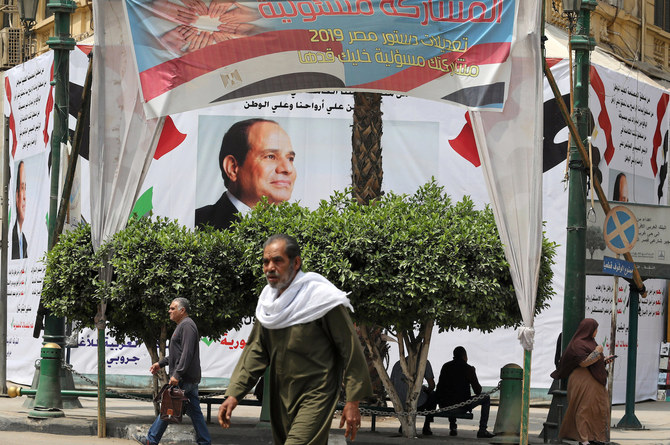
Pedestrians walk in front of a banner of the Egyptian President Abdel Fattah al-Sisi before the upcoming referendum on constitutional amendments in Cairo. (Reuters)
Updated 16 April 2019
Follow

Egypt parliament votes to extend El-Sisi rule

  • The proposed amendments were initially introduced in February by a parliamentary bloc supportive of Abdel Fattah El-Sisi
  • The amendments are expected to be put to a public referendum later this month

CAIRO: Egypt's parliament on Tuesday approved constitutional amendments allowing general-turned-president Abdel Fattah El-Sisi to stay in power until 2030, state media reported.
Deputies also backed other sweeping changes to the constitution including to give the military greater influence in political life as well as granting El-Sisi more control over the judiciary.
The amendments are expected to be put to a public referendum later this month.
"The president's current term shall expire at the end of six years from the date of his election as president in 2018," reported the official Al-Ahram news website and broadcaster Nile TV.
"He can be re-elected for another (six-year) term."
El-Sisi led the army's overthrow of elected president Mohamed Morsi in 2013 following mass protests against the Islamist leader's rule.
He won his first term as president in 2014 and was re-elected in March 2018 with more than 97 percent of the vote, after standing virtually unopposed.
Mohamed Abu Hamed, a member of parliament who pushed for the constitutional amendments to keep El-Sisi in power, was adamant the changes were needed to allow him to complete political and economic reforms.
"The constitution in 2014 was written under tough exceptional circumstances," he told AFP.
The deputy hailed El-Sisi as a president who "took important political, economic and security measures... (and) must continue with his reforms," in the face of the unrest gripping neighbouring countries.
The vote comes after two veteran presidents were ousted in Algeria and Sudan and amid an escalation of the conflict in Libya.
Keeping El-Sisi in power, he added, reflected "the will of the people".
State-run Al-Ahram news website said several MPs carried Egyptian flags as they gathered for the vote inside the parliament while nationalistic songs played in the background.
The amendments were initially introduced in February by a parliamentary bloc supportive of El-Sisi and updated this week after several rounds of debates.
Prior to the amendments, Egypt's 2014 constitution stipulated only two four-year presidential terms.
The 596-seat parliament, which is dominated by El-Sisi loyalists, was elected in 2015, about a year after El-Sisi took office.
Since El-Sisi overthrew Morsi, Egypt has drawn heavy criticism for its sweeping crackdown on dissent. El-Sisi's supporters say tough measures have been necessary as the country battles an extremist insurgency and has suffered bloody militant attacks against both the security forces and civilians, including churches.
As lawmakers debated the proposed changes, prominent dissident actors Khaled Abol Naga and Amr Waked denounced them as a power grab.
If passed, "these amendments would take us back to a dictatorship fit for the Middle Ages," Waked told a news conference by rights groups in Geneva.
Amnesty International has warned the constitutional amendments "would worsen the devastating human rights crisis Egyptians are already facing".
"They would grant President Abdel Fattah El-Sisi and security forces free rein to further abuse their powers and suppress peaceful dissent for years to come," said Amnesty's Magdalena Mughrabi.
Other constitutional amendments include a quota for women's representation of no less than 25 percent in parliament and forming a second parliamentary chamber.


Israel’s Netanyahu agrees to join Trump’s Board of Peace

Updated 4 sec ago
Follow

Israel’s Netanyahu agrees to join Trump’s Board of Peace

  • Prime Minister Benjamin Netanyahu of Israel says he’s agreed to join Trump’s Board of Peace. Netanyahu made the announcement Wednesday from his office
  • The announcement came after Israel said the makeup of the Board’s Gaza executive body did not align with Israel’s interests
JERUSALEM: Prime Minister Benjamin Netanyahu of Israel said Wednesday he had agreed to join US President Donald Trump’s Board of Peace, after his office earlier criticized makeup of the board’s executive committee.
The board, chaired by Trump, was originally envisioned as a small group of world leaders overseeing the Gaza ceasefire plan. The Trump administration’s ambitions have appeared to balloon into a more sprawling concept, with Trump extending invitations to dozens of nations and hinting it will soon broker global conflicts.
Netanyahu’s office had previously said the executive committee — which includes Turkiye, a key regional rival — wasn’t coordinated with the Israeli government and “is contrary to its policy,” without clarifying its objections. Israel’s far-right finance minister, Bezalel Smotrich, has criticized the board and called for Israel to take unilateral responsibility for Gaza’s future.
Others who have joined the board are the UAE, Morocco, Vietnam, Belarus, Hungary, Kazakhstan and Argentina. Others, including the UK, Russia and the executive arm of the European Union, say they have received invitations but have not yet responded.
It came as Trump traveled to the World Economic Forum meeting in Davos, Switzerland, where he is expected to provide more details about the board. There are many unanswered questions. It was not immediately clear how many or which other leaders would receive invitations.
When asked by a reporter Tuesday if the board should replace the UN, Trump said, “It might.” He asserted that the world body “hasn’t been very helpful” and “has never lived up to its potential” but also said the UN should continue ”because the potential is so great.”
That has created controversy, with some saying Trump is trying to replace the UN French Foreign Minister Jean-Noel Barrot said Tuesday, “Yes to implementing the peace plan presented by the president of the United States, which we wholeheartedly support, but no to creating an organization as it has been presented, which would replace the United Nations.”
Told late Monday that French President Emmanuel Macron was unlikely to join, Trump said, “Well, nobody wants him because he’s going to be out of office very soon.” A day later, Trump called Macron “a friend of mine” but reiterated that the French leader is “not going to be there very much longer.”
The executive board’s members include US Secretary of State Marco Rubio, Trump envoy Steve Witkoff, Trump’s son-in-law Jared Kushner, former British Prime Minister Tony Blair, Apollo Global Management CEO Marc Rowan, World Bank President Ajay Banga, and Trump’s deputy national security adviser Robert Gabriel.
The White House also announced the members of another board, the Gaza Executive Board, which, according to the ceasefire, will be in charge of implementing the tough second phase of the agreement. That includes deploying an international security force, disarming Hamas and rebuilding the war-devastated territory.
Nickolay Mladenov, a former Bulgarian politician and UN Mideast envoy, is to serve as the Gaza executive board’s representative overseeing day-to-day matters. Additional members include: Witkoff, Kushner, Blair, Rowan, Turkish Foreign Minister Hakan Fidan; Qatari diplomat Ali Al-Thawadi; Hassan Rashad, director of Egypt’s General Intelligence Agency; Emirati minister Reem Al-Hashimy; Israeli businessman Yakir Gabay; and Sigrid Kaag, the Netherlands’ former deputy prime minister and a Mideast expert.
The board also will supervise a newly appointed committee of Palestinian technocrats who will be running Gaza’s day-to-day affairs.