‘A hunter’s hope’: Snaring birds in warring Afghanistan

1 / 8
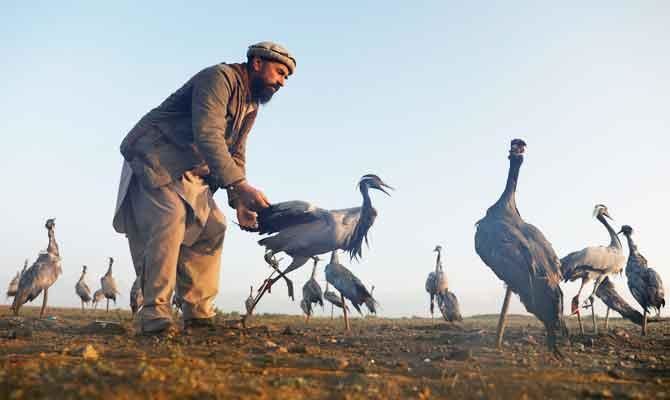
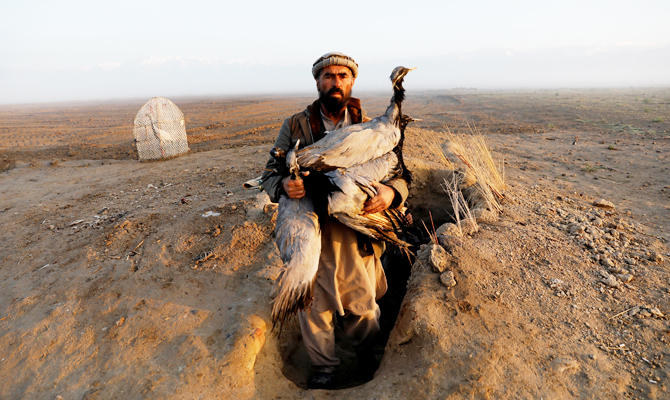
Jan Agha, 49, an Afghan hunter, inspects a crane in a field in Bagram, Parwan province, Afghanistan April 10, 2019. (REUTERS)
2 / 8
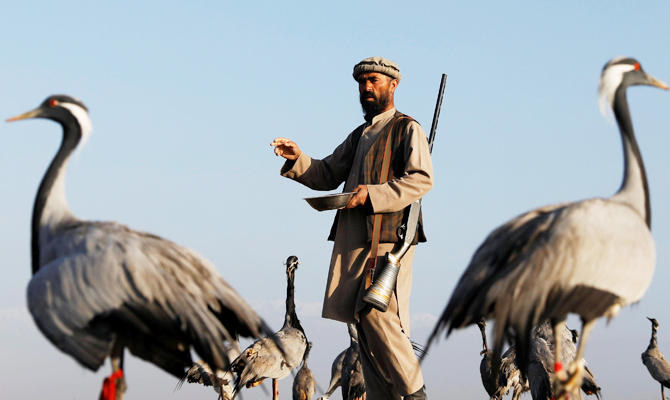
Jan Agha, 49, an Afghan hunter, feeds his cranes at a field in Bagram, Parwan province, Afghanistan April 10, 2019. (REUTERS)
3 / 8
Jan Agha, 49, an Afghan hunter, gives water to his cranes at a field in Bagram, Parwan province, Afghanistan April 10, 2019. (REUTERS)
4 / 8
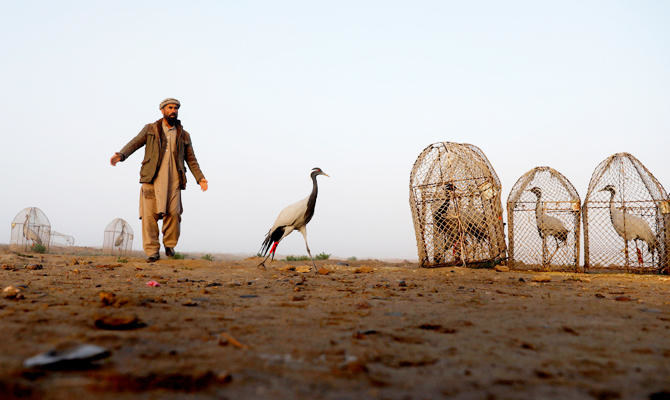
Jan Agha, 49, an Afghan hunter, guides a crane towards cages at a field in Bagram, Parwan province, Afghanistan April 10, 2019. (REUTERS)
5 / 8
Jan Agha, 49, an Afghan hunter, feeds his cranes at a field in Bagram, Parwan province, Afghanistan April 10, 2019. (REUTERS)
6 / 8
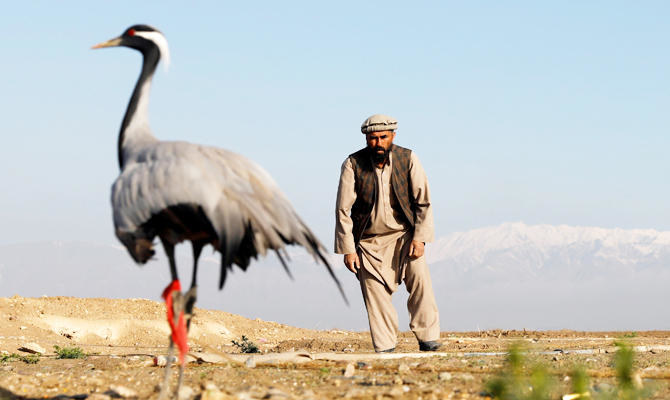
Jan Agha, 49, an Afghan hunter, tries to catch his crane at a field in Bagram, Parwan province, Afghanistan April 10, 2019. (REUTERS)
7 / 8
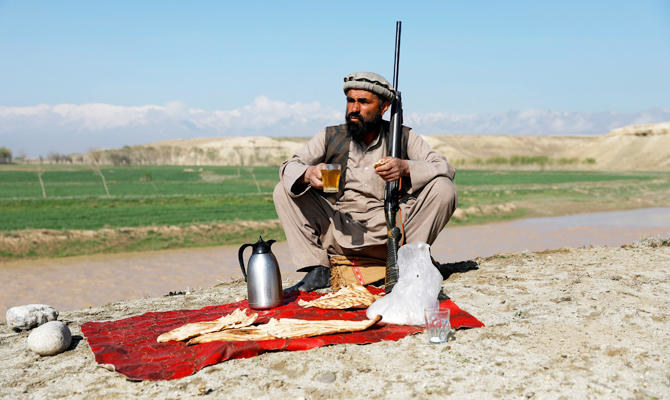
Jan Agha, 49, an Afghan hunter, has breakfast at his hunting field in Bagram, Parwan province, Afghanistan April 10, 2019. (REUTERS)
8 / 8
Jan Agha, 49, an Afghan hunter, carries artificial cranes at a field in Bagram, Parwan province, Afghanistan April 10, 2019. (REUTERS)
Updated 15 April 2019
Follow

‘A hunter’s hope’: Snaring birds in warring Afghanistan

  • The war has left much of the environment near Kabul devastated with uncleared mines, pollution, uncontrolled building and general neglect

BAGRAM, Afghanistan: As the early morning light breaks over the plain north of Kabul, bird hunter Jan Agha checks his snares as he has done for the past 30 years, hoping to catch a crane, using a tethered bird to lure others down to the nets.
Bird hunting is an ancient sport in Afghanistan, where local and migrating species have flocked for thousands of years and where even amid the chaos of the past 40 years of conflict, the tradition persists.
“I have learned different types of hunting from my ancestors because they were hunters too,” said 49-year-old Jan Agha, a farmer in Parwan province.
“Some of my sons have learned hunting from me and I hope to see at least two of my sons become hunters so my name is remembered and people know my sons after my death.”
The war has left much of the environment near Kabul devastated with uncleared mines, pollution, uncontrolled building and general neglect. Only in the last few years has there been an effort to restore areas like the former royal hunting grounds at Kol-e-Hashmat Khan in the city’s southwest.
Spring is the season of cranes, which the hunters try to catch alive in snares, using a specially trained tethered bird whose cries attract passing flocks.

“I like this crane because it won’t be silent when the other big groups of cranes come, and it always forces them to come down. I like it because he is really a hunter bird.”
With environmental controls virtually non-existent, there is little check on how many birds are caught or shot and Jan Agha, who started hunting when he was around 12 or 13, reckons he has taken more than 1,000 cranes and an uncountable number of quails, ducks hawks and sparrows.
The birds are usually taken to shops near the town of Bagram or to Kabul itself, where there is a popular bird market in the center of the old city.
For Jan Agha, hunting is a relief, taking him out of the daily round and into the harshly beautiful countryside, where groups of hunters set out in the night, picnicking at night in the desert before testing their skills at dawn.
“The pleasure of hunting is to be in open space. I like the mountain, desert, shotgun and being awake during the night to hunt,” he said. “The pleasure of hunting is to be a success in it. A hunter’s hope is hunting. Being a success in every job in the world has a special pleasure.”


Some Warren Buffett wisdom on his last day leading Berkshire Hathaway

Updated 31 December 2025
Follow

Some Warren Buffett wisdom on his last day leading Berkshire Hathaway

OMAHA, Nebraska: The advice that legendary investor Warren Buffett offered on investing and life over the years helped earn him legions of followers who eagerly read his annual letters and filled an arena in Omaha every year to listen to him at Berkshire Hathaway’s annual meetings.
Buffett’s last day as CEO is Wednesday after six decades of building up the Berkshire conglomerate. He’ll remain chairman, but Greg Abel will take over leadership.
Here’s a collection of some of Buffett’s most famous quotes from over the years:
___
“Be fearful when others are greedy, and greedy when others are fearful.”
That’s how Buffett summed up his investing approach of buying out-of-favor stocks and companies when they were selling for less than he estimated they were worth.
He also urged investors to stick with industries they understand that fall within their “circle of competence” and offered this classic maxim: “Rule No. 1: Never lose money. Rule No. 2: Never forget Rule No. 1.”
___
“After they first obey all rules, I then want employees to ask themselves whether they are willing to have any contemplated act appear the next day on the front page of their local paper to be read by their spouses, children and friends with the reporting done by an informed and critical reporter.
“If they follow this test, they need not fear my other message to them: Lose money for the firm and I will be understanding; lose a shred of reputation for the firm and I will be ruthless.”
That’s the ethical standard Buffett explained to a Congressional committee in 1991 that he would apply as he cleaned up the Wall Street investment firm Salomon Brothers. He has reiterated the newspaper test many times since over the years.
___
“You only find out who is swimming naked when the tide goes out.”
Many companies might do well when times are good and the economy is growing, but Buffett told investors that a crisis always reveals whether businesses are making sound decisions.
___
“Who you associate with is just enormously important. Don’t expect that you’ll make every decision right on that. But you are going to have your life progress in the general direction of the people you work with, that you admire, that become your friends.”
Buffett always told young people that they should try to hang out with people who they feel are better than them because that will help improve their lives. He said that’s especially true when choosing a spouse, which might be the most important decision in life.
___
“Our unwavering conclusion: never bet against America.”
Buffett has always remained steadfast in his belief in the American capitalist system. He wrote in 2021 that “there has been no incubator for unleashing human potential like America. Despite some severe interruptions, our country’s economic progress has been breathtaking.”