

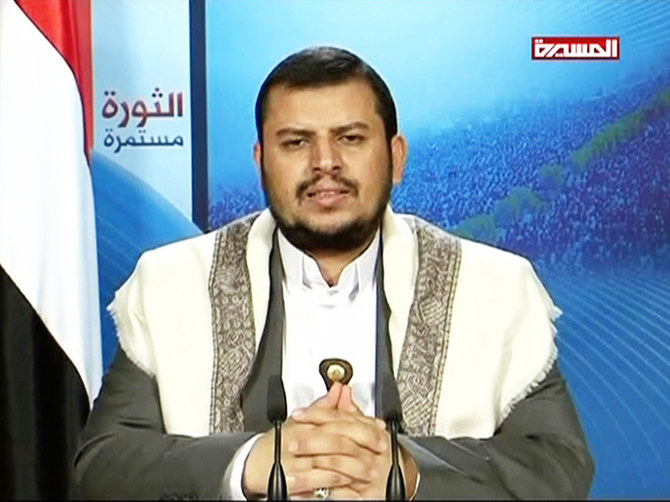
Exposed: How Al-Houthi brainwashes children, blesses targeting civilians

An image grab taken from a video broadcast by Al-Masira TV on March 26, 2015, shows Yemeni Shiite Houthi movement's leader Abdulmalik Al-Huthi delivering a televised statement. (Al-MASIRA TV/AFP)
Updated 15 April 2019
Follow

Exposed: How Al-Houthi brainwashes children, blesses targeting civilians

  • Yemen militia leader is the latest subject of Arab News campaign

JEDDAH: For 15 years, he and his fanatical followers have tried to hoodwink the world into believing they are persecuted underdogs, defending Yemen against its oppressors.

But today Abdul-Malik Al-Houthi is exposed for what he is — a violent ideologue motivated by bigotry, hatred and intolerance.

Al-Houthi, 40, leader of the Iran-backed Houthi militias in Yemen, is the latest subject of Preachers of Hate — a continuing Arab News campaign in which we analyze the words and deeds of militant extremists, place them in context, and explain their malign influence on those who follow them.

With their slogan “God is great, death to America, death to Israel, curse the Jews and victory for Islam,” the Houthis have a long history of intolerance. Al-Houthi is from the same mold as Osama bin Laden, Hezbollah chief Hassan Nasrallah, Iranian militia strongman Qassim Soleimani and Daesh leader Abu Bakr Al-Baghdadi, analysts told Arab News.

Far from being an “underdog,” Al-Houthi has overseen the launch of ballistic missiles targeting civilian population centers in Saudi Arabia — including the city of Makkah, the most sacred place in the religion he claims to revere.


Using the Houthi-run Al-Masirah TV channel and Hezbollah’s Al-Manar TV station, he broadcasts his messages of hate to anyone who will listen. Al-Houthi is cut from the same cloth as the leaders of other violent extremist groups, Saudi political analyst Hamdan Al-Shehri said.  

“He has no qualms about putting children and women in harm’s way ... this is the exact strategy employed by other militias and terrorist organizations, including Hezbollah, Al-Qaeda and Daesh.”


Also read:

Brenton Tarrant: How the far right changed the face of terror

• Qaradawi and Qatar: the hate preacher who became Doha’s spiritual guide

• Salman Al-Odah: The chameleon cleric


Trump warns of ‘bad things’ if Iran doesn’t make a deal, as second US carrier nears Mideast

Updated 5 sec ago
Follow

Trump warns of ‘bad things’ if Iran doesn’t make a deal, as second US carrier nears Mideast

DUBAI: Iran held annual military drills with Russia on Thursday as a second American aircraft carrier drew closer to the Middle East, with both the United States and Iran signaling they are prepared for war if talks on Tehran’s nuclear program fizzle out.
President Donald Trump said Thursday he believes 10 to 15 days is “enough time” for Iran to reach a deal. But the talks have been deadlocked for years, and Iran has refused to discuss wider US and Israeli demands that it scale back its missile program and sever ties to armed groups. Indirect talks held in recent weeks made little visible progress, and one or both sides could be buying time for final war preparations.
Iran’s theocracy is more vulnerable than ever following 12 days of Israeli and US strikes on its nuclear sites and military last year, as well as mass protests in January that were violently suppressed.
In a letter to the UN Security Council on Thursday, Amir Saeid Iravani, the Iranian ambassador to the UN, said that while Iran does not seek “tension or war and will not initiate a war,” any US aggression will be responded to “decisively and proportionately.”
“In such circumstances, all bases, facilities, and assets of the hostile force in the region would constitute legitimate targets in the context of Iran’s defensive response,” Iravani said.
Earlier this week, Iran conducted a drill that involved live-fire in the Strait of Hormuz, the narrow opening of the Arabian Gulf through which a fifth of the world’s traded oil passes.
Tensions are also rising inside Iran, as mourners hold ceremonies honoring slain protesters 40 days after their killing by security forces. Some gatherings have seen anti-government chants despite threats from authorities.
Trump again threatens Iran
The movements of additional American warships and airplanes, with the USS Gerald R. Ford aircraft carrier near the mouth of the Mediterranean Sea, don’t guarantee a US strike on Iran — but they bolster Trump’s ability to carry out one should he choose to do so.
He has so far held off on striking Iran after setting red lines over the killing of peaceful protesters and mass executions, while reengaging in nuclear talks that were disrupted by the war in June.
Iran has agreed to draw up a written proposal to address US concerns raised during this week’s indirect nuclear talks in Geneva, according to a senior US official who was not authorized to comment publicly and spoke on the condition of anonymity.
The official said top national security officials gathered Wednesday to discuss Iran, and were briefed that the “full forces” needed to carry out potential military action are expected to be in place by mid-March. The official did not provide a timeline for when Iran is expected to deliver its written response.
“It’s proven to be, over the years, not easy to make a meaningful deal with Iran, and we have to make a meaningful deal. Otherwise, bad things happen,” Trump said Thursday.
With the US military presence in the region mounting, one senior regional government official said he has stressed to Iranian officials in private conversations that Trump has proven that his rhetoric should be taken at face value and that he’s serious about his threat to carry out a strike if Iran doesn’t offer adequate concessions.
The official, who spoke on the condition of anonymity to discuss delicate diplomatic conversations, said he has advised the Iranians to look to how Trump has dealt with other international issues and draw lessons on how it should move forward.
The official added that he’s made to case to the Trump administration it could draw concessions from Iran in the near-term if it focuses on nuclear issues and leaves the push on Tehran to scale back its ballistic missile program and support for proxy group for later.
The official also said that Trump ordering a limited strike aimed at pressuring Iran could backfire and lead to Supreme Leader Ali Khamenei withdrawing Iran from the talks.
Growing international concern
Polish Prime Minister Donald Tusk urged his nation’s citizens to immediately leave Iran as “within a few, a dozen, or even a few dozen hours, the possibility of evacuation will be out of the question.” He did not elaborate, and the Polish Embassy in Tehran did not appear to be drawing down its staff.
The German military said that it had moved “a mid-two digit number of non-mission critical personnel” out of a base in northern Iraq because of the current situation in the region and in line with its partners’ actions. It said that some troops remain to help keep the multinational camp running in Irbil, where they train Iraqi forces.
“This week, another 50 US combat aircraft — F-35s, F-22s, and F-16s — were ordered to the region, supplementing the hundreds deployed to bases in the Arab Gulf states,” the New York-based Soufan Center think tank wrote. “The deployments reinforce Trump’s threat — restated on a nearly daily basis — to proceed with a major air and missile campaign on the regime if talks fail.”
Iran holds drill with Russia
Iranian forces and Russian sailors conducted the annual drills in the Gulf of Oman and the Indian Ocean aimed at “upgrading operational coordination as well as exchange of military experiences,” Iran’s state-run IRNA news agency reported.
Footage released by Iran showed members of the paramilitary Revolutionary Guard’s naval special forces board a vessel in the exercise. Those forces are believed to have been used in the past to seize vessels in key international waterways.
Iran also issued a rocket-fire warning to pilots in the region, suggesting it planned to launch anti-ship missiles in the exercise.
Meanwhile, tracking data showed the Ford off the coast of Morocco in the Atlantic Ocean midday Wednesday, meaning the carrier could transit through Gibraltar and potentially station in the eastern Mediterranean with its supporting guided-missile destroyers.
It would likely take more than a week for the Ford to be off the coast of Iran.
Netanyahu warns Iran
Israel is making its own preparations for possible Iranian missile strikes in response to any US action.
“We are prepared for any scenario,” Israeli Prime Minister Benjamin Netanyahu said Thursday, adding that if Iran attacks Israel, “they will experience a response they cannot even imagine.”
Netanyahu, who met with Trump last week, has long pushed for tougher US action against Iran and says any deal should not only end its nuclear program but curb its missile arsenal and force it to cut ties with militant groups like Hamas and Hezbollah.
Iran has said the current talks should only focus on its nuclear program, and that it hasn’t been enriching uranium since the US and Israeli strikes last summer. Trump said at the time that the strikes had “obliterated” Iran’s nuclear sites, but the exact damage is unknown as Tehran has barred international inspectors.
Iran has always insisted its nuclear program is peaceful. The US and others suspect it is aimed at eventually developing weapons. Israel is widely believed to have nuclear weapons but has neither confirmed nor denied that.
