

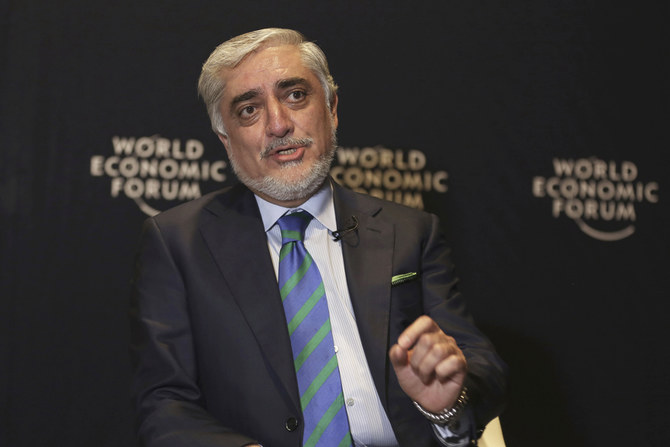

KABUL: Afghanistan’s chief executive said Sunday he would boycott an assembly, or loya jirga, proposed by President Ashraf Ghani on how to make peace with the Taliban.
Dr. Abdullah Abdullah's decision is a further setback for Ghani, who has been excluded from all peace talks between the Taliban and US officials in recent months. The president had called for a jirga in order to lay the framework and conditions for talks with the insurgents.
But Abdullah said he and his party members had not been consulted by Ghani about the gathering, which will bring thousands of delegates and tribal chiefs from across Afghanistan on April 29 to advise the government on the negotiations.
Abdullah, whose ties with Ghani have been shaky since the creation of a power-sharing national unity government in 2014, said he did not see it “helpful to overcome the current challenges in the country.”
His boycott shows new divisions in the government, which was created in a US-brokered deal after 2014 polls.
“We in the Stability and Partnership team have not been involved in any consultation, neither at political party nor individual level, nor at the government level,” a statement cited Abdullah as saying.
“The Stability and Partnership team led by … Abdullah announces that members of the team will not attend the meeting named ‘Consultative Jirga on Peace.’”
Members of the team, which has fielded at least one nominee for September’s presidential race against Ghani, told Arab News they would not attend the jirga either.
Haroon Chakhansuri, a presidential spokesman, said the party led by Abdullah had not shared its concern with the president and that the two leaders would meet to discuss the issue.
Earlier Sunday, disagreements delayed once again a meeting of a newly established reconciliation council with the president for finalizing a delegation for the upcoming meeting with the Taliban in Qatar set for April 19.
The council was set up by Ghani and involves the country’s factions and civil society members. Ghani established it following repeated calls by US envoy Zalamy Khalilzad to form an inclusive team for talks with the Taliban, after Ghani came under fire for creating an earlier version that included his supporters and was not seen as inclusive.
Khalilzad has led almost all talks with the Taliban. These have mostly been held in Qatar. During the last round he discussed the pullout of US troops and a Taliban guarantee that Afghanistan would not pose a threat to any country or US interests when the troops left.
Some politicians said the government opposed the participation of its political rivals in Qatar.
“The government appoints those on the list who work in the government, but we the politicians suggest that there is a need for an Afghan delegation which could represent all of Afghanistan,” politician Ahmadullah Alizai told reporters.
Abdullah’s boycott and disagreement in the leadership council showed how complicated and difficult it was for Ghani “to bring everyone around the table to make the process possible,” Bilal Sarwary, a senior Afghan journalist, told Arab News.


