Pakistan says IMF bailout package ‘more or less’ final

1 / 2
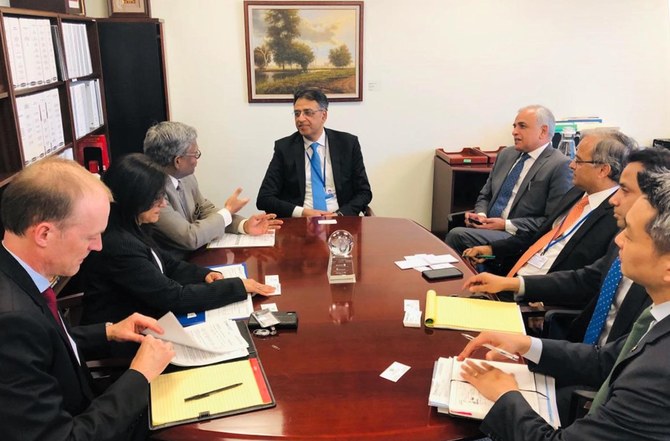
Finance Minister Asad Umar had meeting with team of World Bank’s Multilateral investment guarantee agency (MIGA) at Washington DC on 12 April, 2019 (PID)
2 / 2
In this file photo, Pakistan’s Finance Minister Asad Umar gestures during a news conference in Islamabad, Pakistan, November 30, 2018. (Reuters)
Updated 14 April 2019
Follow

Pakistan says IMF bailout package ‘more or less’ final

  • Finance minister says hoping for a “full agreement” in the next few days
  • Pakistan launched talks with the IMF for its 13th financial assistance package in October

ISLAMABAD: Pakistan’s minister for finance has said Pakistan and the International Monetary Fund had “more or less” finalized a bailout package, local media reported on Saturday, six months after Islamabad requested financial assistance from the Fund to address its economic challenges.
Wrestling with a ballooning current account deficit, Pakistan sought its 13th IMF bailout package in October. Currently, foreign reserves of $8.5 billion are better than the start of the year, but barely cover two months’ worth of imports.
“During the last two days, we have, more or less, reached an understanding,” Dawn newspaper quoted Asad Umar as saying at a news briefing in Washington on Thursday evening. “In the next day or two, we hope to reach a full agreement.”
He said as a next step, IMF officials would now visit Pakistan in the next few weeks to work out technical details. “But in principle, we have reached an agreement,” Umar added.
The finance minister, who reached Washington on Tuesday evening, left for New York on Friday after two days of talks with the IMF and World Bank officials on the sidelines of the group’s spring meetings. The team of experts that came with him remains behind in Washington to finalize the details of a multi-billion dollar, three-year bailout package.
Talks with the IMF began soon after Prime Minister Imran Khan’s government was appointed last August but a package has been held up by differences over the pace and scale of reforms that Pakistan would be required to undertake.
The IMF has pressed Pakistan to improve tax revenue collection, bolster foreign currency reserves and narrow a current account deficit expected to top 5 percent of gross domestic product this year.
Pakistani officials say they agree on the need for reforms but do not want to sign up to conditions that would derail the economy, with growth set to slow this year to around 4 percent from 5.2 percent last year.
Last month Asad Umar said Pakistan and the IMF had reduced their differences. He has also repeatedly said the IMF was not demanding that Pakistan set a market-oriented exchange rate.


Pakistan reviews austerity measures amid Middle East crisis, urges strict nationwide implementation

Updated 11 March 2026
Follow

Pakistan reviews austerity measures amid Middle East crisis, urges strict nationwide implementation

  • Deputy Prime Minister Ishaq Dar chairs review meeting of austerity steps
  • Officials briefed on salary cuts, school closures, four‑day week, petrol conservation

ISLAMABAD: Pakistan’s government on Wednesday assessed progress on a sweeping set of austerity measures introduced to mitigate the country’s economic strain from sharply rising global oil prices and supply disruptions linked to the ongoing war in the Middle East.

Prime Minister Shehbaz Sharif this week announced a series of austerity steps, including a four‑day work week for government offices, requiring 50  percent of staff to work from home, cutting fuel allowances for official vehicles by half, grounding up to 60  percent of the government fleet and closing all schools for two weeks to conserve fuel amid the global oil crisis.

The measures were unveiled in response to global oil market volatility triggered by the conflict involving the United States, Israel and Iran, which has disrupted supply routes such as the Strait of Hormuz and pushed crude prices sharply higher, straining Pakistan’s heavily import‑dependent energy sector.

“The meeting stressed the importance of strict and transparent adherence to the austerity measures, promoting fiscal responsibility and prudent use of public resources,” Deputy Prime Minister and Foreign Minister Senator Mohammad Ishaq Dar said in a statement.

He was chairing a meeting of the Committee for Monitoring and Implementation of Conservation and Additional Austerity Measures, constituted under the directions of the PM, bringing together federal and provincial officials to review execution of the broad cost‑cutting plan. 

Dar emphasized the government’s commitment to enforcing the PM’s austerity steps nationwide. The committee’s review also covered reductions in departmental expenditure, deductions from salaries of senior officials earning over Rs. 300,000 ($1,120), and coordination with provincial administrations to ensure uniform implementation of the plan.

Participants at the meeting reiterated that all ministries and divisions must continue strict monitoring and reporting, with transparent oversight mechanisms, as Pakistan navigates the economic pressures from the prolonged Middle East crisis and its fallout on global energy and trade markets.