


AMMAN: Benjamin Netanyahu’s victory in Israeli elections have caused irreparable damage to a two-state solution, analysts have told Arab News.
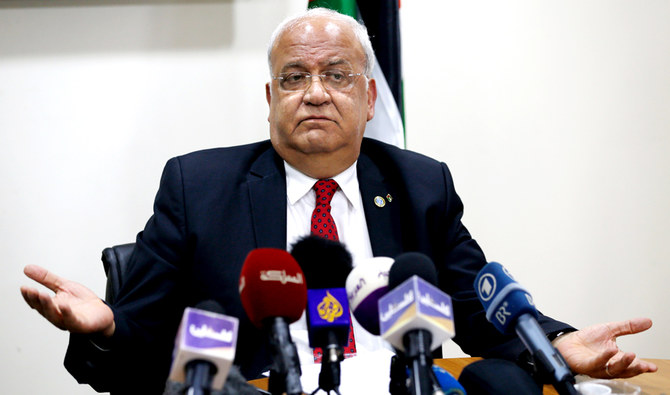
Saeb Erekat, secretary of the Palestine Liberation Organization’s (PLO) Executive Committee, said the election results reflected the hawkish behavior of Israelis who were not interested in peace.
“It’s obvious that the Israeli voting behavior is for the continuation of the status quo and the occupation,” he told Arab News.
Palestinians were angry after Netanyahu pledged on the campaign trail to annex illegal settlements in the West Bank.
The Palestinians and many countries deem settlements to be illegal under the Geneva conventions that bar settling on land captured in war.
Israel disputes this, citing security needs and biblical, historical and political connections to the land.
Palestinian activists believe Netanyahu has been emboldened by support from US President Donald Trump, who said the US would recognize Israeli sovereignty over the Golan Heights.
Annexing settlements would all but end any final chances for a two-state solution with the Palestinians and potentially push the sides toward a single, binational state.
Anees Sweidan, head of the PLO’s International Affairs Department, said the election results were unsurprising and that the “radicalization” of Israel would not have happened without public support from the US.
“This is why we have to expect more radical American and Israeli decisions which will move our entire region toward the abyss,” he told Arab News.
Trump caused international outrage when he said the US would recognize Jerusalem as the official capital of Israel. Palestinians see East Jerusalem as the capital of their own future state.
The US leader was slammed by Hanan Ashrawi, a member of the PLO’s Executive Committee.
She said Netanyahu had been “emboldened by the Trump administration’s reckless policies and blind support.”
Hanna Issa, from the Christian-Muslim Council for Jerusalem, said that Netanyahu had succeeded in getting a record number of seats in the Israeli Knesset since 1948 without having a political or social or security program.
“He did what Palestinians didn’t expect, namely get support from the world’s superpowers,” Issa told Arab News.
Two Arab parties ran in the election: Hadash-Ta’al and the United Arab List-Balad. In the previous poll, they ran together as the Joint List. The split in the Joint List led to the establishment of the two parties — and calls for a boycott.
The Jerusalem Post reported that by 3 p.m. on voting day just 20 percent of Arab voters had cast their ballots, prompting candidates and Arab-Israeli leaders to urge people to take part in the electoral process.
Botrus Mansour, a lawyer from Nazareth, said there were many reasons for the low Arab turnout.
“In addition to anger at the current nominees who couldn’t keep a Joint List intact, there has been a general feeling that Arab Knesset members are not given a chance to have an effect,” he told Arab News.
Mansour, who heads the Baptist School in Nazareth, also said many intellectuals felt there was no need to legitimize Israel.
“Most of the intellectuals were disappointed with the general shift to the right in Israel and decided to stay away.”
Naser Laham, editor-in-chief of Maan News and an analyst, said the election result would have an impact on Palestinian President Mahmoud Abbas.
It would push him to one of two options, he said. “More waiting for a miracle to happen, or adopting the strategy of the Joint Arab List inside the Green Line (that separates Israel from the West Bank) which focuses on Palestinians calling for equality in political rights throughout the area between the river and the sea,” he told Arab News.


