Young Pakistani wins over family to let her sing

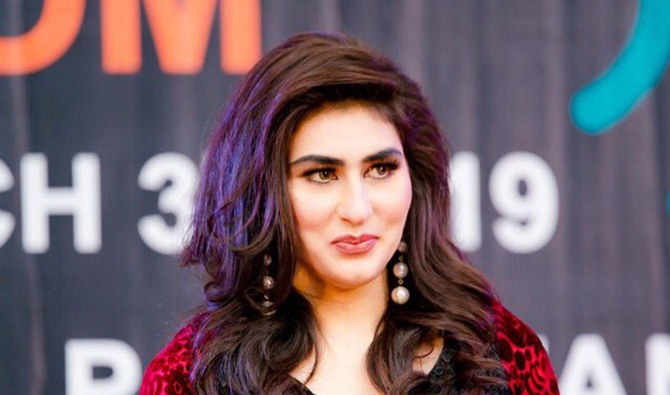
Twenty-year-old Sana Tajik grew up in Lower Dir district of Pakistan and two years ago, her family moved to Peshawar where she managed to convince her parents to allow her to sing – Photo Courtesy (Sana Tajik Twitter)
Updated 09 April 2019
Follow

Young Pakistani wins over family to let her sing

  • Has fan following in Pashto-speaking areas of Pakistan and neighboring Afghanistan, the singer says
  • Violence against female artists is common in Pakistan's northwestern Khyber Pakhtunkhwa province

PESHAWAR: Twenty-year-old Sana Tajik managed to convince her parents to allow her to follow her childhood dreams and become a singer, but she realises the dangers of being a woman, let alone a woman entertainer, in tribal northwest Pakistan.
The Pashtun singer grew up in Lower Dir, once a Taliban stronghold of Khyber Pakhtunkhwa province, where performing arts were widely considered to be un-Islamic. She realised early on that violence against female artists was common.
In 2018, five female singers were killed in the northwest and in March this year, a popular Pashtun stage singer and actress was shot and killed near Peshawar, allegedly by her husband.
But two years ago, Tajik's family moved from their ancestral village to the state capital Peshawar where she managed to convince her parents to allow her to sing.
"At first, there were a lot of objections, from family, as well as people in our village. But now, with the passing of time, and after seeing my videos and songs, things have become normal again," Tajik told Reuters at her home.
She has released her songs over social media and said she already had a fan following in Pashto-speaking areas of Pakistan and neighbouring Afghanistan. Her second song, "Halaka Charta Ye", which means "Oh boy, where are you?", was a great hit.
"I was extremely happy because so many people were listening to my songs and liked them. My passion for music increased further, and I decided to make more and more songs and videos," she said.
Despite her success, Tajik says she often feels nervous about security because the Taliban's influence in the region can still be felt. During the 1996-2001 Taliban regime in Afghanistan, music was considered the handiwork of the devil, particularly if the artist was a woman.
Pakistan's port city of Karachi is home to an estimated 7 million Pashtuns, the largest urban Pashtun population in the world, including 50,000 registered Afghan refugees. Even though it's the other end of the country, Sana Tajik's music is known, though not accepted by all.
"If this lady sang hymns and devotional songs, that would have been better. It would have sent a good message to the Pashtun people," said resident Iqbal Swati.
"Instead, she is wearing half-sleeved clothes while singing; this is not at all nice. This is not our culture."
Tajik's music teacher, Safdar Ali Qalandri, said he often warns her of the dangers ahead.
"One, she is a female. And secondly, this is Peshawar, where, as you know, extreme 'purdah' (covering of women) is observed. Taking up singing while living in this society is extremely tough."


Former spy chief Faiz Hameed appeals conviction by Pakistan military court

Updated 11 sec ago
Follow

Former spy chief Faiz Hameed appeals conviction by Pakistan military court

  • The ex-ISI chief was sentenced to 14 years in prison over engagement in political activities, misuse of authority
  • His conviction is highly unusual in a country where the military has ruled for almost half of its 78-year history

ISLAMABAD: Pakistan’s former intelligence chief Lt. Gen. (retired) Faiz Hameed has appealed his sentencing to 14 years in prison by a Pakistani military court, Hameed’s lawyer said on Sunday. 

Hameed was arrested in Aug. 2024 amid accusations he was involved in land grabbing and coercive seizures of property belonging to the owner of the Top City housing development near Islamabad. At the time, the military said multiple violations of the Pakistan Army Act after his retirement had also been established, prompting court martial proceedings.

On Dec. 11, Pakistan’s military announced that Hameed was found guilty of engaging in political activities, violating the Official Secrets Act and misusing authority and government resources as the chief of the Inter-Services Intelligence (ISI) agency.

“We have filed an appeal against the sentence handed down to Lt. Gen. Faiz Hameed by the military courts. The appeal was submitted to the Registrar Court of Appeals, AG Branch, Chief of Army Staff,” Hameed’s counsel Mian Ali Ashfaq told Arab News, without providing further details.

Hameed served as the ISI director-general from 2019 to 2021. His conviction is highly unusual in a country where the military has ruled for almost half of its history and continues to exert significant influence during civilian rule.

The Inter-Services Public Relations (ISPR), the military’s media wing, had said that Hameed was tried on four charges relating to political interference, breaches of the Official Secrets Act, misuse of authority and causing “wrongful loss to persons.”

“After lengthy and laborious legal proceedings, accused has been found guilty on all charges and sentenced to 14 years rigorous imprisonment by the Court which has been promulgated on 11 December 2025,” the ISPR said on Dec. 11.

Hameed was widely seen as close to Imran Khan when he was the prime minister and after his removal in a no-trust vote in 2022.

The military had previously accused Hameed of helping engineer political unrest during violent clashes on May 9, 2023, when Khan supporters rioted nationwide after his brief arrest on graft charges. Protesters were accused of torching government and military buildings “at the behest of and in collusion with vested political interests.” Khan, jailed since August 2023 on charges he says are politically motivated, denies ordering the attacks.

In its Dec. 11 statement, the military said the trial against Hameed complied with all legal requirements, adding that the former spy chief was given full rights, including the ability to choose his defense team, and retained the right to appeal “at the relevant forum.”

The ISPR also said his alleged role in “fomenting vested political agitation and instability in cahoots with political elements” was being handled separately, leading to speculation about more inquiries and legal cases.

Hameed, who retired in Dec. 2022, has long been a polarizing figure. The ruling Pakistan Muslim League-Nawaz (PML-N) also accuses him of helping engineer the 2017 removal of former premier Nawaz Sharif through court cases. Hameed denied the allegations.

“This is a landmark decision and I think the rule of law and accountability mechanism has been strengthened,” Information Minister Attaullah Tarar, who belongs to the PMLN-N, had told a Pakistani broadcaster after the announcement of the verdict against Hameed.