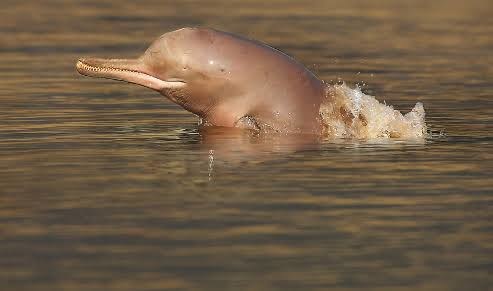
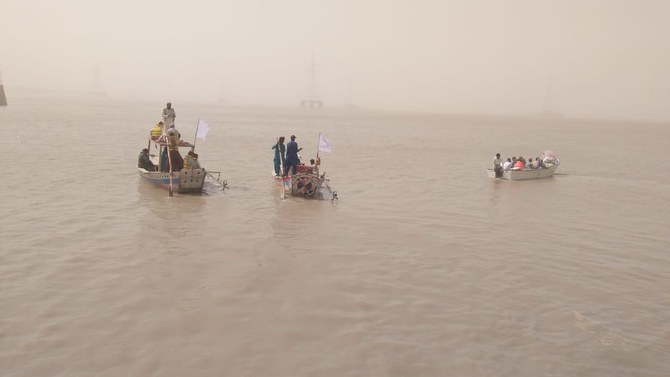
Karachi: The wildlife department of Pakistan’s southern province of Sindh kicked off a five-day survey on Monday to count Indus dolphins, which are among the world’s rarest mammals, for conservation purposes.
“The survey is carried out by a 22-member team and will reveal the current population of blind Indus dolphins,” wildlife conservator, Javed Mahar, told Arab News on Monday.
Indus freshwater dolphins are usually described as “blind” since their eyes are not fully developed due to the murky river water, pushing it to “rely on echolocation, or sound sensors, to find fish, shrimp, and other prey inside the waters,” he added.
While the natural habitat for Indus dolphin existed in the river from Attock in Punjab to the Indus delta in the Arabia Sea, the survey team, comprising officials of the province’s wildlife and irrigation departments, would focus on the area between Guddu and Sukkur barrage, said Mahar.
“The constructions of dams and barrages restricted the movement of this freshwater mammal. In early 1974, a Swiss professor, Giorgio Pilleri, conducted a survey and subsequently recommended to preserve the dolphins through law,” he continued.
The count in the first survey was 150.
Consequently, the government of Sindh designated a 200-kilometer stretch of the river between Guddu and Sukkur barrage as the Indus Dolphin Reserve in 1974. The place is now a legally protected area with the largest population of aquatic animal.
Official claims that while the two of the world’s four types of fresh water dolphins – the Ganges river dolphin, called Susu, and Yangtze river dolphin, called Baiji – are almost non-existent the number of Indus dolphins has strangely grown from 150 in 1974 to 918 in 2012, when the last survey was conducted.
After a gap of six years, the World Wide Fund for Nature (WWF) Pakistan conducted an unofficial survey last year and claimed the existing population of Indus dolphin was about 1800. However, Mahar said the exact figure of the current population would come to light after the conclusion of the ongoing survey.
Despite their growing number, officials and experts say, the blind dolphins could be facing extinction due to the shrinkage of their habitat, shortage of water and increasing pollution in the river.
“Unlike Ganga, Yangtze and Amazon, there’s no shipping in Indus. Yet, the dolphins remain in danger due to multiple factors,” Mahar said.
Dr. Alia Bano Munshi, a marine life expert and recipient of the pride of performance award, urged lawmakers to tighten legislation to secure Indus dolphin and other rare aquatic species from vanishing altogether.
“Water population, slow movement of water, low levels of water and hot weather are some of the factors threatening these dolphins,” Munshi told Arab News.
She added that these rare mammals could be saved through preventive measures and continuous monitoring.


![]()
![]()
![]()
![]()

Sindh wildlife department kicks off survey to save Indus dolphins


Sindh wildlife department kicks off survey to save Indus dolphins
- The population of Indus dolphins has increased, official says
- This rare specie is ‘blind’ in murky river water and relies on echolocation to find prey
Latest updates


© 2026 SAUDI RESEARCH & PUBLISHING COMPANY, All Rights Reserved And subject to Terms of Use Agreement.