London judge discharges jury in landmark Barclays Qatar case

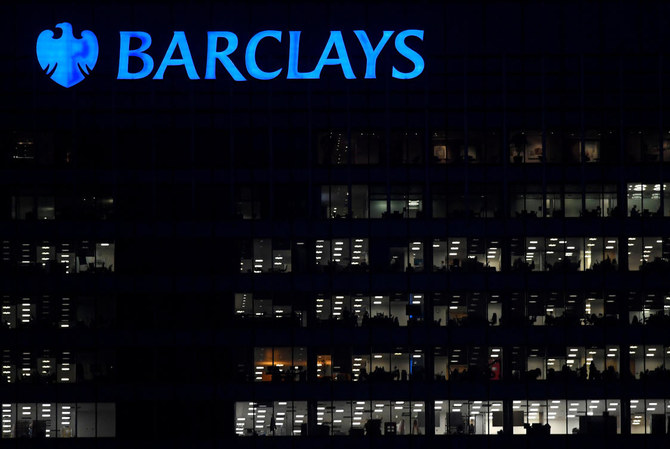
Workers are seen in at Barclays bank offices in the Canary Wharf financial district in London. (Reuters)
Updated 08 April 2019
Follow

London judge discharges jury in landmark Barclays Qatar case

  • Jury discharged in landmark trial
  • Reporting restrictions in place

LONDON: A London jury has been discharged in a landmark fraud trial of four former Barclays executives accused of paying Qatar undisclosed fees to help rescue the bank at the height of the credit crisis in 2008.
Judge Robert Jay told the jury at Southwark Crown Court on Monday he was required to discharge them. No further details could be published due to continued reporting restrictions.
Former chief executive John Varley, Roger Jenkins, Tom Kalaris and Richard Boath are charged with conspiring to commit fraud by false representation when Barclays raised more than 11 billion pounds ($14 billion) from investors in 2008, allowing the British bank to avoid a state bailout.
Prosecutors allege the bankers excluded from public documents and hid from other investors around 322 million pounds in fees paid to the Qatari investors through so-called advisory service agreements (ASAs).
The defendants deny wrongdoing and said they had relied on legal advice.
The prosecution, brought by the UK Serious Fraud Office, is the first jury trial of a leading bank’s CEO over conduct during the financial crisis.
Qatari investors plowed around 4 billion pounds into Barclays during two fund raisings in June and October 2008.


Middle East war economic impact to depend on duration, damage, energy costs, IMF official says

Updated 3 sec ago
Follow

Middle East war economic impact to depend on duration, damage, energy costs, IMF official says

  • Katz: Prolonged increase in energy prices could unanchor inflation expectations
  • IMF: 2026 global GDP outlook was solid, too early to judge war’s impact on growth
WASHINGTON: The Middle East war’s impact on the global economy will depend on its duration and damage to infrastructure and industries in the region, particularly whether energy price increases are short-lived or persistent, the International Monetary Fund’s number two official said on Tuesday. IMF First Deputy Managing Director Dan Katz told the Milken Institute Future of Finance conference in Washington that if there is prolonged uncertainty from the conflict and a prolonged impact on energy prices, “I would expect central banks to be cautious and ‌respond to the ‌situation as it materializes.”
He said the conflict could ​be “very ‌impactful ⁠on ​the global economy ⁠across a range of across a range of metrics, whether it’s inflation, growth and so on” but it was still early to have a firm conviction.
Prior to the US and Israeli air strikes on Iran and counterattacks across the region, the IMF had forecast solid global GDP growth of 3.3 percent in 2026, powering through tariff disruptions due in part to the continued AI investment boom and expectations of productivity gains.
Katz said ⁠that the economic impact from the Middle East conflict would ‌be influenced by its duration and further geopolitical ‌developments.
Earlier, the IMF said it was monitoring the ​conflict’s disruptions to trade and economic activity, ‌surging energy prices and increased financial market volatility.
“The situation remains highly fluid and ‌adds to an already uncertain global economic environment,” the Fund said in a statement issued from Washington. Katz said the IMF will look at the conflict’s direct impacts on the region, including damage to infrastructure, and disruptions to key sectors.
“Tourism is an important one. Air travel. Is ‌there physical damage to infrastructure, production facilities, and the big industry in particular that everyone will be focused on is, ⁠of course, the energy ⁠industry,” he said.
Oil rose further on Tuesday as Iran vowed to attack ships passing through the Strait of Hormuz. Brent crude oil , the global benchmark, surged to $83 per barrel, up 15 percent from its level on Friday.
Katz said he expected central banks to “look through” a temporary rise in energy prices, given their focus on core inflation. But central banks could respond if a more persistent energy shock results in “a destabilizing of inflation expectations.”
He said the post-COVID inflation spike of 2022 was influenced by energy impacts from Russia’s invasion of Ukraine, with more pass-through from headline inflation to core inflation.
“And so I’m sure central banks, as they are thinking about how the ​geopolitical situation is translating into ​energy markets, will be looking at the lessons of the pandemic and seeing if they can apply any of those lessons in setting monetary policy,” Katz said.