

Rights lawyer Amal Clooney leads push to protect journalists

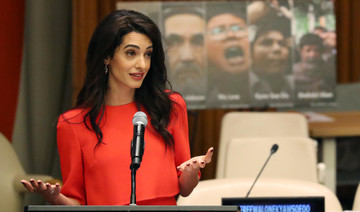
Human rights lawyer Amal Clooney attends a news conference on media freedom as part of the G7 Foreign Ministers’ meeting in Dinard, France. (Reuters)
Updated 05 April 2019
Follow

Rights lawyer Amal Clooney leads push to protect journalists

  • More than 60 journalists were killed in 2018 according to Reporters Without Borders, more than half of them targeted deliberately
  • Last year, Clooney joined the legal team representing two Reuters journalists who were convicted under Myanmar’s official secrets act and sentenced to seven years in prison

DINARD, France: International human rights lawyer Amal Clooney will help lead a British-Canadian push to defend journalists from attacks and restrictions around the world, ministers said on Friday.

She was named co-chair of a legal panel that will draw up proposals to counter laws that hinder reporters.

“Those with a pen in their hand should not feel a noose around their neck,” the British-Lebanese barrister told an event on the issue at a G7 meeting of foreign ministers in France.

More than 60 journalists were killed in 2018 according to Reporters Without Borders, more than half of them targeted deliberately.

Britain’s foreign minister, Jeremy Hunt, told the event that democratic states needed to make it “an international taboo of the highest order” to murder, arrest or detain journalists for doing their jobs.

Hunt, who appeared alongside his Canadian counterpart Chrystia Freeland, also named Clooney as his special envoy on media freedom.

“When journalists are not able to question those in authority, hold them to account, freely and with impunity then you start a slippery slope to the closed societies that none of us want to see growing in influence,” he said.

Last year, Clooney joined the legal team representing two Reuters journalists who were convicted under Myanmar’s official secrets act and sentenced to seven years in prison.

On Friday, she said only one in ten countries enjoyed a free press.

The legal panel, she added, could propose reforms of national laws that run counter to international standards and encourage governments to give journalists more consular protection abroad. The proposals will not be legally binding.

Meta to charge Arab advertisers extra fee for reaching European audiences

Updated 11 March 2026
Follow

Meta to charge Arab advertisers extra fee for reaching European audiences

  • US tech giant told advertisers it will add fees ranging from 2 to 5 percent on image and video ads delivered on its platforms to offset digital service taxes
  • Charges are determined by where the audience is located, not where the advertiser is based

LONDON: Meta will from July 1 impose location-based surcharges on advertisers targeting audiences in six European countries, a move that will directly affect Arab businesses that run campaigns across the continent.

The US tech giant announced it will add fees ranging from 2 to 5 percent on image and video ads delivered on its platforms, including Facebook, Instagram and WhatsApp, to offset digital service taxes imposed by individual governments.

Crucially, the charges are determined by where the audience is located, not where the advertiser is based.

That means Saudi, Emirati, Egyptian or other Arab companies paying to reach consumers in the UK, France or Italy will face the additional costs regardless of their own country’s tax arrangements with Meta.

Fees will apply at 2 percent for ads reaching UK audiences, 3 percent for France, Italy and Spain, and 5 percent for Austria and Turkiye.

“If you deliver $100 in ads to Italy, where there is a 3% location fee, you will be charged $100 (ad delivery), plus $3 (location fee), for $103 total,” the company wrote in an email to an advertiser initially reported by Bloomberg. “Note that any applicable VAT will be calculated on top of the total amount.”

The taxes have been introduced at different points, starting with France in 2019, though not the EU as a bloc.

Many tech companies report substantial sales in Europe and millions of users but pay minimal tax on profits. The goal is to claw back locally derived economic value, Bloomberg reported.

The move follows similar decisions by Google and Amazon, which have also begun passing European digital tax costs on to advertisers.

For Arab brands with growing European footprints, particularly in fashion, travel, hospitality and media, the new fees add another layer of cost to campaigns already subject to currency and targeting complexities.

Digital services taxes, levied as a percentage of revenues earned by major tech platforms in individual countries, have drawn criticism from Washington, which argues they unfairly target US companies.

Meta has been reached for comments.