KUALA LUMPUR: Former Malaysian Prime Minister Najib Razak pleaded not guilty during his appearance in court Wednesday for corruption allegations, exactly 10 years after he was first elected to office only to suffer a spectacular defeat last year.
The trial was originally due to start in February but was delayed by procedural matters. There is a chance it may be pushed back again Wednesday as Najib’s lawyers had earlier this week applied to review the top court’s ruling for the trial to begin despite several pending appeals.
Ten years ago this Wednesday, Najib became Malaysia’s sixth prime minister but anger over the 1MDB investment fund scandal led to his electoral loss last May. US investigators say more than $4.5 billion was stolen from 1MDB by associates of Najib between 2009 and 2014. They say the ill-gotten gains were laundered through layers of bank accounts in the US and other countries to finance Hollywood films and buy hotels, a luxury yacht, art works, jewelry and other extravagances.
Some $700 million from the fund that Najib set up for Malaysia’s economic development allegedly landed in his own bank account.
One of only a few Southeast Asian leaders to be arraigned after losing office, Najib has denied any wrongdoing.
The 65-year-old was greeted by a small group of supporters as he arrived at the courthouse. They all bowed their heads in a short prayer before Najib went up to the courtroom.
Wednesday’s trial is the first of several against Najib, who has been charged with 42 counts of criminal breach of trust, graft, abuse of power and money laundering in one of Malaysia’s biggest criminal proceedings. His wife, Rosmah Mansor, also has been charged with money laundering and tax evasion linked to 1MDB. She has also pleaded not guilty and her trial has not been set.
Najib’s son, Norashman Najib, praised his father for his “tremendous strength and resolve.” He tweeted late Tuesday that the trial will be an “excruciatingly difficult period” for his father but that “with the right attitude, even the most trying of situations can be a blessing from Allah.”
The patrician Najib, whose father and uncle were Malaysia’s second and third prime ministers respectively, has fought back with a political makeover on social media that aims to transform his image from an out-of-touch elitist to a leader for the working class.
A Malay-language catchphrase translating to “What’s to be ashamed about, my boss?” was coined while he was campaigning in a by-election last month and has become his new rallying cry. Expensive tailored suits have been replaced by hoodies and jeans. A picture Najib posted on social media showing himself posing on a Yamaha motorcycle with his new “’no-shame” meme resonated with many Malay youths disenchanted by Prime Minister Mahathir Mohamad’s new government.
In another offbeat music video that he uploaded on social media, Najib slammed the new government as “liars” and crooned about the “slander and revenge” against him in a Malay-language rendition of the 1970’s R&B soul hit “Kiss and Say Goodbye” by the Manhattans.
He posts a dozen messages daily, mostly mocking the new government and its policies, and touching on the plight of the needy.
Despite his smiles and “cool” public persona, Najib could face years in prison if convicted.
Once a towering figure in politics, Najib has fallen from grace swiftly since his historic electoral loss, which led to the first change of government since Malaysia’s independence from Britain in 1957.
The new government soon after it took office reopened investigations into 1MDB that had been stifled under Najib. He and his wife were barred from leaving the country and grilled by anti-graft officials, and their properties raided. Truckloads of luggage stashed with cash, jewellery and hundreds of expensive designer bags worth a staggering $270 million were seized from their home and other properties.


![]()

Malaysian ex-PM Najib pleads not guilty on graft charges
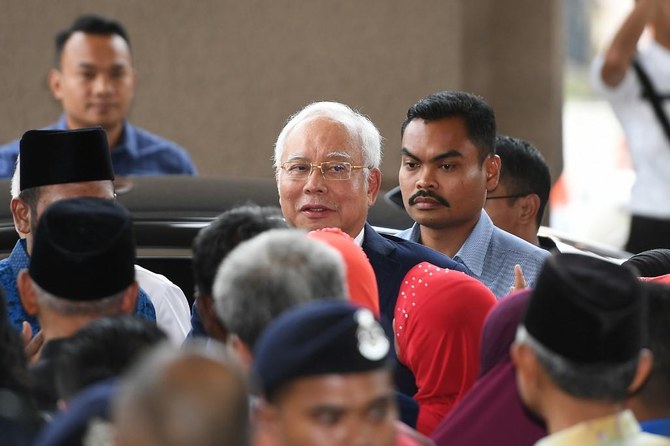
Malaysian ex-PM Najib pleads not guilty on graft charges
- Investigators said Najib associates stole more than $4.5m between 2009 and 2014
- The ex-PM laundered his money through extravagant purchases


Latest updates



© 2026 SAUDI RESEARCH & PUBLISHING COMPANY, All Rights Reserved And subject to Terms of Use Agreement.